economy | briefs | fdi | agriculture | growth | MSMEs | capacity utilisation

Nepal’s economy grew 3.02% in the first quarter of FY 2082/83, led by electricity, gas, finance, and services, but challenges persist in agriculture, MSMEs, and investment flows. Mixed signals emerge as paddy production is projected to fall, FDI commitments slow after initial gains, and micro, small and medium businesses struggle with low capacity utilisation and limited access to credit.
Economy grows by 3.02% in first quarter
Preliminary data from the Nepal Statistics Office (NSO) shows that Nepal's economy grew by 3.02% in the first quarter of FY 2082/83. Growth was observed across all 18 industrial sectors.
Electricity and gas led with 14.92% growth. Finance and insurance grew by 7.07%. Technical and administrative services each rose by 5.5%. The agriculture, forestry, and fishing sector recorded growth by 1.36%, supported by the higher output of livestock, vegetables, and fruits. However, rice production was low.
Compared to the previous quarter, the economy fell by 1.7%, wherein 13 sectors contracted.
Paddy output projected to decline by 4.2% in FY 2025/26
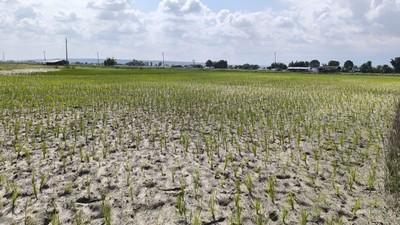
While agriculture, forestry, and fishing sectors registered a modest growth (1.36%) in the first quarter, Nepal’s paddy production is expected to decline by 4.2% in the current fiscal year 2025/26, as stated by the Ministry of Agriculture and Livestock Development.
The ministry estimates paddy output at 5.75 million metric tonnes, down from 5.95 million metric tonnes in FY 2081/82. Average productivity is projected to fall by 1.16%, from 4.19 to 4.14 metric tonnes per hectare.
The primary driver behind the decline is a 3.8% contraction in cultivation area, which declined to 1.37 million hectares this fiscal year, compared with 1.42 million hectares the previous year. Youth out-migration has tightened labour supply, while a gradual shift towards fruit and cash crops has reduced cereal cultivation, particularly in hilly regions. In the Terai region, industrial and infrastructural development has further reduced the land available for paddy cultivation.
Drought during the transplanting period in Madhesh province also weighed on output. Similarly, erratic rainfall and delayed monsoon patterns limited productivity gains.
Estimates are based on provincial data, crop-cutting survey, and satellite-based validation conducted jointly with ICIMOD. Paddy remains critical for food security, accounting for around 12% of agricultural output, within a sector contributing 25.16% of GDP.
475 projects attract NRs 39.23 billion FDI in the first half of FY 2025/26
Foreign Direct Investment (FDI) commitment to Nepal rose by 52.2% year-on-year in the first six months of FY 2025/26, reaching NRs 39.23 billion across 475 projects.
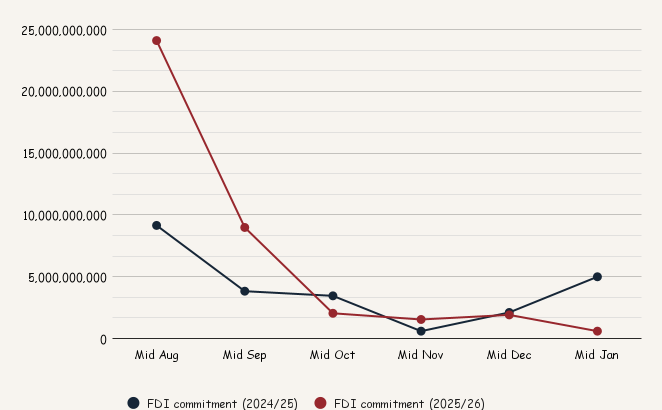
Large FDI commitments came during the first two months of the fiscal year. By mid-September, commitment reached NRs 33.09 billion, which was NRs 12.98 billion compared to six months of the last fiscal year.
However, FDI commitment slowed sharply in the next four months following protests in September. Between mid-September and mid-January, the monthly commitment was NRs 2.04 billion, NRs 1.5 billion, NRs 1.9 million, and NRs 599.5 million, respectively.
In terms of project scale, FDI commitment covered seven large industries, eight medium-scale industries, and 460 small industries. In Poush alone, 36 small-scale industries received a commitment of NRs 599.5 million.
Sector-wise, the agro and forestry industries attracted the highest investment, amounting to NRs 21.89 billion across 13 projects. Tourism followed with NRs 10.54 billion across 145 projects, services received Rs 3.46 billion for 31 projects, and manufacturing attracted NRs 2.03 billion for 27 projects. The ICT sector led in project numbers with 257 projects, but the total value was low at NRs 1.07 billion. Energy drew NRs 184.25 million for one project, and minerals received NRs 45 million for a single project.
In all, 161 projects totalling NRs 36.43 billion were approved through the approval route, while 314 projects worth NRs 2.81 billion were approved through the automatic route.
Chitwan and Makwanpur MSMEs report setbacks with capacity utilisation at 50.7%
The central bank recently released its survey of 321 MSMEs based in Chitwan and Makwanpur published by the research unit of the Nepal Rastra Bank, Birgunj Office.
The study shows that technology adoption remains limited, with only 17.8% rating digital tools positively, while 45.5% consider adoption average and 36.8% rate it bad to very bad. Digital use is mostly confined to payment and production activities, with low integration in marketing, accounting, and administration.
MSMEs reported challenges from the broader business environment: 40.8% viewed the macro environment as having a low negative impact, while 25.1% perceived a high negative impact, citing economic, political, and social instability as major constraints.
Credit finance was another area of concern, with 44.6% rating it bad to very bad, especially due to high interest rates, repayment issues, and cumbersome procedures. Personal savings remain the primary source of funding, although small firms gradually shift toward credit as they grow.
The survey also assessed the state of industries which revealed mixed ratings across key operational areas.
Nearly half of respondents (45.9%) rated their industry’s location as average, while 29% described it as poor to very poor. Only 25% considered their location good to very good. More than half of MSMEs (55.5%) rated the overall labor environment as poor to very poor, with 35.6% considering it average. In terms of raw material availability and quality, 46.3% rated it average, while 32% categorised it as poor to very poor.
Infrastructure was relatively better, with 51.9% rating it as good. Government and central bank support programs were deemed inadequate, with 82.1% expressing dissatisfaction.
According to the study, their average return on investment is 11.7% while capacity utilisation remains low at 50.7%.
Similarly, 52.7% of local firms reported decline in turnover, with 29% facing a sharp drop. Only 27.1% posted growth, while the remaining were stable. Median annual sales are NRs four million.
According to the National Statistics Office’s 2020 survey, the two districts together account for 45,278 establishments, about 4.9% of the national total, and provide employment to 151,209 people, representing 4.7% of the country’s workforce.
Supreme Court halts immediate tax relief for Dolma Impact Fund
The Supreme Court has issued an interim order barring the government from granting immediate tax exemptions to Dolma Impact Fund, a Mauritius-based private equity firm operating in Nepal.
The order, issued on January 8, followed a writ petition challenging a government decision to grant tax exemptions to Dolma under the Double Taxation Avoidance Agreement (DTAA) with Mauritius. Dolma is registered in Mauritius.
The disputed decision had cleared the way for the transfer of proceeds abroad following the sale of shares in Nepali companies without the payment of capital gains tax, permitted under the treaty. Following the decision, the government then terminated the treaty.
A single bench of Justice Mahesh Sharma Paudel directed the government to suspend implementation of any tax exemption granted to the fund until the court reaches a final decision. The court said it must hear arguments from both sides before ruling on the matter and instructed authorities to halt execution of any prior exemption decision.
The court also ordered the Office of the Prime Minister and Council of Ministers, the Ministry of Finance, and the Inland Revenue Department to ensure that Dolma does not remit funds overseas without settling applicable taxes. The interim order was issued under Rule 49(2)(b) of the Supreme Court Rules, 2017.
Lawyers representing the petitioner argued that allowing profit repatriation without tax payment violates Nepal’s tax laws and undermines revenue collection. The court has given the respondents 15 days to submit written explanations through the Office of the Attorney General.
Read More Stories

NEPSE falls nearly 75 points as market sentiment wavers
The stock market was unable to maintain the gains seen on Tuesday, slipping...

India has begun its long-delayed population census. Here's why it matters
India has begun the worlds largest national population count, which could reshape welfare...

The United Nations has called on Israel to repeal a law passed by...


Business + Finance + Economy + Tech + Environment + Nepal & South Asia + In-depth Analysis + News + Investigation + Research + Expert Opinion + Anatomy of Complex Issues.