Nepal Gen Z Protests | Child Rights & Protection | Law & Ethics | School Uniform
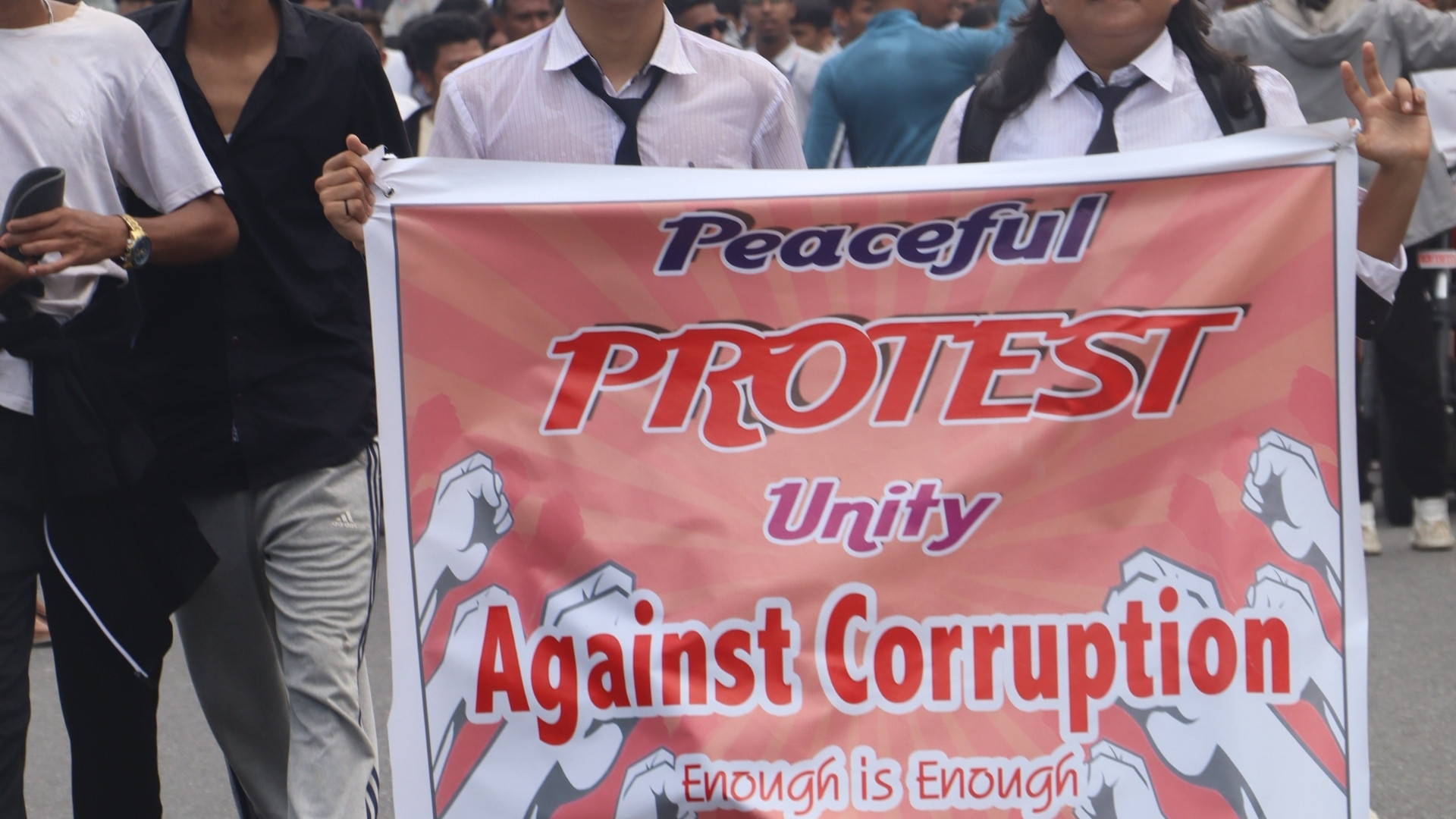
It was the morning of September 9 when I returned home after an unintended all-nighter at the office. The Kathmandu district administration would impose a curfew from 8:30 AM to contain expected public unrest following the death of 21 protesters aged from 18 to 64, the previous day.
A whirlwind of events swept across the country afterwards, with the nation paying a heavy price. In just 36 hours, 74 people lost their lives, and the country lost its key infrastructures to arson and vandalism.
That morning I paused at a small tea shop, sipping a cup of tea while listening in on the surrounding conversations. Nobody had really slept. Their voices trembled with anger, while their eyes carried deep grief. The conversations reflected a profound sense of personal loss, amplified and circulated in a continuous loop on social media platforms, especially TikTok.
By then, reports that police also shot children as young as six and 12—some said eight and 14—had gone viral on social media like Reddit and TikTok, which later turned out to be untrue.
“This shouldn’t have happened; the government shouldn’t have fired at children—no matter whose children they are, they are still children,” said a person who was there for a cup of tea just like me.
“Why did police fire at children after telling protesters to come in school uniform with ID so they’d be safe?” asked the shopkeeper aunt, adding what she’d seen on TikTok: “Police can’t harass students in uniform under international law.”
Her words echoed a troubling dilemma that lingered in the background of last week. According to several videos circulating on social media, several students in uniforms had attended the protest that day. After what unfolded, one of the first questions was who called on children and students to turn up in uniform, under the false assurance that international law would shield them from force. It’s well known that demonstrations in Nepal can easily spiral out of control, given the country’s deeply polarised politics and already unstable, highly charged atmosphere.
Just five months ago, a so-called “peaceful” political protest quickly descended into chaos, leading to arson, looting and clashes with police, which left two dead. Durga Prasain, one of the organisers of the protest, known for his disruptive gimmicks, was seen trying to breach a prohibited area in his four-wheeler, forcing his way through a police barricade. Its footage went viral. At the same time, the police used excessive force to suppress the protest. The scenes that unfolded that day reflected the volatility of protests in the country.
Who called on the students?
To begin with, none of the organisers in Kathmandu, including the Generation_Z (Instagram: gen.znepal) and popular content creators like Nimesh Shrestha—who called for the protests jointly with the Hami Nepal team, had urged children and students to wear their uniforms. They called on ‘Generation Z’ or ‘Gen Z’, which they defined as those born between 1997 and 2012—they are 13 to 28 years old as of 2025, for an initially peaceful protest across the country.
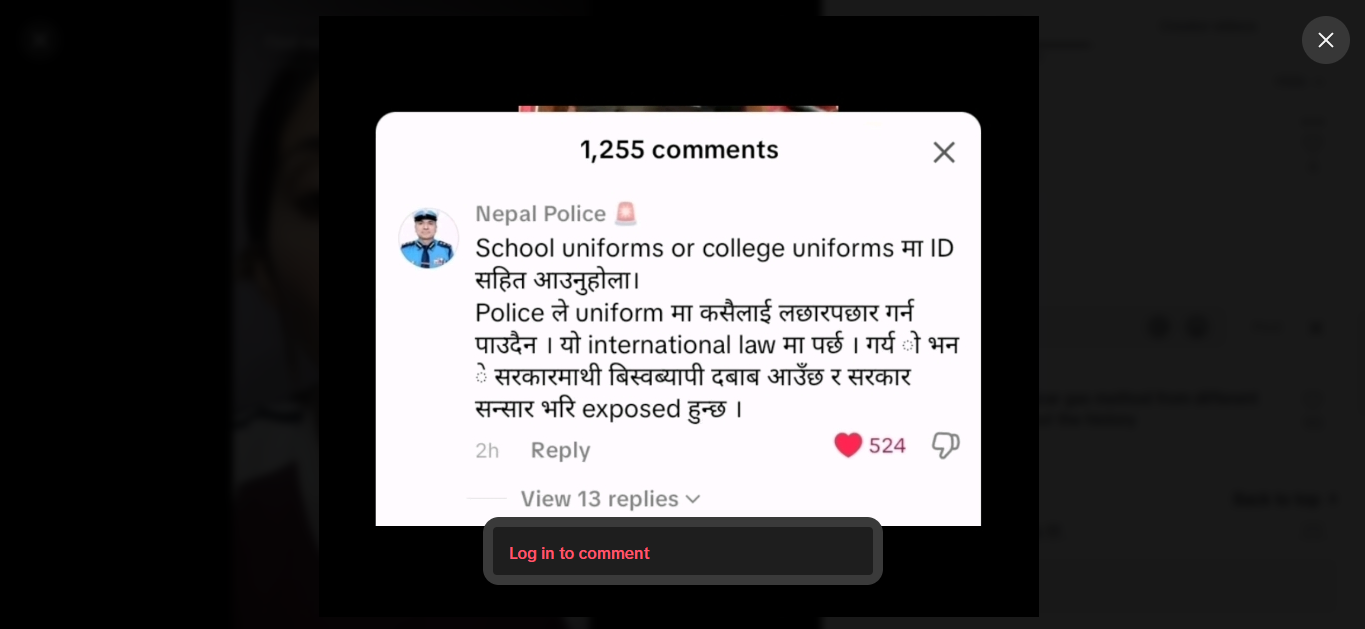
Our screening of social media platforms suggests that a TikTok account named ‘Nepal Police 🚨’ with username ‘policerabindra4’ spread the misinformation, commenting on others’ profiles. [See screenshot below]
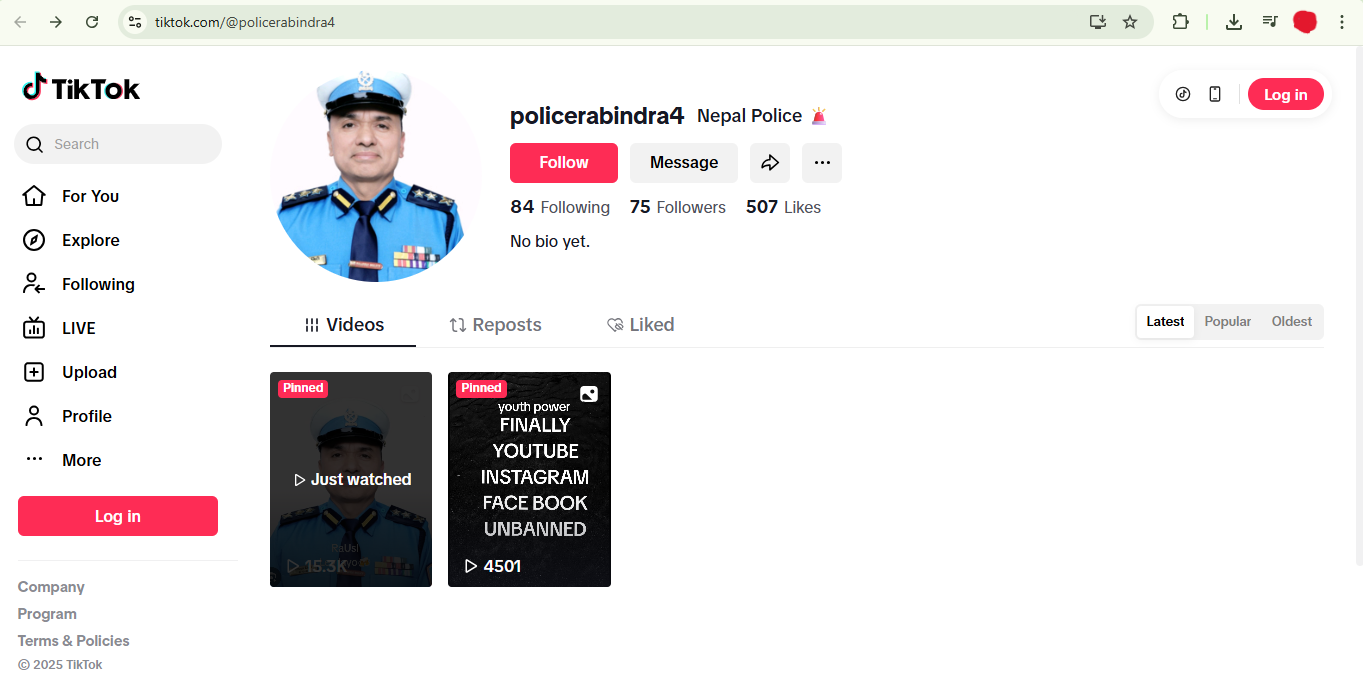
The comment received 1,139 likes and 42 replies—mostly thanking Nepal Police for the information—read: “@Nepal Police 🚨 :School uniforms or college uniforms मा ID सहित आउनुहोला। Police ले uniform मा कसैलाई लछारपछार गर्न पाउदैन । यो international law मा पर्छ । गर्य ो भन े सरकारमाथी बिस्वब्यापी दबाब आउँछ र सरकार सन्सार भरि exposed हुन्छ ।” [See screenshot below]
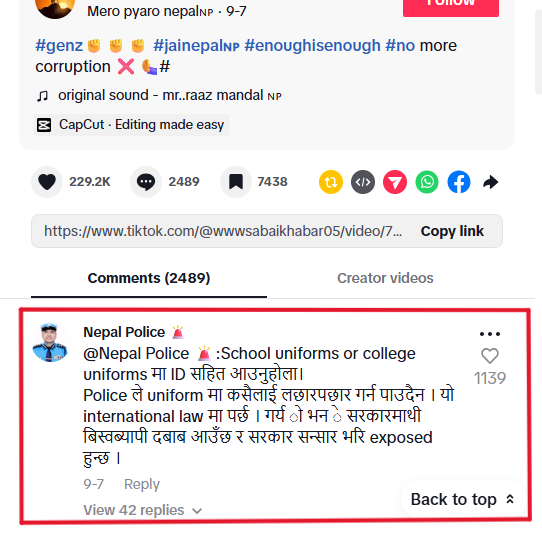
The account claiming to be Nepal Police, which it is not, commented on a TikTok account on September 7. Thereafter, more importantly, a screenshot of the comment made rounds on the platform throughout the day. [See the image below]
The account is currently disabled or removed. [See screenshot below]

Another text emerged, urging people to share by copying and pasting, in the comments of popular creators like Nimesh Shrestha, Sajan Shrestha, Barsha Jung Chhetri, Apoorva Kshitiz Singh and Asheem Man Singh Basnyat (Managing Director of Pathao), among others. Of them, Nimesh and Barsha were seen participating in the Federal Parliament building arson.
While Apoorwa called on people to form locality-based WhatsApp groups and locate political leaders’ houses, and vandalise them. He himself participated in pelting stones and arson at CPN-UML’s Gokul Baskota’s house.
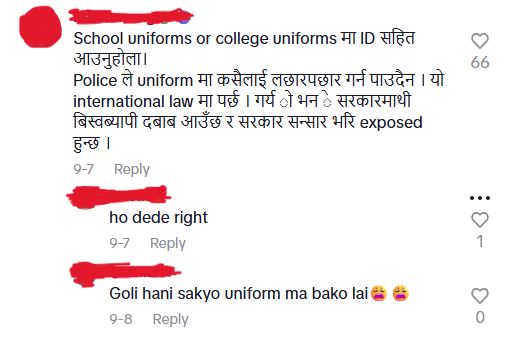
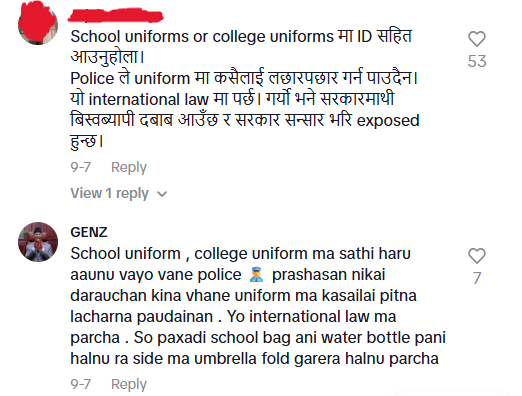
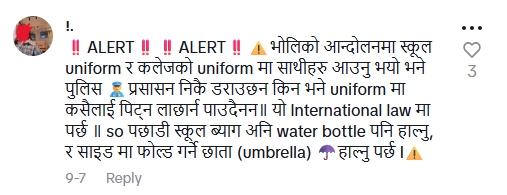
And many more. The text—same and a bit modified—also appears as written on pictures, in captions and comments on TikTok, until the morning of September 8. [See screenshots below]
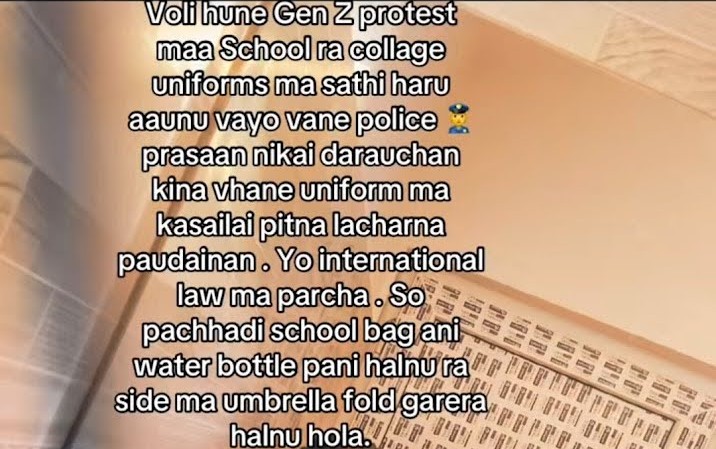
This appeal, which began on September 7, rapidly gained traction across social media platforms, making it to Facebook and Instagram, too, throughout the day. [See two screenshots below]
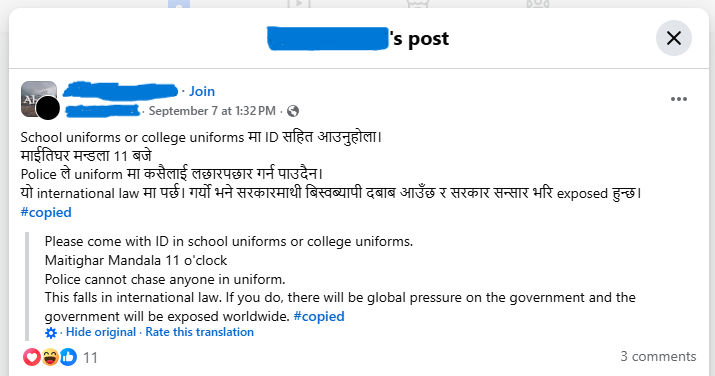
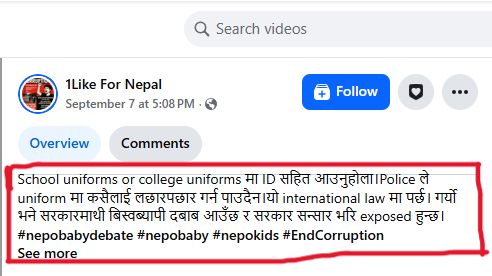
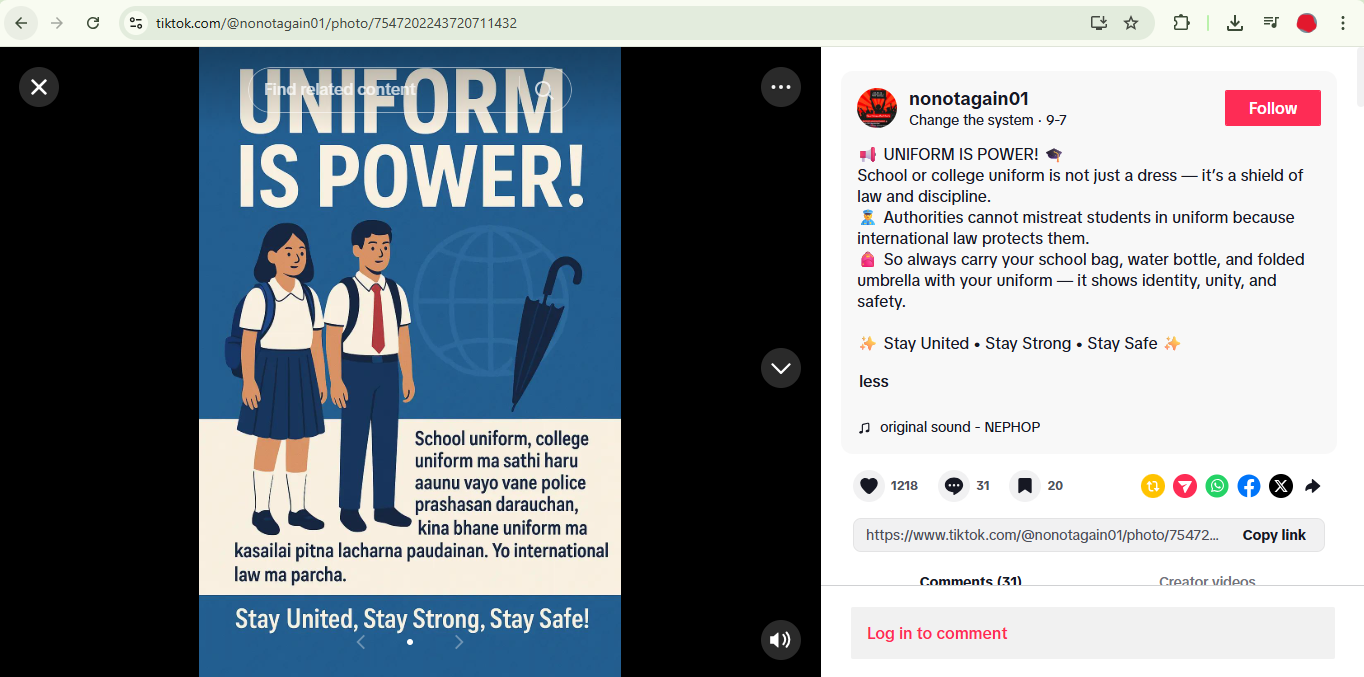
Another image that gained traction as a protest guide was [see screenshots below]
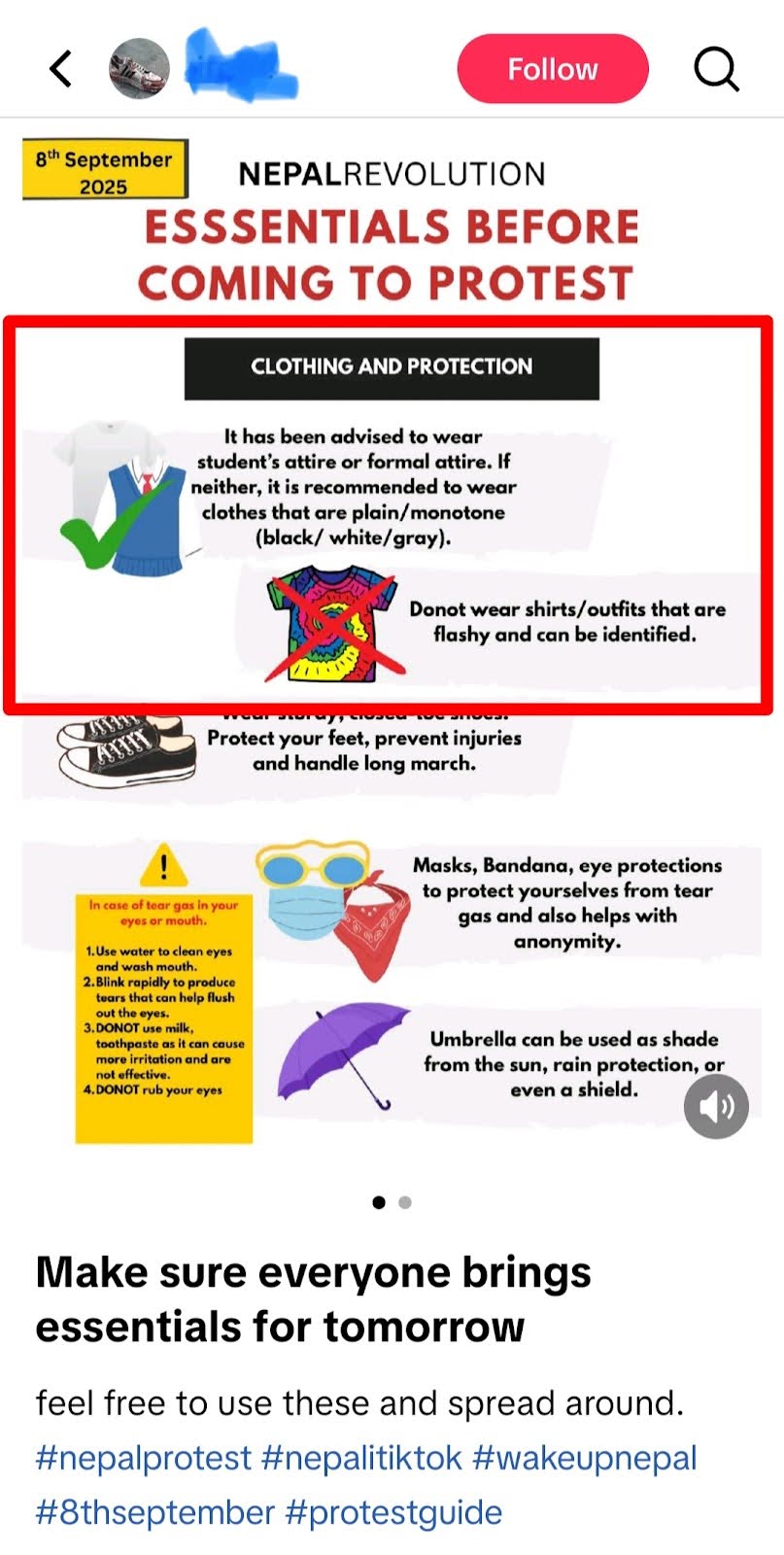
The fake information also spilt into mainstream commentary. In a two-minute Instagram reels of the podcast On Air with Sanjay, posted on the ‘vyasamedianetwork’ account on September 7, host Sanjay Silwal Gupta mentioned he had read that “brothers and sisters will come to protests tomorrow in uniform” and asked his guest, Advocate Khadga Bahadur Budhathoki, about the consequences.
Budhathoki responded that the state cannot use force on children, whether they are in uniform or not, citing prevailing laws and briefly explaining juvenile justice. He reinforced the idea of wearing uniform at the protest. Neither the host nor the guest, however, questioned whether it was right—or even lawful—to mobilise children in political rallies and protests in the first place.
Both reels combined have over 100,000 likes, 21,815 shares and 1,544 reposts [as of 6 PM, September 18].
Meanwhile, protest organisers in other parts of the country had called children and students in their uniforms—which our analysis terms as the effect of such misleading content viral across the social media platforms.
Now, it is worth confronting the deeper concern: was it ethical—or legal—to draw children into the protests at all? Nepal’s laws are clear on this.
Article 39(6) of the Constitution states that “no child shall be recruited or used in the army, police or any armed group, or be subjected, in the name of cultural or religious traditions, to abuse, exclusion or physical, mental, sexual or other form of exploitation or improper use by any means or in any manner.”
Section 7(7) of the Act Relating to Children, 2018, reinforces this prohibition, stating: No child shall be deployed in the army, police or armed group and be used for armed conflict or political purpose directly or indirectly.
Section 7(8) states “No person shall launch, or cause to launch, an attack on the places, services and facilities used in children’s interest, including school, or obstruct, or cause to obstruct, their operation and management during armed conflicts or in any adverse circumstances in whatever pretext.” Ullens School was targeted by a mob on September 9.
International law reinforces the same protections. Article 19 of the UN Convention on the Rights of the Child (CRC) to which Nepal is a signatory requires states to protect children from “all forms of physical or mental violence, injury or abuse.” Its Optional Protocol on the involvement of children in armed conflict prohibits their participation in hostilities. The UN Basic Principles on the Use of Force and Firearms by Law Enforcement Officials also demand heightened restraint when minors are present at demonstrations.
Underlying these provisions is a fundamental principle: children do not have full legal agency. The CRC (Article 5) stresses that children’s rights must be exercised in accordance with their “evolving capacities,” meaning adults—parents, guardians, the state—are obligated to protect them from situations they cannot fully understand or consent to. Anyone under 18 cannot be presumed to grasp the risks surrounding a political protest in the streets.
Taken together, the law is clear: children should never have been there—not as frontline protesters, not as symbolic shields against the police. Yet fake information was amplified through social media profiles that told them otherwise, and the state, along with protest organisers, allowed the message to spread unchecked.
Despite large circulation on social media calling on children and students’ participation, neither the Kathmandu district administration and police administration nor protest organisers take cognisance of it or issued any notice that they cannot be mobilised.
Yet, as footage circulating on social media shows, many students in school uniforms were actively present that day.
Read More Stories

NEPSE falls nearly 75 points as market sentiment wavers
The stock market was unable to maintain the gains seen on Tuesday, slipping...
India has begun its long-delayed population census. Here's why it matters
India has begun the worlds largest national population count, which could reshape welfare...
The United Nations has called on Israel to repeal a law passed by...


Business + Finance + Economy + Tech + Environment + Nepal & South Asia + In-depth Analysis + News + Investigation + Research + Expert Opinion + Anatomy of Complex Issues.