Party Manifesto | Political Agenda | HoR Election 2026 | RPP
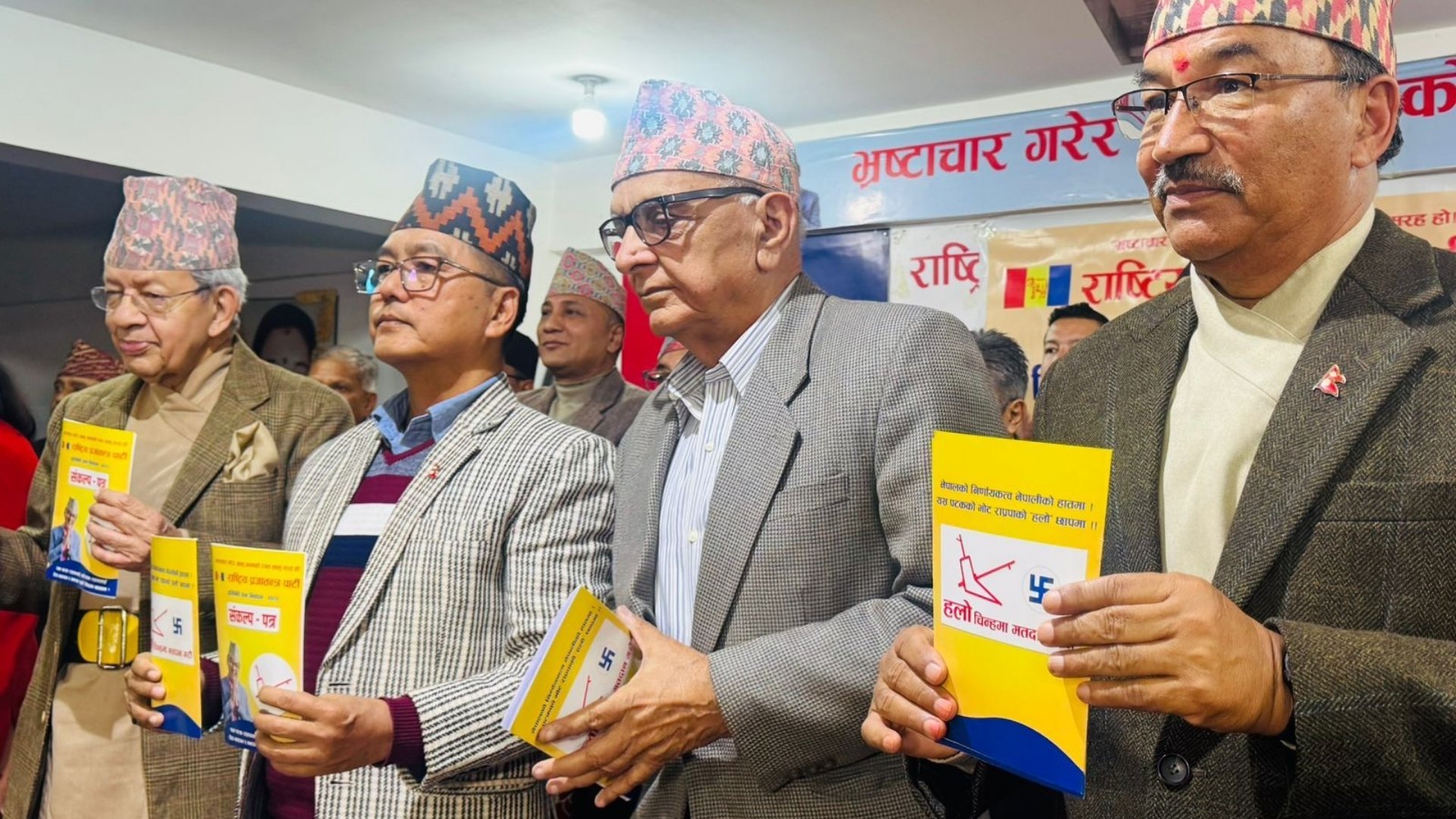
In its manifesto for the March 5 election, the Rastriya Prajatantra Party (RPP) promises what it describes as a structural reset of the Nepali state.
Blending calls for the restoration of the monarchy and a Hindu state with ambitious energy, infrastructure and industrial targets, the party is positioning itself not as a reformist force within the current system, but as a challenger to the federal republican order itself.
Constitutional overhaul and system redesign
At the core of the manifesto is a pledge to amend the constitution to reinstate the monarchy as a “guardian institution” and declare Nepal a Hindu state while guaranteeing religious freedom for all.
The party proposes abolishing the provincial structure and replacing it with a two-tier system consisting of a strong central government and empowered local bodies.
RPP promises to introduce a two-term limit for executive office holders, establish non-party local governments and legally prohibit shutdown politics, stating it will never call a “Nepal Bandh.”
It pledges to form a high-level citizens’ commission to investigate assets accumulated by political leaders and senior officials since 1990, confiscate illegally acquired wealth and strengthen anti-corruption enforcement. Whistleblower protection laws, conflict-of-interest legislation and depoliticised constitutional appointments are also promised.
The manifesto also calls for banning politically affiliated trade unions and depoliticising universities and state institutions.
Time-bound infrastructure push
The party sets clear deadlines for infrastructure.
It promises to upgrade the Mahendra Highway to international standards within three years and complete ongoing and proposed national pride projects within the same timeframe. It pledges to accelerate strategic road corridors and expand electric rail and podway transport systems powered by domestic electricity.
The emphasis on three-year completion deadlines signals an attempt to contrast with the delays that have plagued large-scale public projects.
Energy production decade: 28,500 megawatts by 2035
Energy is the manifesto’s economic backbone. RPP proposes declaring the coming decade an “Energy Production Decade,” targeting 28,500 megawatts of electricity generation by 2035. It envisions Nepal as a 100% green energy user and a major regional electricity exporter.
The party says it may declare an “Energy Emergency” if required to fast-track projects. It promises to amend electricity, forest and environmental laws to remove bottlenecks, promote large reservoir-based hydropower projects in all seven provinces and expand cross-border transmission infrastructure.
On domestic consumption, RPP pledges free electricity for citizens below the poverty line, power at cost price for cooking and subsidised tariffs for industry and irrigation. It also proposes promoting green hydrogen production and electrifying transport systems.
Beyond hydropower, the manifesto outlines plans to explore and process rare earth elements and other strategic minerals within the country.
Rare earths, used in defence technology, electronics and medical equipment, are framed as a strategic opportunity. The party proposes public-private partnerships in extraction and processing and a broader industrial policy built around domestic resource utilisation.
RPP also promises to establish fertiliser factories, expand irrigation and ensure direct transfer of agricultural subsidies to farmers’ bank accounts.
Economic targets: 7% growth, middle-income by 2031
The manifesto sets a target of achieving 7% economic growth within five years and upgrading Nepal to middle-income status by 2031. Branding its model as “Reform 3.0” and “protectionist development,” the party seeks to balance private sector expansion with targeted protection of domestic industries.
It pledges to widen the tax base without increasing tax rates, launch an “Investment Promotion Decade,” strengthen public-private partnerships and remove Nepal from the FATF grey list through improved financial governance.
A single-window system for investors is promised, alongside regulatory simplification and recognition of the gig economy through a formal legal framework.
The party describes the private sector as the backbone of employment and GDP, but with a state that actively shapes industrial policy.
Digital state within five years
RPP promises to make the government fully paperless within five years, introduce a unified digital public service portal and implement full e-procurement and digital budget tracking systems. It aims to expand IT exports, artificial intelligence training and content moderation industries as employment generators.
Digital literacy would be compulsory up to Grade 12, supported by trained computer teachers in schools. A Technical and Vocational Education Fund would be established, alongside “earn while you learn” models and stronger industry-academia linkages.
Education, health and social policies
The manifesto promises free education in government schools up to Grade 12. It proposes restructuring universities under a Board of Trustees model to depoliticise governance and elevate academic standards.
The party pledges to reposition Tribhuvan University as a national centre of excellence and expand the Budhanilkantha School-type model schools to all seven provinces.
The party says it would prohibit trade unions in educational institutions and expand technical and vocational education to address youth unemployment.
On health, RPP pledges free basic healthcare for all citizens and expanded health insurance coverage. It promises to establish Bir Hospital-level facilities in all seven provinces, strengthen free dialysis services and increase state support for cancer, kidney and spinal treatment.
The party proposes creating a national burn treatment hospital and fund, strengthening ward-level health profiling systems and positioning Nepal as a regional hub for health and education services.
The manifesto proposes establishing ration card centres in every municipality to support low-income households, mobilising lakhs of national volunteers annually and expanding social security protections for vulnerable groups.
National security and foreign policy reset
Under the slogan “Nepal First, Nepali First,” the manifesto emphasises sovereignty and non-interference.
The party pledges to ensure the country’s territory is not used against any country, review and scrap what it describes as unequal treaties and revive the longstanding Zone of Peace proposal. It also commits to continuing platforms such as the Sagarmatha Dialogue to strengthen climate diplomacy.
RPP promises to modernise and strengthen the Nepal Army while preserving its “traditional glory", make military service more attractive, and depoliticise the Nepal Police, Armed Police Force and National Investigation Department.
Additionally, like most other parties, RPP promises to ensure voting rights for Nepalis abroad from the next election cycle and to guarantee continuity of citizenship for people of Nepali origin under the principle of “one time Nepali, always Nepali.” The party recognises diaspora capital and skills as strategic development resources.
Taken together, RPP’s manifesto is not incremental. It seeks to dismantle federalism, restore the monarchy, reshape the constitutional order and pursue an energy-led industrial transformation backed by protectionist economic policies.
Whether voters embrace that high-stakes reset over the existing federal republican framework will be decided at the ballot box. But the manifesto makes clear that RPP is campaigning on systemic reordering rather than administrative reform.
Read More Stories

NEPSE falls nearly 75 points as market sentiment wavers
The stock market was unable to maintain the gains seen on Tuesday, slipping...
India has begun its long-delayed population census. Here's why it matters
India has begun the worlds largest national population count, which could reshape welfare...
The United Nations has called on Israel to repeal a law passed by...


Business + Finance + Economy + Tech + Environment + Nepal & South Asia + In-depth Analysis + News + Investigation + Research + Expert Opinion + Anatomy of Complex Issues.