Party Manifesto | Political Agenda | HoR Election 2026 | Nepali Congress
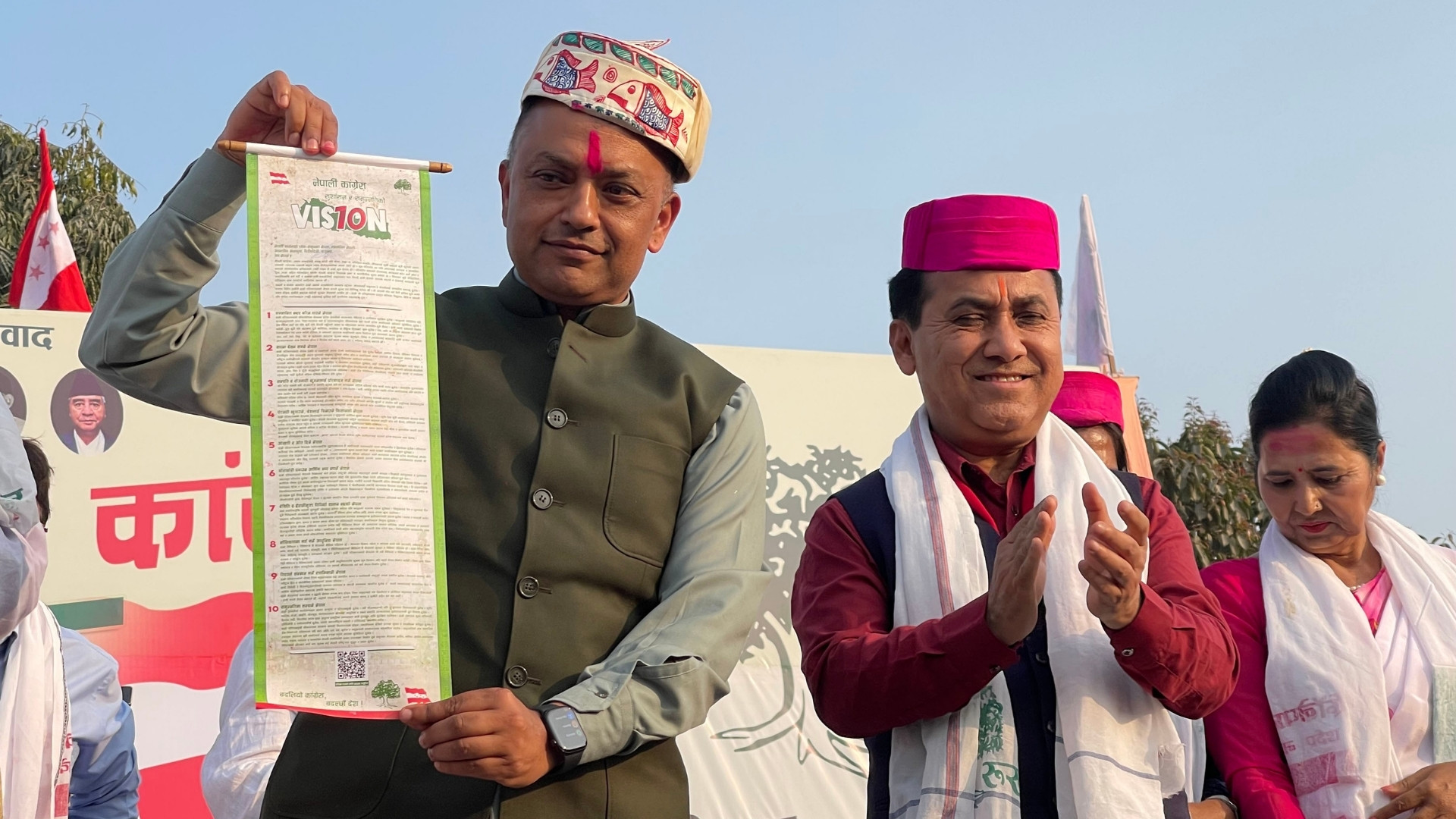
The Nepali Congress has released its election manifesto, adding its vision to a crowded political field. The party, one of the oldest in the country, unveiled the document it called “Pratigya Patra” in Janakpurdham.
Unlike some past manifestos that are heavy on slogans, the Congress document features a combination of numerical targets, structural reforms, and high-level policy pledges. Many described it as a blend of measurable promises and broad political commitments.
Economic growth, jobs and poverty reduction
The party pledges to create 1.2 million jobs in five years, with at least 300,000 jobs annually. The party aims for a more production-oriented economy by raising investment to 40% of GDP.
Nepali Congress targets a double-digit economic growth to stimulate broader wealth creation, but does not specify the exact rate. The party commits to anchoring Nepal toward upper-middle-income status by 2030 and expand the economy to NRs 11.5 trillion within the next five years, which means it will require an annual growth rate of roughly 12.8%.
In addition to growth targets, the party also pledges to reduce the poverty rate below 10%. As part of its plan to support middle-income citizens, it will grant an income tax exemption on earnings up to NRs one million.
While these targets sound bold for an economy that has historically faced weak investment flows, low productivity and structural constraints, the 200-page manifesto does not yet present detailed costs or implementation plans behind them.
Energy and industrial expansion
The manifesto features energy prominently, given its perceived link to industrialisation and jobs. The party promises to expand the country’s electricity generation capacity to 28,500 megawatts within 10 years.
The manifesto calls for accelerated transmission build-out and expanded regional power trade. It also proposes a one-door system to streamline environmental, land and forest clearances.
The party’s energy agenda comes as part of a broader competition among parties to promise megawatt targets, although financing, land acquisition and regulatory clearance timelines remain potential bottlenecks.
Agriculture and rural development
In the agriculture sector, which employs a significant share of the country’s population, the party pledges to double farmers’ income within five years.
The manifesto calls for a significant expansion of irrigation coverage nationwide. It also emphasises mechanisation, storage facilities and agro-industrial linkages to strengthen farmer productivity.
While these goals are specific, the document stops short of explaining how these income and infrastructure goals will be financed or managed at scale.
Governance, federalism and institutional reform
Like many other parties, Congress emphasises governance reforms.
The party promises a monthly public performance reporting system for ministries to track progress. It pledges to clarify powers among federal, provincial and local governments, potentially through legal or constitutional steps.
Fiscal federalism reforms, including clearer revenue-sharing arrangements, are also part of the party’s governance agenda.
Under the broad anti-corruption language that appears throughout the manifesto, including calls to “eradicate corruption” and “restore public trust,” the party pledges to form a high-level commission to investigate assets of senior public office holders since 1991, and expand anti-corruption laws. In contrast, the party has fielded several candidates with pending corruption allegations, creating a mixed narrative about sincerity and political strategy.
Health and education
The manifesto promises free treatment for children under three and senior citizens above 73, alongside expanded and more inclusive health insurance coverage.
On education, the party vows to reform higher education governance and align education with labour-market needs.
Compared to measurable economic targets, these social sector pledges are broader and often lack specific budgetary or implementation frameworks in the document.
Environment, climate and sustainable development
Environmental commitments in the Congress manifesto go beyond general language.
The document pledges to maintain forest cover targets, including aiming for about 46% forest cover. It also frames a net-zero emissions approach and pledges to integrate climate adaptation into national development planning.
While these environmental goals are specific, they will require clear policy roadmaps and investment frameworks to be realistic, especially in a climate-vulnerable and disaster-prone country like Nepal.
Diaspora, foreign policy and social security
Congress commits to encouraging diaspora return and engagement in domestic development. It also articulates a foreign policy based on sovereign equality and respect for the Nepali passport.
On social protection, the manifesto promises to expand social security coverage and control illegal wealth accumulation—issues that have been raised as part of the party’s economic justice agenda.
The Congress manifesto combines numerically framed ambitions with broad policy and governance visions. It sets out measurable goals on jobs, investment, energy, poverty reduction and forests, while also advancing institutional reform, social sector expansion and anti-corruption rhetoric.
As Nepal heads into the March election, the test for voters will be distinguishing between verifiable promises and those that require deeper structural commitment and clarity.
Read More Stories

NEPSE falls nearly 75 points as market sentiment wavers
The stock market was unable to maintain the gains seen on Tuesday, slipping...

India has begun its long-delayed population census. Here's why it matters
India has begun the worlds largest national population count, which could reshape welfare...

The United Nations has called on Israel to repeal a law passed by...


Business + Finance + Economy + Tech + Environment + Nepal & South Asia + In-depth Analysis + News + Investigation + Research + Expert Opinion + Anatomy of Complex Issues.