election Manifesto | Political Agenda | HoR Election 2026 | NCP | economic reform | constitution
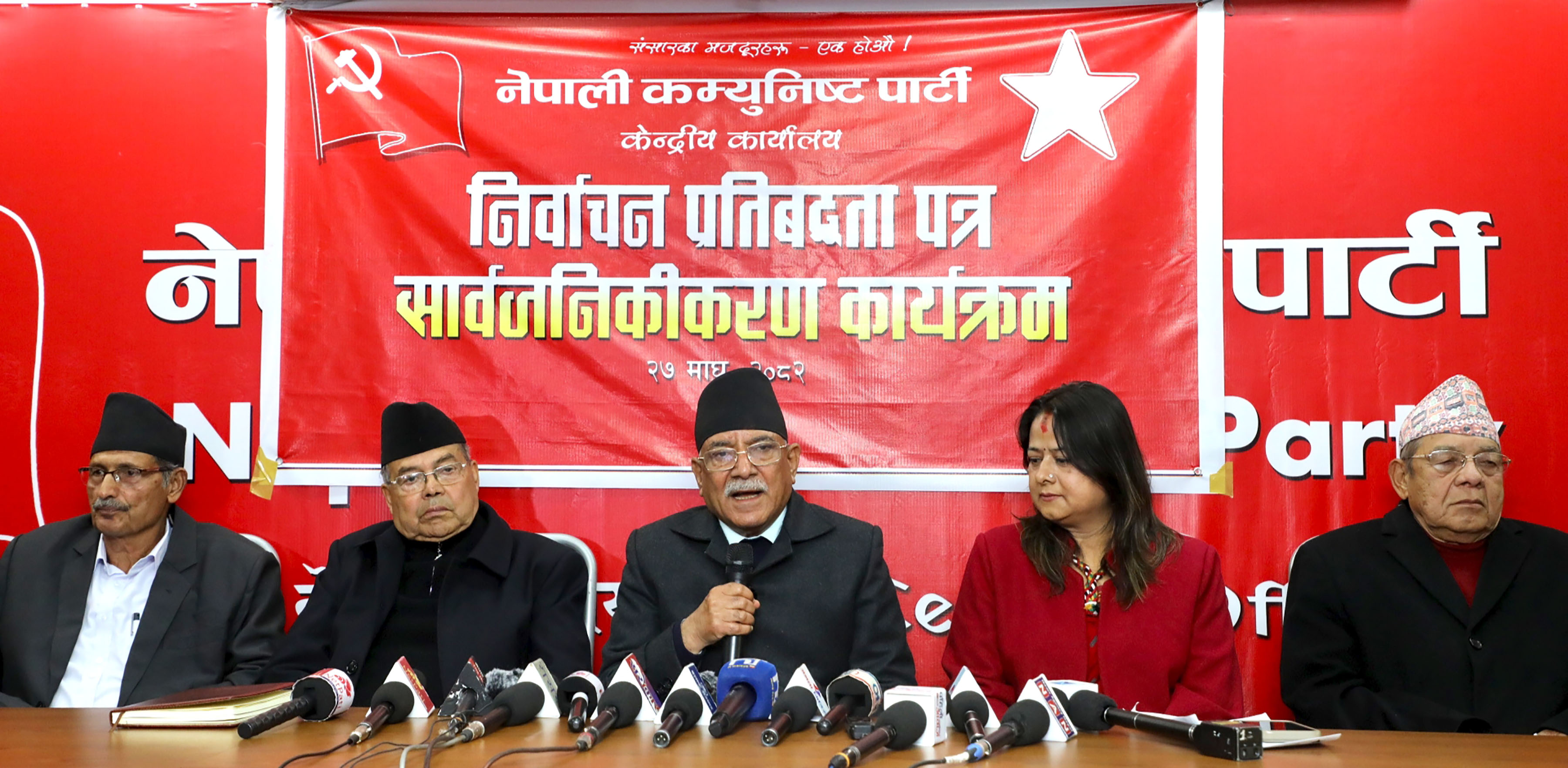
The Nepali Communist Party (NCP) has unveiled its manifesto for the March 5 general election, laying out an extensive list of time-bound commitments covering political reform, economic growth, infrastructure expansion, social protection and environmental sustainability.
The party is a merger of 22 different communist and socialist factions, including CPN (Maoist Centre) led by Pushpa Kamal Dahal and CPN (Unified Socialist) led by Madhav Kumar Nepal. Dahal serves as the convener and Nepal co-convener of the newly formed NCP.
Many of the pledges are quantified and deadline-driven. Yet several flagship commitments echo promises made in 2017 and 2022, when party leadership held decisive influence in national politics.
The party has reiterated proportional inclusion for women, Dalits, indigenous nationalities, Madhesis, Muslims and other marginalised groups, alongside targeted entrepreneurship programs and credit facilities.
Political stability, constitutional reform and federal implementation
The NCP pledges to amend the constitution to ensure political stability and balance of power, reform what it calls a “costly and chaotic” electoral system, and form a smaller, expert-inclusive federal council of ministers instead of the existing constitutionally allowed 25-member cabinet. It promises to pass all laws necessary for the full implementation of federalism within one year of the formation of the new House of Representatives.
A key fiscal commitment includes allocating 60% of the federal budget to sectors tied to fundamental rights, education, health, housing, drinking water, food security and culture, channelled through provincial and local governments. The manifesto also promises restructuring of constitutional commissions, eliminating overlaps and strengthening institutions such as inclusion-related commissions.
Anti-corruption and administrative overhaul
The party pledges to establish an independent high-powered commission within one year to investigate the assets of all past and present public office holders. It proposes a unified Lokpal mechanism integrating anti-corruption bodies. But it doesn’t mention how far it is willing to go back in its investigation.
Administrative reform commitments include the passing of the federal civil service law, federal police adjustment law, merit-based appointments and protection from political interference, performance-based evaluation systems, digital (faceless, paperless, cashless) governance, time-card systems for public service delivery, and expansion of the government workforce by 30% over five years.
Economic growth targets and employment
Economically, the NCP sets ambitious macroeconomic and employment targets.
The manifesto pledges to achieve double-digit GDP growth, above 10%, within five years, reduce multidimensional poverty from 20.15% to 5%, create 1.5 million formal jobs over the same period, and transform 100,000 returnee migrant youths into entrepreneurs.
Priority sectors for investment and expansion include agriculture, industry, tourism, information technology, energy and services. The party also proposes the development of provincial economic corridors and the promotion of cooperative and collective production models to stimulate growth and employment.
However, similar employment-focused and growth-heavy commitments were central to the 2017 “Prosperous Nepal, Happy Nepali” platform and were reiterated in 2022, raising persistent questions about implementation capacity and the gap between projected targets and actual economic performance.
Agriculture, land reform and irrigation
The NCP promises to enact the Integrated Agriculture Act and the Farmers’ Rights Act within one year of forming the government. It pledges to establish integrated agricultural service centres in every ward, create a national agricultural disaster fund, and achieve self-sufficiency in staple crops within two years. The party also commits to expanding irrigation coverage to 60% of arable land within five years.
On land reform, it promises to distribute land titles to landless Dalits and informal settlers within two years and to digitise land administration systems to improve transparency and efficiency.
Energy production and export
In the energy sector, the manifesto sets a target of generating 15,000 megawatts of electricity within five years, raising per capita electricity consumption to 750 kWh, and expanding energy exports under existing bilateral and regional agreements.
While ambitious, energy expansion has been a recurring pledge in previous election cycles, with implementation progressing incrementally rather than at a transformative scale.
Infrastructure: Nijgadh, highways and rail
On large-scale infrastructure, the NCP reiterates its commitment to completing the controversial Nijgadh International Airport within five years but doesn’t explain how it plans to finance the project which many consider as a white elephant project, environmentally destructive, and too big for Nepal to implement on its own It also promises the four-lane expansion of the East–West Highway, the development of a metro rail system in Kathmandu, and the timely completion of major national pride projects.
The manifesto commits to developing 20 smart cities and 100 smart villages within five years, featuring planned settlements, digitised public services, organised housing and modern infrastructure.
However, urban modernisation and “smart” settlement language have also featured in previous election cycles. Despite earlier pledges, rapid urbanisation has continued largely in an unplanned manner, with persistent infrastructure and service delivery gaps, prompting scrutiny over feasibility.
Drinking water, housing, food security and health
The party promises to ensure clean drinking water access to every household within five years and to declare Nepal hunger-free within two years. It pledges to expand school meal programmes linked to local agricultural production and to implement housing security and organised settlement programmes. Universal drinking water access has been a long-standing national objective across political cycles, with steady but incomplete progress.
In health and social protection, the NCP commits to universal health insurance coverage in the next six years, guaranteeing free public health services as a fundamental right. It also promises expansion of community-based health infrastructure and strengthened maternal and child nutrition programmes.
Additionally, the manifesto outlines reforms to broaden financial inclusion, regulate informal financial practices, integrate digital fintech systems and digitise land records. The emphasis on e-governance and technology-driven public administration reflects a continuation of earlier state modernisation agendas, now framed in more explicitly digital terms.
The party reaffirms a non-aligned foreign policy stance and commits to resolving border disputes, including Kalapani, Lipulekh and Limpiyadhura, through diplomatic dialogue. It also promises strengthened economic diplomacy and engagement in multilateral forums.
Repetition and deliverability questions
Many of the 2026 commitments, including Nijgadh International Airport, smart urban development, energy expansion, job creation and large infrastructure projects, were also central to the 2017 and 2022 platforms when current NCP party leaders held dominant or influential positions in government, as well as powerful political actors.
While the 2026 manifesto provides more quantified targets and deadlines, its broad ambition mirrors past cycles in which implementation often lagged behind rhetoric.
The key political question now is not the breadth of the promises, which are extensive and detailed, but whether institutional capacity, fiscal space, political stability and environmental clearances will allow these commitments to move beyond manifesto language.
Read More Stories

NEPSE falls nearly 75 points as market sentiment wavers
The stock market was unable to maintain the gains seen on Tuesday, slipping...

India has begun its long-delayed population census. Here's why it matters
India has begun the worlds largest national population count, which could reshape welfare...

The United Nations has called on Israel to repeal a law passed by...


Business + Finance + Economy + Tech + Environment + Nepal & South Asia + In-depth Analysis + News + Investigation + Research + Expert Opinion + Anatomy of Complex Issues.