hydro power |

The 1,200 MW Budhi Gandaki reservoir-based hydropower project has finally found its financing structure. Last Friday, the council of ministers approved the investment modality for the long-stalled project, agreeing to provide NRs 150 billion in concessional loans at one percent interest.
The base cost of the project is USD 2.77 billion (approximately NRs 374 billion) with an eight year construction period. The total project cost is estimated at NRs 406 billion including interest during construction.
The financing structure has been designed with a debt–equity ratio of 70:30, where the Government of Nepal will have 80% ownership and Nepal Electricity Authority (NEA) owning 20%.
The government’s total investment in the project will amount to NRs 248 billion, including NRs 97.47 billion as equity and NRs 150 billion as concessional loans. The government has already spent Rs 45 billion, which will be converted into equity investment in the company.
Upon project completion or in the final phase of construction, a certain percentage of shares may be issued to the general public, based on actual financial indicators, suitability, and feasibility, to reduce debt burden or restructure the government’s shareholding.
During construction, the government proposes to invest the amounts collected from customs duty and value-added tax (VAT) into the project. Additionally, 50% of the infrastructure tax currently levied at customs points on petroleum imports is proposed to be immediately allocated for investment in the project. The KP Oli-led government first imposed a 5-rupee infrastructure development tax in May 2016 on every litre of petrol, diesel and aviation fuel, collected at customs point. The levy was later increased to 10 rupees in February 2020, again under former Prime Minister Oli. As of December 30, the government has collected NRs 168 billion through the tax scheme.
Additionally, NEA will invest NRs 24.37 billion as equity. Its proposed financing sources include share issuance, energy bonds, loans from banks and financial institutions, concessional government loans, funds collected from the petroleum infrastructure tax, and share issuance to migrant workers, non-resident Nepalis, and the general public.
To reduce financing costs and enhance project viability, the government will issue NRs 30 billion worth of energy bonds that would count toward mandatory liquidity requirements.
These bonds may be purchased by banks and financial institutions, insurance and reinsurance companies, and public funds.
The project will avail loans totaling NRs 104 billion from banks and financial institutions through co-financing involving the Employees Provident Fund, Citizen Investment Trust, Social Security Fund, insurance and reinsurance companies, HIDCL, Nepal Telecom, and commercial banks.
Budhi Gandaki is expected to generate 1.41 billion units of electricity in the dry season and 1.97 billion units in the wet season, totaling 3.38 billion units annually. The proposed power purchase rates are NRs 12.40 per unit in the dry season and NRs 7.10 per unit in the wet season. Once electricity generation begins, the project is expected to earn annual revenue of NRs 31.48 billion.
The proposed duration of the electricity generation license is 50 years. If construction is completed within eight years, the project will generate electricity for the remaining 42 years. The detailed project report (DPR) and tender documents are ready. Progress on land acquisition, considered the most complex aspect of the project, has reached nearly 90%.
A total of NRs 42.65 billion has been distributed to landowners as compensation for land, structures, trees, and crops. The project will physically and economically affect 8,117 households in Gorkha and Dhading districts, of which 3,560 households will be fully displaced.
Full-scale construction is expected to commence from January 2028.
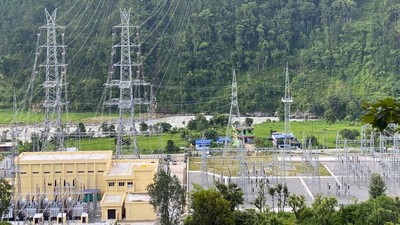
A 263-meter high curved arch dam will be built across the Budhi Gandaki River, which flows along the border of Gorkha and Dhading. This will affect 14 former VDCs in Dhading (now four rural municipalities and one municipality) and 13 former VDCs in Gorkha (now four rural municipalities).
Once the dam is built, the resulting reservoir will spread over 63 square kilometers in the upper riparian area. The 63-square-kilometer reservoir is expected to create opportunities for employment, business, tourism hubs, fisheries, and downstream benefits. The project’s maximum water level will reach up to 540 meters.
Earlier, NPC and the MoF had agreed on the investment modality for the 1,200-MW Budhi Gandaki project. Most recently, outgoing Minister for Energy, Water Resources and Irrigation Kulman Ghising had forwarded the proposed investment modality to the MoF for approval. Although investment frameworks were prepared repeatedly in the past, the project could not move into construction due to the lack of approval. As a result, despite being listed as a government priority since the budget speech of fiscal year 2011/12, the project failed to gain momentum.
Designated a National Pride Project, Budhi Gandaki’s progress over the past 13 years has largely been limited to land acquisition and compensation distribution. Although around 90% of land acquisition and compensation payments have been completed, the project could not begin structural construction because the investment modality had not been finalised.
The project considered to be strategically important from energy security perspective has been repeatedly derailed by political turnover and disputes over how the project should be awarded and financed, with the project contract awarded, canceled, restored, and canceled again over the past decade.
In 2017, Prachanda-led government awarded the building project to Chinese contractor China Gezhouba Group Corporation (CGGC) without competitive bidding. The same year, another government led by Sher Bahadur Deuba annulled the Memorandum of Understanding signed with CGGC, arguing that the agreement had been concluded without competitive bidding and labeling the decision to award the project as arbitrary and procedurally flawed.
The following year, in September 2018, the KP Sharma Oli administration overturned that decision and reinstated the contract with the Chinese firm. However, the project failed to advance as expected. Citing prolonged inaction, the Deuba-led government in April 2022 once again revoked CGGC’s license, this time deciding that the project would be developed using domestic resources instead of foreign investment.
Read More Stories

NEPSE falls nearly 75 points as market sentiment wavers
The stock market was unable to maintain the gains seen on Tuesday, slipping...
India has begun its long-delayed population census. Here's why it matters
India has begun the worlds largest national population count, which could reshape welfare...
The United Nations has called on Israel to repeal a law passed by...


Business + Finance + Economy + Tech + Environment + Nepal & South Asia + In-depth Analysis + News + Investigation + Research + Expert Opinion + Anatomy of Complex Issues.