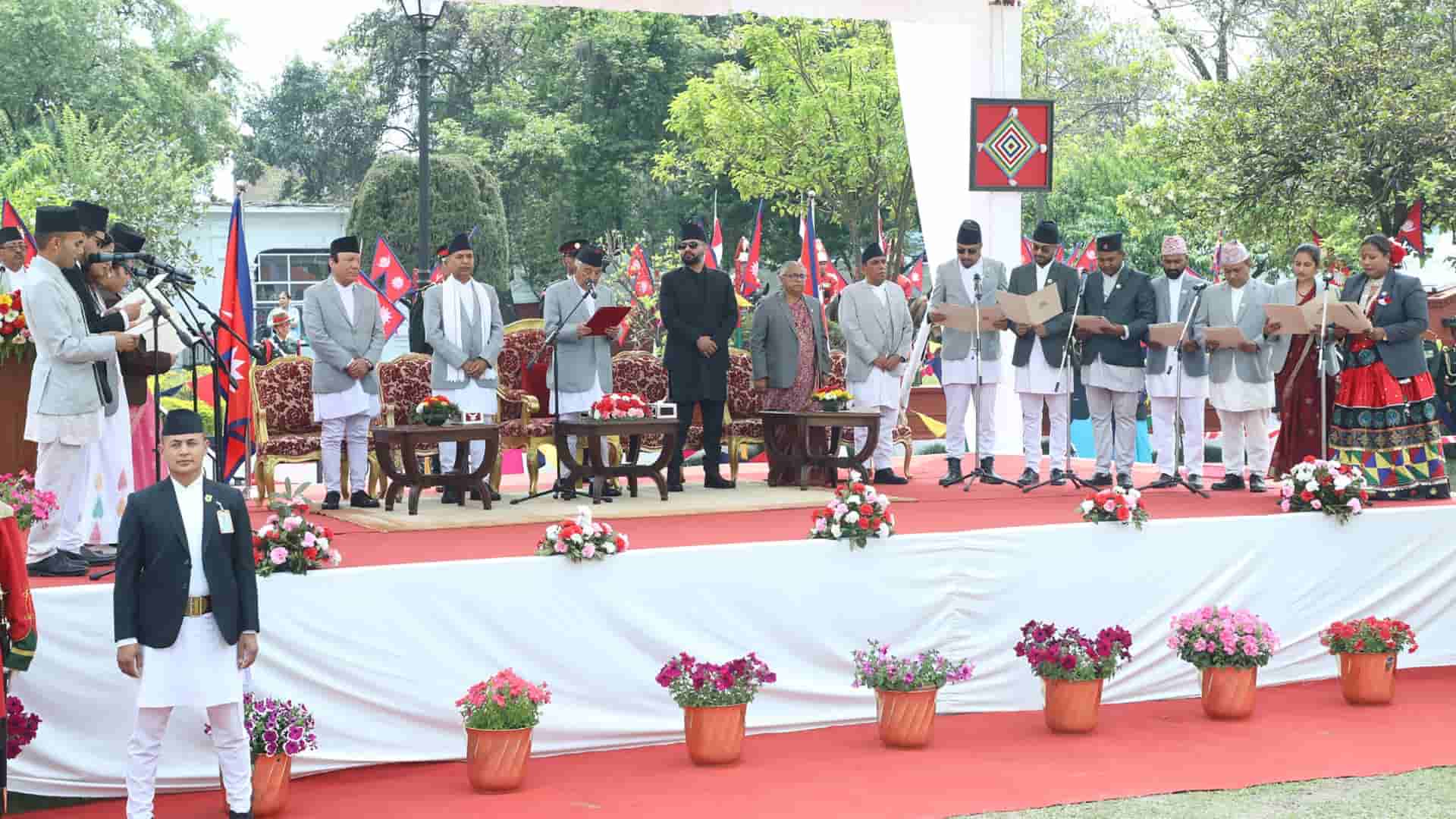
In a solemn and symbolic ceremony held at the Federal Parliament of Nepal, newly appointed parliamentarians took their oath of office on Thursday, formally stepping into their constitutional roles. Similarly, the new Prime Minister Balendra Shah took his oath of office on Friday, followed by his cabinet at a formal ceremony held at the President’s Office, Shital Niwas.
Held in a structured and ceremonial setting, these events followed established legal procedures that govern how public officials enter into duty. The ceremony carries both legal and institutional significance.
The oath of office is not merely symbolic under Nepali law; no individual can exercise the authority of a public office without first taking an oath of office and secrecy. While the oath explicitly refers to secrecy, the Oath Act does not clearly outline what it entails. In practice, this is generally understood to indicate a duty to protect sensitive state matters, including information related to governance, cabinet discussions, diplomacy, and national security, ensuring trust and integrity in public office. This requirement ensures that every office holder begins their role with a formal commitment to the Constitution and prevailing laws.
At the centre of the ceremonies are the words of the oath itself. While the core wording remains the same for all public office holders, including parliamentarians, ministers, and other officials, it is structured in a standard format with minor variations such as the designation of the position and the choice between invoking God or Country and People, but in practice they tend to say all God, Country and People.
What is in the oath?
I, ……………………, solemnly swear in the name of God/the nation and the people, pledging full loyalty to the Constitution of Nepal, which establishes Nepal’s sovereignty and the authority of the state in the people, and with true faithfulness, that I will faithfully discharge the responsibilities of the office of .................................. in accordance with the prevailing laws, for the welfare of the country and its people, without fear of anyone, without favoritism, and without prejudice or ill intent. I further swear that any information that comes to my knowledge in the course of performing my duties will not be disclosed or indicated in any way under any circumstances, whether I remain in office or not, except as required by law.
शपथको आधिकारिक व्यहोरा
म .................................. नेपालको सार्वभौमसत्ता र राजकीयसत्ता नेपाली जनतामा निहित रहेको नेपालको संविधानप्रति पूर्ण वफादार रही सत्य निष्ठापूर्वक प्रतिज्ञा गर्दै ईश्वरको/देश र जनताको नाममा शपथ लिन्छु कि .................................. पदको जिम्मेवारी प्रचलित कानूनको पालना गरी मुलुक र जनताको भलो चिताई कसैको डर नमानी, पक्षपात नगरी, पूर्वाग्रह वा खराब भावना नलिई इमान्दारीका साथ वहन गर्नेछु र आफ्नो कर्तव्य पालनाको सिलसिलामा आफूलाई जानकारीमा आएको कुरा म पदमा बहाल रहँदा वा नरहँदा जुनसुकै अवस्थामा पनि प्रचलित कानूनको पालना गर्दा बाहेक अरु अवस्थामा कुनै किसिमबाट पनि प्रकट वा संकेत गर्ने छैन।
The oath comprises six key elements: a personal declaration, an invocation (sworn in the name of God, the nation, and the people), a pledge of loyalty to the constitution, a commitment to perform duties faithfully, a promise to act without fear or favoritism and an oath of confidentiality regarding sensitive information (the ending section).
The oath may be administered in Nepali or, if preferred, in an individual’s mother tongue with a certified translation submitted beforehand. Once taken and signed, it is officially recorded, after which the individual is eligible to assume office.
The format and wording of this oath are explicitly provided in the Schedule of the Oath Act, 2079, ensuring uniformity across all public offices. In this way, the ceremony remains not only a constitutional formality but also a standardised legal process governing the public authorities.
Another notable aspect of the oath taking ceremony of the parliamentarians was their attire. In line with legal provisions, officials appeared in formal dress, with many choosing traditional or cultural clothing that reflected Nepal’s diversity. The law allows such cultural expression, provided it maintains the dignity of the occasion.
Read More Stories

NEPSE falls nearly 75 points as market sentiment wavers
The stock market was unable to maintain the gains seen on Tuesday, slipping...

India has begun its long-delayed population census. Here's why it matters
India has begun the worlds largest national population count, which could reshape welfare...
The United Nations has called on Israel to repeal a law passed by...


Business + Finance + Economy + Tech + Environment + Nepal & South Asia + In-depth Analysis + News + Investigation + Research + Expert Opinion + Anatomy of Complex Issues.