Party Politics | 11th CPN-UML General Convention | Renewed Leadership
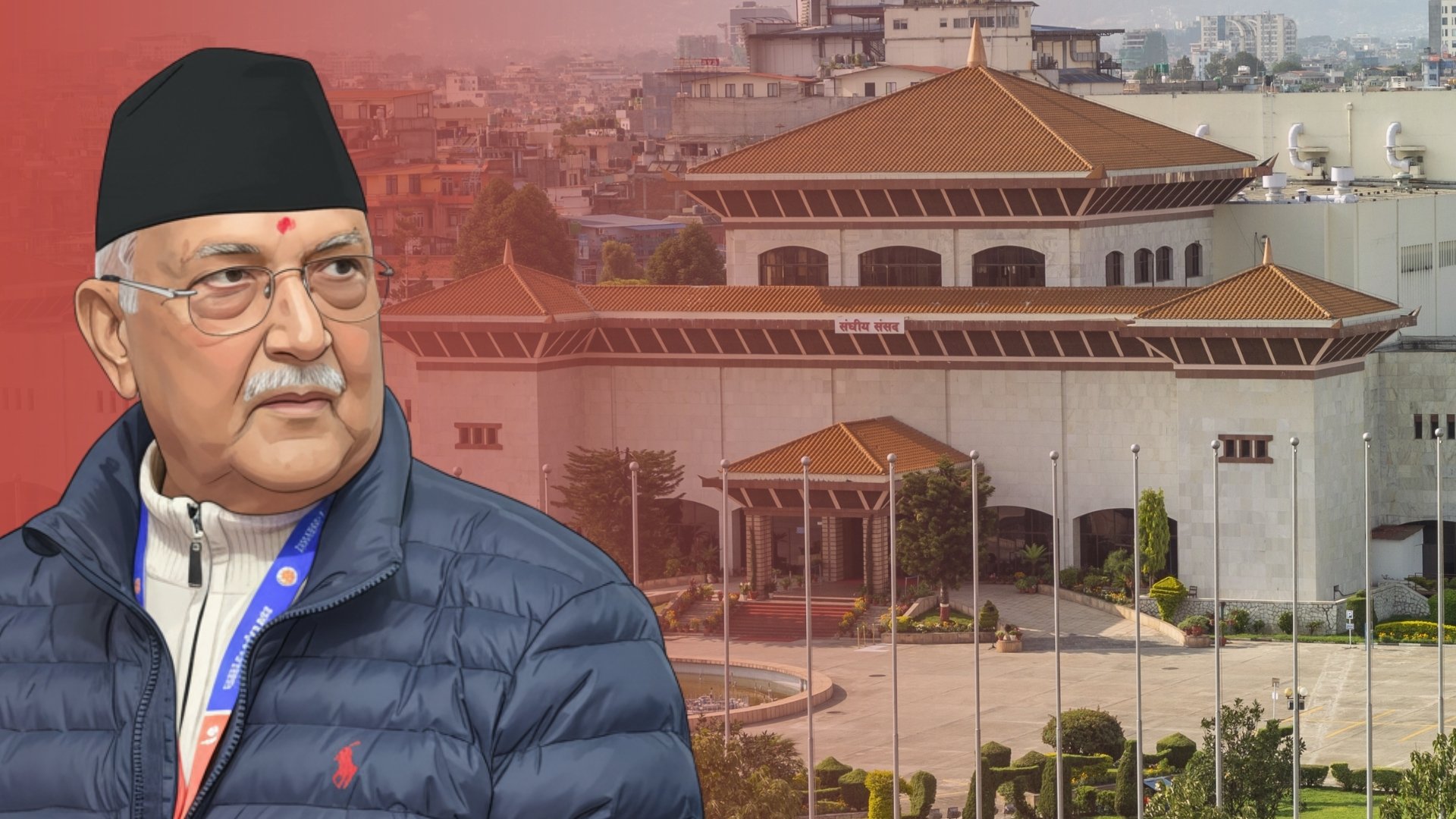
KP Sharma Oli’s dominating re-election at the 11th General Convention of the CPN-UML reflects more than personal popularity. It reveals an enduring grip on party machinery at a time when Nepal’s multiparty democracy is shrouded in uncertainty.
The vote came barely three months after UML offices nationwide, including the central secretariat, were vandalised during youth-led anti-corruption protests in September. Oli’s own home was burnt.
Amid this, the party’s ability to convene the convention a full year ahead of schedule serves as a testament to its organisational resilience, a quality few political forces can claim.
The UML’s oldest rival and self-styled torchbearer of democracy, the Nepali Congress, is still juggling whether to hold a general or special convention. The CPN (Maoist Centre), whose former self had an organisational setup far and wide, has dissolved itself into a nine-party merger Nepali Communist Party (NCP), with Pushpa Kamal Dahal and Madhav Kumar Nepal as convener and co-convener, respectively.
In this context, UML’s internal elections assume significance that extends well beyond the party’s immediate corridors of power. The renewed leadership mandate also counters the narrative that UML operates solely through rigid, Oli-centric centralisation, given 25% of delegates voted for Ishwar Pokhrel.
All of this unfolds against the backdrop of an interim government whose legitimacy Oli has questioned since its formation, rendering it unconstitutional and the September events that he framed as an attack exclusively against his party and leadership.
In that sense, his Third consecutive term reflects not public affection but the enduring strength of the party infrastructure as a force capable of weathering protests, crises, and political turbulence alike.
To grasp what Oli’s victory may mean for Nepal’s politics in years to come, he must be seen as a political function, whose relevance peaks during institutional breakdowns.
Oli as political function
Oli’s influence tends to peak during moments of instability rather than calm. To understand this, we must follow his power consolidation in the party amid the fall of the monarchy and a fragile peace process with the Maoists.
In 1993, he ranked fifth in the standing committee member and fourth in 2003 from 12th-ranked central committee member in 1989.
In a communist party, rank determines who controls decisions, cadres, and resources, so leaders with top positions can shape policy, manage internal rivals, and survive crises. Essentially, power comes more from position in the party than from public popularity.
Cut to 2006, his agenda was less about ideology than about organisation: strengthening the party, enforcing discipline, and preparing UML to compete in a volatile political transition to republican politics.
In 2008, Oli contested the first Constituent Assembly (CA) elections from Jhapa, but lost. The party performed poorly, finishing in third with 108 of 601 seats. The results followed the resignation of Madhav Kumar Nepal as general secretary, which was the sole executive office in the party then.
The first CA (2008-12) failed to deliver the constitution. Meanwhile, the 2009 general convention adopted Oli’s proposal, which the 2003 convention had rejected, to restructure leadership into multiple offices. Oli strongly advocated for democracy within the party structure. He ran for party presidency against Jhalanath Khanal, but lost.
In the Second CA (2013-15) elections, he won from Jhapa while UML improved to the second-largest party with 175 seats. He subsequently defeated the party president, Khanal, in the run for the parliamentary party leader.
The 2014 convention elected Oli as party president against Senior Leader Nepal by a narrow margin. He now controlled policy, discipline, and nominations, while leaders like Khanal, Nepal had little to no say in party policies and decisions.
The electoral recovery and subsequent delivery of the constitution in 2015 reinforced his image as the party’s anchor during moments of uncertainty. However, the delivery didn’t come unopposed.
UML, in particular Oli, had influential roles in expediting the promulgation of the constitution, despite deep reservations in the plains communities about its inadequacies. Following the deadly Third Madhes Aandolan, the party became deeply unpopular in the plains.
Oli’s hardline stance and dismissive public remarks became emblematic of the fraught relationship with Madhesi and Tharu protesters, demanding autonomous provinces, citizenship and land rights, among others.
He derided a human chain formed by Madhesi activists as a chain of flies (“माखे साङ्लो”), a simile that many perceived as diminishing the protesters’ dignity.
He even went on to say: what difference does it make if two or four mangoes fall (“दुई चार ओटा आँप झर्दैमा के फरक पर्छ”), suggesting casualties and unrest were minor in the larger political calculation.
His stance on citizenship, encapsulated in the remark citizenship is not chocolate to be handed out freely at borders, reflected a broader unwillingness to address longstanding grievances in the plains regarding access to legal citizenship.
Collectively, these statements symbolised a strategy that prioritised rapid constitutional delivery over negotiation with protesters, signalling a majoritarian approach that alienated communities in the plains and eroded trust in what Oli acclaimed as the “world’s best constitution” at the time.
When the Indian blockade struck the country at a time when it was still reeling from the aftermath of the 2015 earthquake, the national crisis gave Oli another opportunity to both tackle the crisis and advance his politics.
Oli mobilised nationalist sentiment, casting external pressure as the overriding crisis while suppressing Madhesi and Tharu protests. Eventually, the politics of grievance were subordinated to the politics of sovereignty, which paid dividends in 2017.
Oli later went on to preside over the map controversy with India in 2020, during which the government adopted a revised national map incorporating disputed territories. The whole episode further reinforced his political standing.
Unity, rupture, and organisational survival
The 2017 electoral alliance between UML and the Maoist Centre reshaped Nepal’s political landscape, producing a sweeping communist victory. The subsequent unification between the two major left forces into the Nepal Communist Party in 2018 was framed as a historic moment of stability. But it soon proved fragile.
In 2021, the Supreme Court annulled the NCP, restoring UML and the Maoist Centre as separate entities, which exposed UML to its most serious rupture in years. Senior leaders, including Madhav Kumar Nepal, broke away to form the CPN (Unified Socialist), draining lawmakers and regional influence.
The vulnerability was brief as Oli’s dominance continued in practice. In the aftermath, he tightened organisational control, rebuilding party committees and reframing the split as a necessary purge rather than a loss.
The party’s first statute convention, held the same year, officially codified the president as the supreme executive, while the general secretary executes decisions, positioning UML leaner, more disciplined, and firmly centred around his leadership.
The 2022 federal and provincial elections tested that model. Entering the race amid predictions of decline and facing new parties and independent figures, UML nonetheless secured 78 seats, emerging as the second-largest force in the House. Oli re-emerged as an unavoidable actor in government formation.
At the closing of the recent 11th convention, Oli also reflected publicly on the lessons drawn from the 2021 unification with the Maoist Centre and its collapse. The party, he said, would no longer pursue mergers or alter its identity in search of numerical advantage. UML’s name and symbol, he insisted, were settled. Those wishing to align with the party were welcome, but only by joining it under its existing statute, structure, and leadership.
The statement, more than retrospective, signalled a recalibration of strategy grounded in organisational integrity over expansive alliances. After years of experimentation with unity and accommodation, Oli had returned to a familiar principle, consolidation over compromise, discipline over diffusion.
In doing so, he reaffirmed the logic that has defined his political rise and survival. Even when isolated and unpopular, control over party machinery has allowed him to endure.
Visibility without structure
Oli’s third term as party president begins despite noticeable dips in popularity.
The evolution of digital platforms has helped challenge traditional norms and parties, signalling a shift from cadre-based politics to a hybrid model where visibility and narrative control on social media can rival institutional authority.
Figures like Kathmandu Mayor Balendra Shah and Rastriya Swatantra Party (RSP) President Rabi Lamichhane epitomised this new mode of politics. Shah’s cult personality amplified through social media and Lamichhane’s mass mobilisation has expanded their reach, often portraying traditional parties as villains and disconnected from contemporary digital-driven political realities.
Yet these actors’ reliance on digital visibility and personal charisma exposes structural limits. Without embedded organisational networks, their influence can remain largely symbolic.
Such constraint became evident for an established party like UML in Madhesh Province, when its organisational resilience was tested starkly following the Third Madhes Aandolan.
When the province was formed, consisting of eight districts, UML secured 21 of 107 assembly seats despite the electoral alliance with the Maoist Centre.
Following the 2021 split, 13 of 21 members defected to the new party, the CPN (Unified Socialist), led by Oli’s rival Nepal. It also meant UML remained out of power for the full term (2017–2022), while a ruling partner in the other six provinces.
By the second Provincial Assembly, UML reclaimed its position as the largest party in Madhesh with 24 seats despite the split, demonstrating the party’s capacity to recover from political isolation even amid public perception of declining legitimacy.
However, in November, controversies surrounding the appointment of Saroj Kumar Yadav as chief minister highlighted the tension between internal control and public perception, triggering protests and media scrutiny for bypassing coalition norms and constitutional expectations.
That regained stronghold will be tested again in the upcoming elections.
The politics of confrontation
Now that Oli has a renewed mandate in the party for the next five years, his post-convention speeches signal more than routine opposition. They mark a turn toward a heightened, openly combative posture against the interim government and those aligned with it, including the ‘Gen Z’ activists.
In his closing address at the convention, Oli framed any physical attack on UML leadership as an attack on the state itself. His remarks followed assaults on UML convoys, including those involving newly elected secretary and close ally Mahesh Basnet, in Simara, Biratnagar, and Dhangadhi.
He has rejected the controversial unilateral agreement between the interim government and ‘Gen Z’ representatives, portraying it as an illegitimate accommodation that undermines institutional authority. The party, he said, does not recognise the Gauri Bahadur Karki-led judicial commission formed to investigate the incidents of September 8 and 9.
He accuses former judge Karki of prejudices reflected in his posts on ‘X’ while the country was reeling under widespread unrest on September 9.
Karki had called for leaders, including Oli, Deuba, and Dahal, to be detained, barred from leaving the country, and subjected to investigation, while referring to them as “traitors” and insisting that no one should be harmed. Now that the Supreme Court has upheld the legality and legitimacy of the commission, Oli would reportedly send his response via writing or may testify before the officials at his residence in Gundu.
Although a swift turn, his stiffness resonates with impunity political leadership and then-security officers enjoyed post 2015 movements in the plains.
While after much pressure from the Madhesi forces, the then government did form a commission to investigate the violence during the unrest under former Supreme Court Justice Girish Chandra Lal in September 2016, the report submitted to the government in December 2017 has not been made public yet.
Moreover, since being ousted in September, Oli has consistently described the Sushila Karki-led interim administration as unconstitutional and “born out of vandalism and arson,” dismissing it as a “government of publicity” rather than a popular mandate, which he in fact had only a short time ago as Prime Minister.
The current posturing, which can also be seen as a counter to an increasing digital hostility toward him and his party, raises a possibility of escalation of political confrontation leading to a prolonged political uncertainty.
Meanwhile, Oli’s re-election has also shut down the possibility, at least for now, of former Head of State Bidya Devi Bhandari returning into active politics, an attempt, purely unethical, after leading the country’s top constitutional position for two terms.
Oli had an influential role in enabling that ambition, holding double standards about Bhandari’s eligibility to return to active politics. When it favoured him, he asserted that Bhandari could make that choice but later retracted when it seemed to threaten his position within the party.
While her return undermines the prominence and legacy of the constitutional post, the current political reality is that her presence has created a minor front within the party, which desperately makes efforts to curb Oli’s unchecked power exercise.
Oli’s win in broader political landscape
Oli’s trajectory underscores a larger pattern in Nepali politics that institutional resilience continues to outweigh fleeting public sentiment. Where alternative forces dominate attention, UML’s deep-rooted organisational structure allows it to absorb shocks, regroup, and reassert itself. The resilience doesn’t imply the party has public confidence at the moment.
It, however, exists within a system that remains deeply fragile, as uncertainty over election timing and disputes regarding the reinstatement of the House or at least the convening of the National Assembly.
Oli has sought to anchor this uncertainty to a clear political claim: that the interim government’s sole mandate is to conduct elections, not to take decisions with long-term consequences. If it cannot fulfil that mandate, he argues, it should vacate the space. While framed as a constitutional restraint, many interpret this as a calibrated warning, a reminder of the leverage his party retains in an unsettled transition.
Against this backdrop, delegates did not vote for Oli because he is universally admired, nor because they are blind to his contradictions. Urban discourse often caricatures UML cadres as unthinking loyalists, reducing their political choice to ridicule as if one must choose between being human and being UML. That framing overlooks a more pragmatic calculus.
Oli is also chosen for tangible, demonstrated deliverables: for presiding over the promulgation of the constitution, for holding the party together when its offices were attacked and its supporters publicly vilified, and for reorganising UML as a credible national force even when it stood widely isolated from power for months or years.
For many within the party, Oli represents a source of strength in moments when political affiliation itself has felt prohibitive, even punishable. When the home is under attack, people do not abandon it to debate the shortcomings of its head. They close ranks to defend it. That instinct for collective survival, more than ideology or charisma, explains the loyalty he commands.
Yet, a politics sustained by siege can blur the boundary between defending institutions and dominating them. A leader who draws authority from crises may struggle to operate without one.
Oli’s repeated invocation of constitutionalism sits uneasily alongside his own record of constitutional breaches, reminding the country that survivalist politics can corrode the very order it claims to protect.
His victory, then, signals not closure but continuity of a political system where organisation still defeats outrage, where institutions outlast sentiment, and where crisis remains the currency of power.
For his rivals, his re-election is anything but welcoming, as it exerts pressure on Deuba, Dahal and Nepal to look for a comeback, at any political cost.
Whether Nepal can move beyond this cycle will depend not only on Oli or UML, but on whether alternative forces can build something sturdier than protest, and whether established parties can rediscover legitimacy without waiting for the next breakdown.
Read More Stories

NEPSE falls nearly 75 points as market sentiment wavers
The stock market was unable to maintain the gains seen on Tuesday, slipping...
India has begun its long-delayed population census. Here's why it matters
India has begun the worlds largest national population count, which could reshape welfare...
The United Nations has called on Israel to repeal a law passed by...


Business + Finance + Economy + Tech + Environment + Nepal & South Asia + In-depth Analysis + News + Investigation + Research + Expert Opinion + Anatomy of Complex Issues.