Earthquake Periodicity | Seismic Cycle | Western Nepal | Disaster Preparedness
For years, public discussion around Nepal’s seismic risk has carried a haunting refrain: western Nepal is “overdue.”
The argument, repeated in policy rooms, rests on a simple timeline. A massive earthquake struck western Nepal in 1505. More than 500 years have passed. Strain must be building. Therefore, another megaquake is due.
But a new 6,000-year earthquake record from Lake Rara complicates that story.
Published this month in Science Advances, the study suggests that large Himalayan earthquakes do not follow predictable cycles. Instead, their long-term timing appears statistically random, with clusters of small to moderate events temporarily relieving local stress along the Main Himalayan Thrust.
The fundamentals remain unchanged. Nepal sits atop the collision zone where the Indian Plate pushes beneath the Eurasian Plate along the Main Himalayan Thrust. Strain accumulates. Earthquakes release it. The hazard is permanent.
[Read also: A decade of our fault lines]
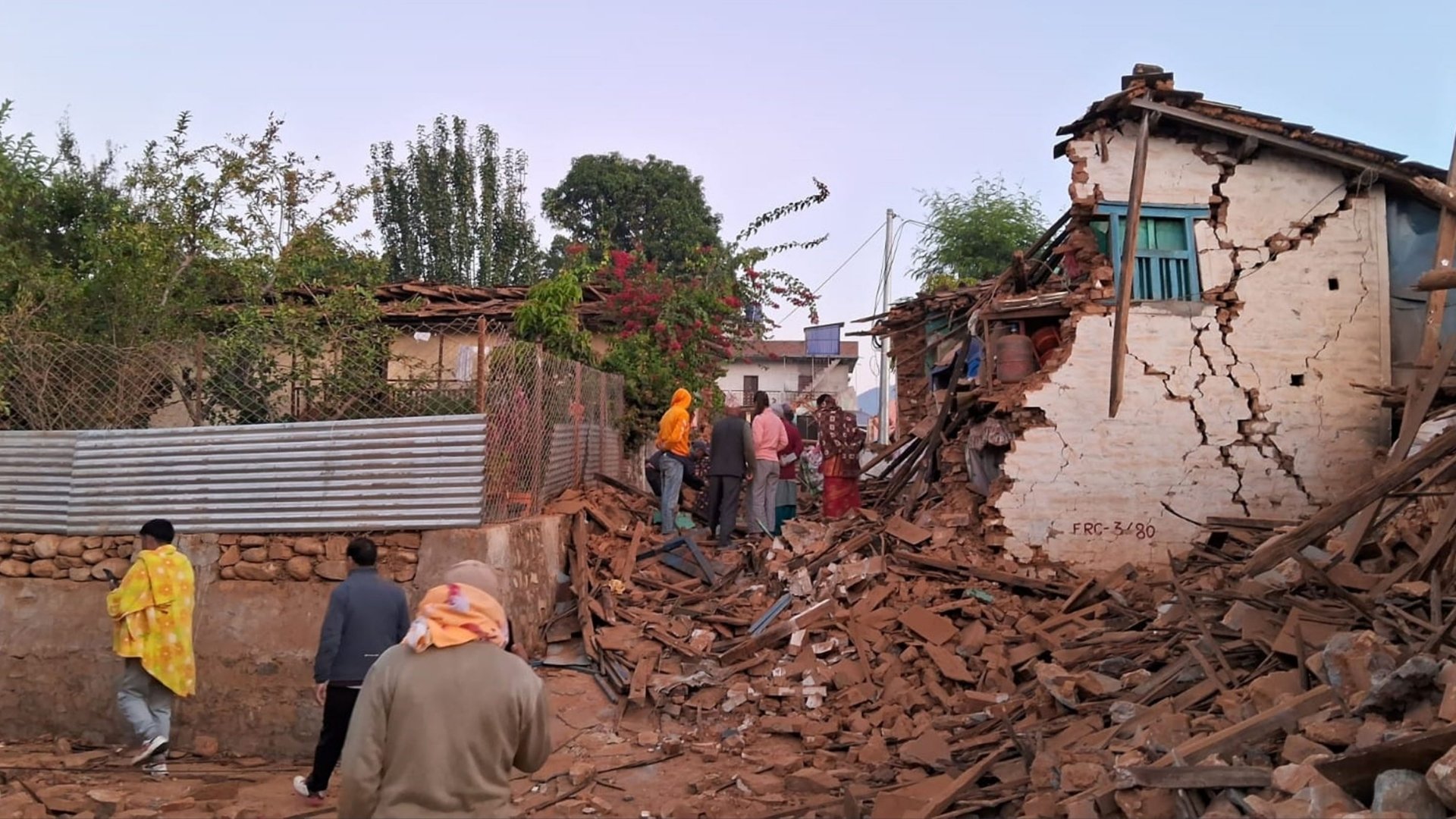
Nepal is one of the world’s most seismically vulnerable countries. The devastation of the 2015 Gorkha earthquake and its aftershocks, the 2023 Jajarkot earthquake, and the structural and logistical vulnerabilities revealed by both events are fully consistent with the new research.
Where the science pushes back
The divergence emerges around timing.
Earlier studies referenced the long “seismic silence” in western Nepal since 1505, framing it as a gap signalling mounting pressure and an impending rupture.
In the new study, the Lake Rara sediment record, spanning six millennia and containing 50 earthquake-triggered deposits, finds no evidence that major earthquakes occur at regular or quasi-regular intervals. Instead, recurrence matches what statisticians call a Poisson (random) distribution. Events occur independently of how much time has passed since the last one.
The researchers confirmed this pattern by comparing it with long-term paleoseismic datasets from New Zealand, Indonesia, Chile, and the Cascadia subduction zone (USA), as well as synthetic catalogues based on the 2015 Gorkha earthquake rupture model.
Across all these tectonic settings, earthquakes showed the same statistical randomness, with only short-term clustering of smaller events. This demonstrates that the stochastic nature of seismicity is not unique to the Himalaya but a global phenomenon.
In practical terms, the 500-year gap since 1505 does not, by itself, increase the probability of a major earthquake tomorrow. Time elapsed is not a ticking clock. Inter-event intervals vary dramatically; some are under 200 years, others exceed 700 years, and one approaches 1,200 years. Apparent cycles in small datasets can be misleading.
Stress release at multiple scales
The new study also shows that tectonic strain is relieved not only by megaquakes but by smaller and moderate events. Clusters of these events temporarily release local stress before the system returns to a long-term background rate.
This makes the 2023 Jajarkot earthquake particularly instructive. Although moderate in magnitude, it caused structural damage, road disruptions, and challenges for emergency response.
It illustrates that seismic hazard is not confined to “overdue” megaquakes; even smaller, randomly timed earthquakes can reveal gaps in disaster preparedness and governance.
Seismic gap or permanent risk?
Western Nepal has often been described as a seismic gap, a locked segment awaiting rupture. The Lake Rara findings do not deny strain accumulation. Nor do they claim western Nepal is safe. What they challenge is the inference that a rupture is “overdue” based on elapsed time.
A stochastic model suggests the hazard is constant over time. A megaquake may occur tomorrow or in centuries. The calendar provides no warning.
There is one subtle point where short-term clustering and long-term randomness intersect. The study finds clustering in the decades following major events, similar to aftershock behaviour documented by seismologists. This means seismicity can temporarily intensify. However, beyond roughly a century and a half, earthquake occurrence returns to a background rate indistinguishable from randomness.
In short, earthquakes may cluster in the short term, but there is no long-term seismic metronome.
What remains undeniable
If the earlier studies leaned toward inevitability, the new one leans toward uncertainty. But uncertainty does not equal reassurance.
Whether earthquakes are cyclical or random, structural vulnerability remains the decisive factor in determining future loss. Weak enforcement of building codes, uneven reconstruction, and governance fatigue continue to shape risk. Events like the 2023 Jajarkot earthquake expose these gaps vividly.
The new research reframes the debate. Instead of asking whether western Nepal is overdue, the more accurate question is whether Nepal is prepared for an earthquake that could strike at any time.
If earthquakes are random over long timescales, risk is permanent, not periodic. The calendar offers no protection. The fault lines beneath Nepal are geological in nature. The fault lines above them, in governance, planning, and memory, remain human.
Read More Stories

NEPSE falls nearly 75 points as market sentiment wavers
The stock market was unable to maintain the gains seen on Tuesday, slipping...

India has begun its long-delayed population census. Here's why it matters
India has begun the worlds largest national population count, which could reshape welfare...

The United Nations has called on Israel to repeal a law passed by...


Business + Finance + Economy + Tech + Environment + Nepal & South Asia + In-depth Analysis + News + Investigation + Research + Expert Opinion + Anatomy of Complex Issues.