September 8 | GenZ | Accountability | Judiciary | Governance | Legitimacy
Hello, welcome back to Wednesdays—on a Thursday. Our third issue of the weekly digest on Nepal’s politics, policy, and economy. We are progressing arithmetically to our midweek rhythm.
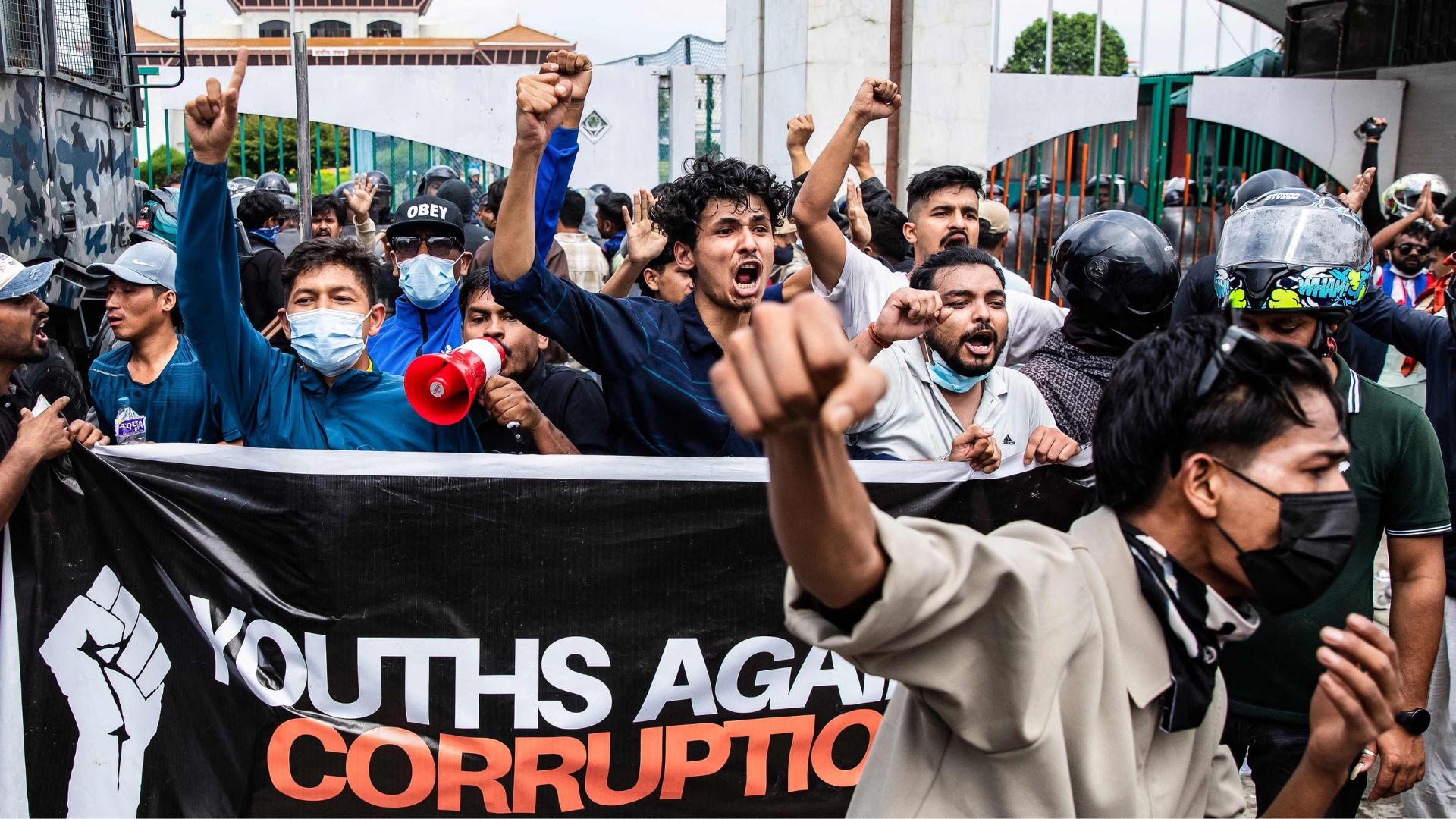
On September 8, 2025, the streets of Kathmandu, Pokhara, Biratnagar, and other cities swelled with tens of thousands of protesters. Many were young, some in school uniforms, others carrying placards that read “No impunity, no corruption.” What began as scattered calls for accountability quickly transformed into the largest civic mobilisation in a decade.
The spark was familiar—anger at entrenched corruption, misuse of public office, and a sense that the law applies only to the powerless. Within hours, chants of “enough is enough” echoed across the country. By nightfall, police crackdowns, clashes, and fires outside government buildings marked how deep the frustration had run.
The protests laid bare a bitter irony: Nepal has some of South Asia’s strongest anti-corruption laws and institutions on paper. Yet citizens see little justice in practice. The gap between promise and performance is not just a legal question—it is a crisis of institutional trust.
Deep Dive: Nepal’s anti-corruption puzzle
Nepal has no shortage of anti-corruption frameworks. The Prevention of Corruption Act, 2002, the Commission for the Investigation of Abuse of Authority (CIAA), the Auditor General’s Office, and the Special Court together create a comprehensive structure on paper.
But these institutions have repeatedly been accused of selective enforcement, party cadre appointments, and inconsistent verdicts. The September 8 protests, followed by targeted attacks on state institutions on September 9, underscored that citizens see corruption as less a legal loophole and more an institutional credibility crisis.
Legal promise vs institutional reality
The Prevention of Corruption Act criminalises giving and taking bribes, misuse of authority, and illicit enrichment; mandates punishment, fines, confiscation, and provides whistle-blower protection.
The CIAA, a constitutional body under Articles 238 and 239, can investigate and prosecute public office bearers for corruption. The Auditor General’s Office, a constitutional body under Articles 240 and 241, audits public expenditures and reports financial irregularities. Nepal is also a party to the UN Convention Against Corruption (UNCAC).
Yet, citizens see these frameworks as largely ineffective. The CIAA is often constrained by political interference, delays, or selective enforcement. Cases stagnate; high-profile personalities evade scrutiny. Auditor General reports highlight irregularities, but follow-through is weak. Institutional reshuffling—such as the shifting of investigative departments under different ministries—reinforces doubts about oversight independence.
Institutional moves that deepened mistrust
In February 2019, Prime Minister KP Sharma Oli transferred three investigative bodies—the Department of Revenue Investigation (DoRI), the Department of Money Laundering Investigation (DoMLI) from the Ministry of Finance, and the National Investigation Department (NID) from the Ministry of Home Affairs—to the Office of the Prime Minister and Council of Ministers.
Observers warned that this centralisation could politicise enforcement decisions. Subsequent administrations, including that of Sher Bahadur Deuba, faced pressure to reverse the arrangement. In August 2022, reports suggested the NID could move back under the Home Ministry.
Seeking to restore professional autonomy, Sushila Karki-led interim government transferred the departments back to respective ministries on September 25. But repeated restructuring leaves enforcement fragmented and undermines continuity in combating financial crimes.
Private sector oversight: Necessary correction or overreach?
In April 2023, the National Assembly passed a bill amending the 1991 CIAA Act to bring certain private sector institutions “connected with public interest” under the Commission’s jurisdiction. The bill aimed partly to meet UNCAC obligations, covering government-linked corporations, banks, financial institutions, academies, and councils.
Supporters argued it closed loopholes in collusion, procurement, and licensing. Critics, including FNCCI, warned it could chill investment; legal experts cautioned commercial disputes could be miscast as corruption. Former CIAA Chief Surya Nath Upadhyay stressed cases without public funds or officials should be excluded.
In March 2025, the National Assembly endorsed amendments made by the House of Representatives to the Prevention of Corruption Act, where the lower house removed the private sector clause. The consolidated act still empowers the CIAA, with court permission, to access telephone records and media details of corruption suspects. While enforcement tools expanded, systemic gaps in accountability for private actors remain unresolved.
Political appointment and the CIAA
CIAA appointments are politically sensitive. Commissioners are appointed by the President on the recommendation of the Constitutional Council, dominated by political leaders. This raises questions of autonomy and politicisation.
Lokman Singh Karki, who served as CIAA Chief (2013–2016), used CIAA as a political weapon, selectively targeting opponents while shielding allies. His removal followed a Supreme Court ruling in January 2017 that disqualified him on grounds of ineligibility, after an impeachment motion had already been registered in Parliament.
In April 2024, the CIAA filed charges in the Nepal Airlines wide-body aircraft corruption case, holding 32 individuals responsible for losses totalling NRs 1.47 billion. Prem Kumar Rai, who had chaired the airline board as Secretary of Civil Aviation when the purchase was approved, was notably not named as a defendant. In July 2025, the Special Court criticised this selective enforcement, stating it undermined the equal application of law and eroded public trust. Rai has been serving as CIAA Chief since February 2021.
Together, these examples show a powerful anti-corruption mandate compromised by political bargaining, selective targeting, and recurrent crises of legitimacy.
Special Court: Designed for speed, contested outcomes
The Special Court was meant to expedite corruption and economic crime cases, but it often fails to deliver impartial justice. In June 2024, the CIAA filed a corruption charge sheet against 12 people, alleging that collusion and irregularities in a contract to print excise stickers caused the state a loss of about Rs 386.7 million.
In November 2024, the Special Court delivered a split verdict: it convicted former executive director Bikal Paudel and former director Safal Shrestha, sentencing each to eight years in prison and imposing fines of more than Rs 380 million, but it acquitted former chief secretary Baikuntha Aryal and nine other senior officials.
The acquittal of Aryal, the seniormost bureaucrat in the case, drew intense criticism in the press and on social media, with accusations that the court had let the top bureaucratic official walk free while punishing subordinates. In August 2025, the CIAA appealed to the Supreme Court, arguing that the Special Court had ignored key audit documents showing Aryal’s authorisation of the flawed procurement.
This reinforces the perception that powerful actors escape accountability, fuelling public frustration, as well as action paralysis in bureaucracy.
Action paralysis and practical costs
Officials often hesitate to make bold decisions, fearing that enforcement agencies could interpret the execution of politically sensitive decisions as corruption. The law considers inaction—failure to make decisions per given authority—itself a corrupt act, but fear of reprisal has made civil servants risk-averse, slowing governance and infrastructure delivery.
Risk-averse civil servants delay projects to avoid investigation, leading to lengthy clearances, stalled contracts, and slower infrastructure delivery. While oversight is necessary, excessive focus on procedural technicalities without systemic accountability produces a trade-off: less corruption in theory, slower delivery in practice.
The crossroads
Nepal’s legislation and institutions are not the main deficit; politics, appointment procedures, and implementation choices hollow out their effectiveness. The September 8 protests underscore public impatience: rules on paper no longer equal rulefulness in practice.
Whether the CIAA, Special Court, financial supervisors, and political leaders can demonstrate coordinated, impartial, and transparent action will determine not only Nepal’s anti-corruption credibility but also whether public trust can be rebuilt.
And… what do you think?
Section 49(b) of the CIAA Act is meant to shield cabinet-level decisions from investigation. Yet in a rare move in June 2025, the CIAA filed a corruption case against former Prime Minister Madhav Kumar Nepal and others, alleging that he facilitated the illegal sale of government-exempt land to Patanjali Yogpeeth and Ayurveda Company Nepal through a cabinet decision during his tenure.
The move ignited a debate: Should cabinet decisions fall under CIAA’s jurisdiction? Critics argue that allowing such scrutiny risks undermining the separation of powers, while supporters say it could prevent abuse of executive authority.
Note: Farsight Impact produces Wednesdays under editorial guidelines and oversight of the_farsight.
Read More Stories

NEPSE falls nearly 75 points as market sentiment wavers
The stock market was unable to maintain the gains seen on Tuesday, slipping...
India has begun its long-delayed population census. Here's why it matters
India has begun the worlds largest national population count, which could reshape welfare...
The United Nations has called on Israel to repeal a law passed by...

Business + Finance + Economy + Tech + Environment + Nepal & South Asia + In-depth Analysis + News + Investigation + Research + Expert Opinion + Anatomy of Complex Issues.