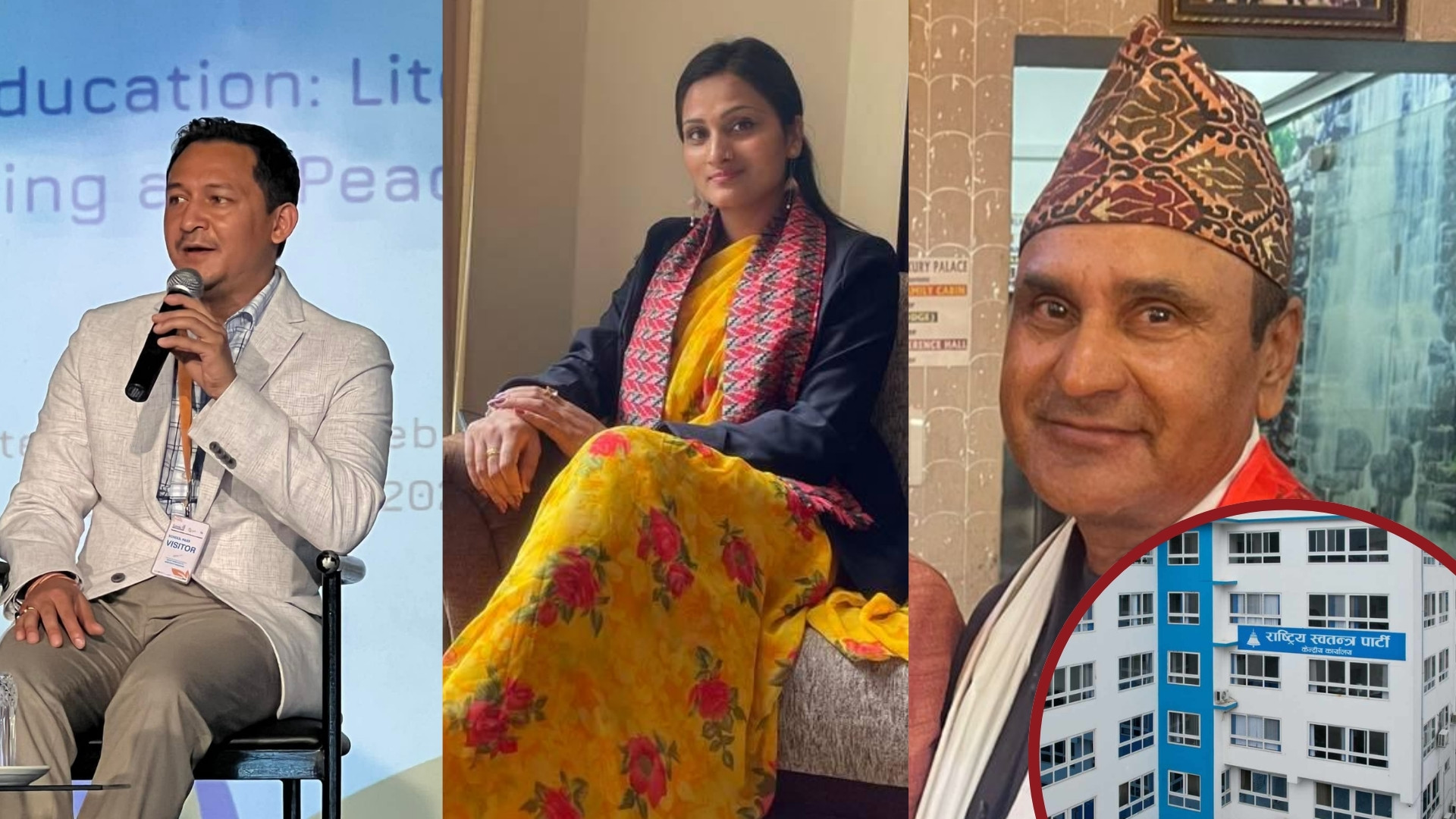
As election closes in, a wave of resignations has hit the Rastriya Swatantra Party (RSP). The most recent defection came from Bharat Prasad Parajuli, the founding president of RSP in Makwanpur, who has returned to the Congress Party, citing dissatisfaction with RSP’s leadership style.
Parajuli had contested the 2022 House of Representatives election from Makwanpur-2, finishing third with 12,059 votes, and considered a natural contender for a ticket this election cycle. However, the party overlooked him, selecting Prashant Upreti, who had made little contribution to party organisation, a move that understandably left Parajuli frustrated. Upreti secured candidacy from Balen Shah’s quota with whom he also worked in the Kathmandu Metropolitan.
Alongside Parajuli, five other RSP leaders, including Nirajan Bartola, the election operations coordinator for Makwanpur-2, and Rammani Neupane, have also joined Congress.
This exodus is part of a broader trend. On Sunday, Harilal Chaulagain from Dolakha, a member of its Bagmati Province Committee, also resigned from the party.
Chaulagain, who also served as a member of the party’s Federal Election Mobilisation Committee, had been actively involved in organisational expansion and election mobilisation efforts.
On Saturday, Dinesh Acharya, a member of RSP’s Central Election Operations Committee, resigned, following Mamata Sharma, founding president of RSP in Madhesh Province, who left last week. Sharma, who had recently served in the Central Women and Social Development Department, explained that corruption and mismanagement within the party made it morally impossible for her to stay.
Lack of recognition for dedicated and capable workers, violation of party rules and principles, and financial irregularities had undermined her political values, Mamata stated in her resignation released in her Facebook account.
Sharma sought to contest elections, ranking third in the Madhesi cluster during the proportional representation primary. When the party submitted the final list placing her seventh, internal opposition ensued. She subsequently withdrew from the proportional list to contest directly from Bara-2.
Sharma has since joined Congress after her resignation.
Dinesh Humagain, vice president of RSP Bagmati Province and a key figure in establishing the party in Kavre, also left last week. He had finished third with 10,573 votes from Kavre-2 in the last election.
Other notable departures include Pawan Chaudhary, head of RSP’s Bara organisational department and candidate from Bara-4 in 2022; Pranaya Shumsher Rana, candidate from Kathmandu-5; founding member Khem Kumari Bhurtel, candidate from Mahottari-4; and local leaders like Guptasen Thakuri, vice president of Susta Rural Municipality (Nawalparasi West), Ishwari Bist, founding mayor of Dhangadhi Sub-Metropolitan City, Surya Bahadur Gaire (Pyuthan), and Jit Bahadur Harijan (Bardghat).
Another party member who is reportedly contemplating to quit the party is Suman Bikram Pandey, who was also sidelined during ticket distribution in Nuwakot-2. Suman, a tourism entrepreneur, is credited with expanding the party’s base in Nuwakot. In the last election, he secured nearly 16,500 votes, finishing behind the Nepali Congress candidate Arjun Nar Singh KC, a joint candidate of the then five-party ruling alliance.
Those leaving the party cite opaque and financially manipulated ticket distribution as the main reason. Pranaya left the Rastriya Swatantra Party, citing concerns that the leadership was compromising the party’s transparency and sidelining democratic processes within its ranks. He had hoped to contest the March 5 election from Kathmandu-5, where Sasmit Pokharel is now contesting the election. In line with the party’s stated commitment to holding primaries, he claimed to have paid the required NRs 25,000 fee to participate in the internal selection process.
Despite assurances of a primary election, the party handpicked another candidate sans the promised primary. Pranaya maintains that not refunding the amount constitutes fraud and argued that the legitimacy of the party’s direct nominees could turn void if challenged in the Supreme Court, as the RSP’s statute does not allow direct candidacy without a primary election.
Two years ago, founding general secretary Dr Mukul Dhakal was disciplined for questioning President Rabi Lamichhane’s leadership style and the party’s procedures. About six months ago, Sumana Shrestha, a former member of the parliament from the RSP, resigned alleging the party was protecting Lamichhane against fraud charges. Santosh Pariyar, also a former parliamentarian, who served as a secretariat member, and the party’s chief whip in the now-dissolved House of Representatives, resigned in mid-November.
Lately, RSP faced intense criticism after it submitted its candidates list of Proportional Representation at the Election Commission. A deeply troubling list emerged, which appeared like a PR lottery for candidates close to the party members. The list included celebrities, business figures, relatives of party leaders, and internet influencers, reeking of favoritism, nepotism and exchanges of favors. Notably, the list violated the spirit of the electoral system, a system the RSP had positioned itself against, mirroring the same favoritism and manipulation long associated with the established mainstream parties.
Following the criticism, several candidates withdrew their names. But candidates like industrialist Vidhushi Rana, former Miss Nepal and entrepreneur Anushka Shrestha and former CNN correspondent Sumnima Udas continued their candidacy despite having little contribution in the party while possessing the capacity to contest elections independently. Their inclusion, a party affiliate said to the_farsight, has raised questions about the party principles, particularly after the leadership sidelined Mamata Sharma. The current wave of resignation is a serious loss to the party, he shared, which will impact the party later, if not immediately in the current elections. Many are also not satisfied with the fact that the party charged NRs 50,000 to interested individuals seeking to be on its PR list, he further added.
The party additionally had to manage direct candidacies following the entry of Balen Shah into the party under whom candidates like KP Khanal, Ashika Tamang, Sudan Gurung, Sagar Dhakal, Bablu Gupta secured tickets to contest the election. Their inclusion has raised discontent among long-serving party cadres. Balen Shah himself emerged as a senior leader in the party, which many observers see has little organisational base beyond its strategic political alliance for the national elections.
Read More Stories

NEPSE falls nearly 75 points as market sentiment wavers
The stock market was unable to maintain the gains seen on Tuesday, slipping...
India has begun its long-delayed population census. Here's why it matters
India has begun the worlds largest national population count, which could reshape welfare...
The United Nations has called on Israel to repeal a law passed by...


Business + Finance + Economy + Tech + Environment + Nepal & South Asia + In-depth Analysis + News + Investigation + Research + Expert Opinion + Anatomy of Complex Issues.