House of Representatives 2026 | Traditional Political Establishment | New Political Order
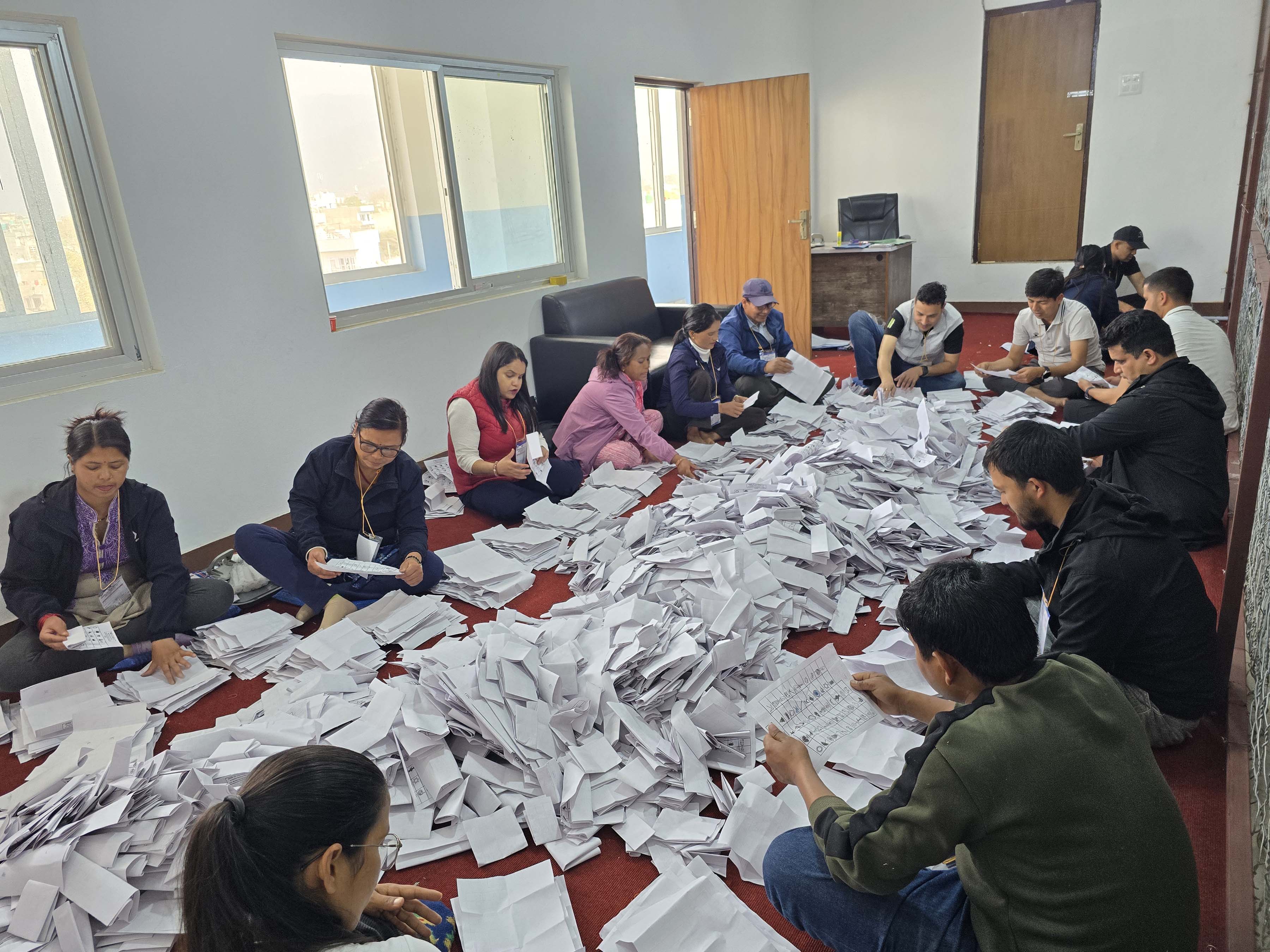
Senior leaders of Nepal’s major political parties, including party presidents, general secretaries and several office bearers, have suffered sweeping defeats in the latest House of Representatives election in what appears to be one of the biggest electoral setbacks for the country’s traditional political leadership.
Only a handful of prominent leaders retained their seats, most notably former prime minister and Nepali Communist Party convener Pushpa Kamal Dahal and Rabi Lamichhane, president of the Rastriya Swatantra Party (RSP).
The results of Thursday’s election signal a dramatic shift in the country’s political landscape. Voters in many constituencies rejected long-established party leaders and turned toward newer political forces, particularly the RSP.
Major upsets
Dahal secured his return to parliament from Rukum East after switching from his previous constituency of Gorkha-2. He won 10,240 votes, defeating Lilamani Gautam of the CPN-UML, who received 3,462 votes—a margin of 6,778 votes.
However, Dahal’s party co-convener and former prime minister Madhav Kumar Nepal suffered a major setback in Rautahat-1, finishing fourth in the race, with 7,669 votes. RSP candidate Rajesh Kumar Chaudhary won the seat with 28,946 votes.
Lamichhane secured another victory in Chitwan-2, winning 54,402 votes and defeating Nepali Congress candidate Meena Kharel, who received 14,564 votes. The margin of victory was nearly 40,000 votes.
One of the most dramatic defeats came in Jhapa-5. Former prime minister and UML president KP Sharma Oli lost to RSP senior leader Balendra Shah. Shah secured 68,348 votes, while Oli managed 18,734 votes, trailing by nearly 50,000 votes.
Oli had previously won the same constituency in the 2022 elections with 52,319 votes, defeating Nepali Congress candidate Khagendra Adhikari, who had secured 23,743 votes. Although Oli recently retained his leadership for a third term during the party’s 11th general convention, voters in his constituency have effectively halted his parliamentary journey.
Similarly, Congress president Gagan Thapa, who was projected as the party’s prime ministerial candidate, also faced defeat. Leaving his traditional constituency of Kathmandu-4, Thapa contested from Sarlahi-4 but lost to RSP candidate Amaresh Kumar Singh, who secured 35,688 votes, while Thapa received 22,831 votes.
In Kathmandu-3, Kulman Ghising, president of the Ujyalo Nepal Party, was defeated by RSP candidate Rajunath Pandey. Pandey received 18,757 votes, while Ghising secured 11,171 votes.
Meanwhile, Harka Raj Rai, president of the Shram Sanskriti Party, secured a parliamentary seat from Sunsari-1 with 35,741 votes, defeating RSP candidate Goma Tamang, who received 27,249 votes.
In Jhapa-3, Rajendra Prasad Lingden, president of the Rastriya Prajatantra Party, was defeated by RSP candidate Prakash Pathak. Pathak secured 38,674 votes, while Lingden received 17,294 votes.
Leaders of Madhes-based parties also faced setbacks. Upendra Yadav, president of the Janata Samajwadi Party Nepal, lost in Saptari-3 to RSP candidate Amar Kant Chaudhary. Chaudhary received 32,875 votes, while Yadav secured 15,239 votes.
Similarly, Janamat Party president Chandra Kant Raut, who rose to prominence in the 2022 elections alongside the RSP, finished third in Saptari-2 with 9,880 votes. RSP candidate Ramji Yadav won the seat with 28,404 votes.
Party leadership wiped out in many constituencies
The electoral setbacks extended deep into the organisational leadership of the country’s two oldest parties, the Congress and the UML.
Within the Congress, both general secretaries lost their seats.
Pradeep Poudel lost to RSP candidate Sasmit Pokharel in Kathmandu-5, with Pokharel securing 30,737 votes and Poudel trailing at 9,159 votes. Guru Raj Ghimire lost to RSP candidate Santosh Rajbanshi in Morang-4. Rajbanshi received 40,833 votes while Ghimire managed to secure 12,818 votes.
Five out of eight deputy general secretaries contested the election. All of them failed to win their constituencies.
Read also: Nepal election records lowest turnout and local boycotts
Farmullah Mansur lost to RSP candidate Arbind Sah in Bara-3, where the latter received 40,697 votes, while the former trailed at 10,052 votes. In Dolpa, Karna Bahadur Budha finished third with 2,947 votes, while the NCP candidate Dhan Bahadur Budha secured the seat with 6,802 votes.
Similarly, Yogendra Chaudhary in Dang-1 lost to RSP candidate Devraj Pathak. Pathak secured 42,602 votes, while Chaudhary received 15,280 votes. Udaya Shumsher Rana was defeated by RSP candidate Buddha Ratna Maharjan in Lalitpur-1, with the latter securing 23,373 votes and the former trailing at 13,520 votes.
In Bajhang, Prakash Rasaili Snehi lost to UML candidate Ain Bahadur Mahar by a margin of 2,239 votes. Mahar secured 18,543 votes, while Snehi received 16,304 votes.
The UML also suffered a series of defeats among its senior officeholders. Party vice-presidents Prithvi Subba Gurung, Bishnu Prasad Poudel, and Gokarna Raj Bista lost their races in Lamjung, Rupandehi-2 and Gulmi-2, respectively. All three lost to RSP candidates.
Gurung, who secured 16,876 votes, lost to Dharma Raj KC, who secured 33,898 votes. Poudel, with 12,861 votes, faced a heavy defeat at the hands of Sulabh Kharel, who received 56,550 votes. Bista lost to Gobinda Panthi by a narrow margin of 561 votes, with Panthi receiving 16,967 votes.
UML general secretary Shankar Pokharel also lost in Dang-2. RSP candidate Bipin Kumar Acharya, securing 43,559 votes, defeated Pokharel, who received 15,287 votes.
Deputy general secretaries Raghubir Mahaseth, with 11,529 votes, and Lekhraj Bhatta, with 9,444 votes, finished third in Dhanusha-4 and Kailali-4, respectively. RSP candidates Raj Kishor Mahato with 48,270 votes and Khem Raj Koirala with 28,556 votes won the constituencies, respectively.
Among party secretaries, Mahesh Basnet, Sherdhan Rai, Rajan Bhattarai, and Bhanubhakta Dhakal also failed to secure parliamentary seats. In Bhaktapur-2, Basnet with 10,996 votes lost to RSP candidate Rajib Khatri, who received 42,334 votes.
Rai, who received 14,750 votes, was defeated by Shram Sanskriti candidate Dhruba Raj Rai, who received 16,663 votes in Bhojpur. In Kathmandu-4, Bhattarai finished third with 5,633 votes, while RSP candidate Pukar Bam registered victory with 29,142 votes.
In Tehrathum, Dhakal lost to Congress candidate Santosh Subba, who secured 11,561 votes, by a margin of 879.
What the results suggest
The scale of defeats among senior leaders suggests a deep erosion of voter confidence in the country’s traditional political leadership.
The results also indicate growing support for newer political actors and alternative parties, particularly the RSP, which appears to have capitalised on public frustration with established parties.
While most senior leaders, including former PM Oli, have humbly accepted the results and wished the winners in their constituencies for a fruitful term, Janamat Party president Raut reacts differently. In a social media post on Sunday, he said the outcome should not be interpreted as a failure of individual leaders or parties but rather as the result of an extraordinary political moment.
“Across the country, the results show a similar pattern. The current disappointing outcome is the result of special circumstances, not the failure of any particular party, leader or candidate,” Raut wrote.
He noted that even long-established parties with large organisational structures and trained cadres had suffered similar setbacks in the election.
“Just wait a year or two. Everything will become clear, and the people will return to us,” Raut said. “Storms do not last forever. It is principles and agendas that keep political movements alive in society.”
If the current trend holds, the next House of Representatives is likely to see weaker representation of traditional party leadership and stronger influence of emerging political forces. This could reshape coalition dynamics and legislative priorities in the coming years.
With RSP already winning 119 FPTP seats and 2.24 million of 4.53 million counted PR votes as of Sunday, 5 PM, the 2026 House will likely have a much weaker opposition, while RSP will enjoy adequate space to execute its ‘citizen contract’.
The election result has also shown that the current election system provides enough space for parties to secure even two-third majority, contrary to what many critics argued against.
Read More Stories

NEPSE falls nearly 75 points as market sentiment wavers
The stock market was unable to maintain the gains seen on Tuesday, slipping...

India has begun its long-delayed population census. Here's why it matters
India has begun the worlds largest national population count, which could reshape welfare...
The United Nations has called on Israel to repeal a law passed by...


Business + Finance + Economy + Tech + Environment + Nepal & South Asia + In-depth Analysis + News + Investigation + Research + Expert Opinion + Anatomy of Complex Issues.