Tourist arrival 2025 | Visit Nepal decade | Special Tourism Year | Politcal & Climate shocks
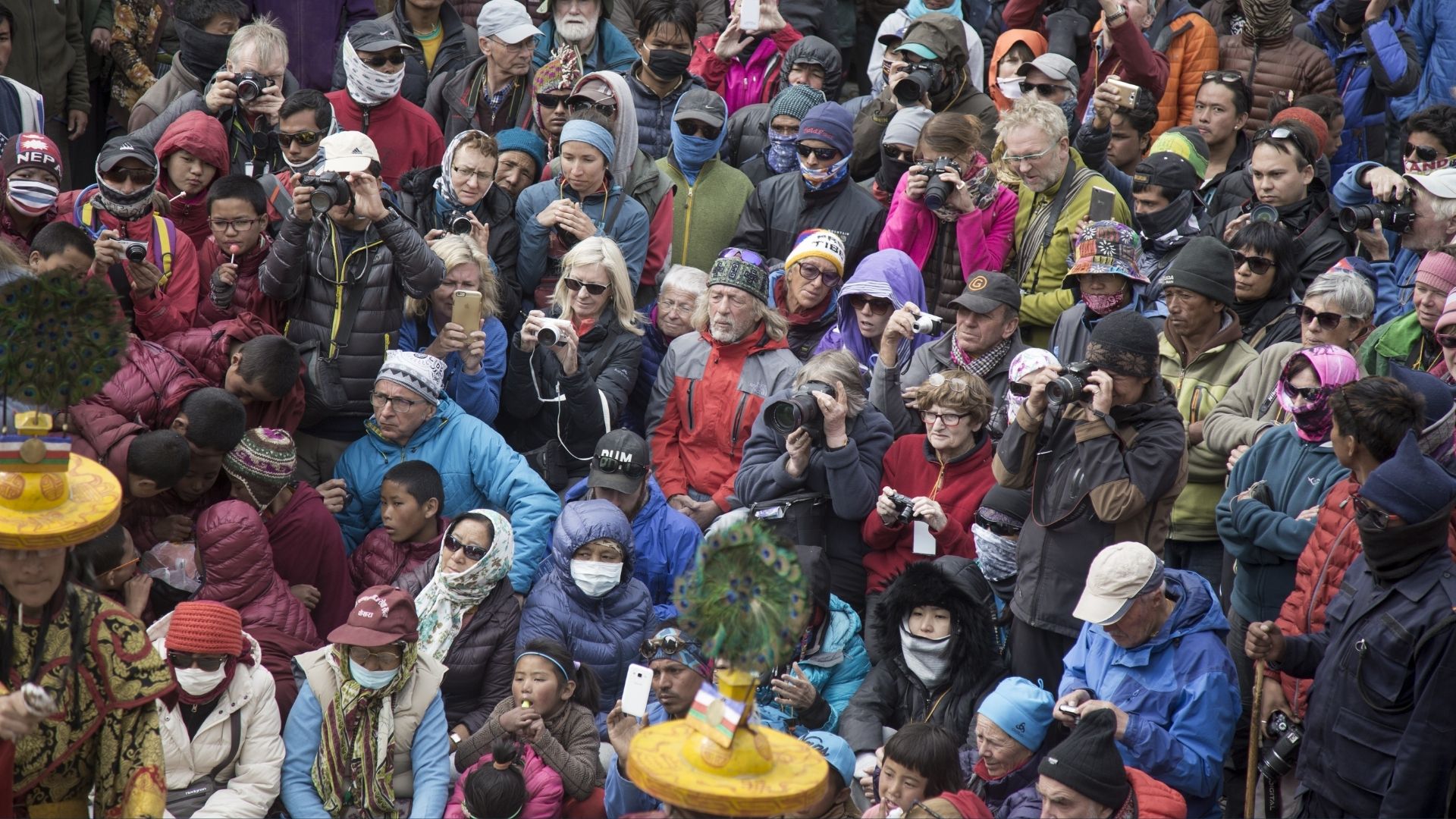
Tourist arrivals rose by just 0.95% in 2025, despite the government branding the year as a “Special Tourism Year.” This dismal performance came amid political unrest that witnessed severe attacks on its hospitality sector.
Nepal welcomed a total of 1.16 million tourists in the country in 2025, which is still 3% short of pre-pandemic level, exposing how fragile that recovery remains.
Monthly tourist arrivals in 2024 and 2025
That vulnerability became most visible in September, just weeks before the peak autumn season. Tourist arrivals fell to 78,711, an 18.26% year-on-year decline, following youth-led protests that escalated into nationwide unrest.
The unrest spilt directly into the tourism economy. Several high-profile hotels in Kathmandu and Pokhara were vandalised and forced to suspend operations. Key attractions, including the Chandragiri hill cable car and the Sunrise Convention Centre in Godawari, also suffered extensive damage during the unrest.
Although arrivals rebounded in October to 128,443, surpassing the same month last year, the disruption raised concerns about sectoral resilience and investor confidence.
Between mid-January and mid-December 2025, tourism-related projects secured foreign investment commitments worth NRs 155.26 billion. Historically, only a portion of such pledges translates into actual inflows, and recent instability is expected to delay decisions on large hospitality projects.
Political unrest was not the only shock. Heavy rainfall in early October triggered floods and landslides across eastern and southern Nepal, blocking highways, grounding domestic flights, and disrupting international travel.
The events highlighted the tourism sector’s growing exposure to climate-related risks, particularly during peak travel periods when infrastructure and logistics are under the greatest strain.
India leads arrivals, China recovery lags
India remained Nepal’s largest source market, contributing 238,438 visitors in 2025. The United States and China followed, with the three countries together accounting for nearly 43% of total arrivals.
Tourism source countries (2024-2025)
While overall market composition remained broadly stable, China’s recovery lagged behind government targets. Reviving Chinese tourism was a central focus of 2025, which coincided with the 70th anniversary of Nepal–China diplomatic relations.
Before the pandemic, China was Nepal’s second-largest source market, sending 169,543 visitors in 2019, or 14.2% of total arrivals. Numbers collapsed during the pandemic and, despite a gradual rebound, reached only 86,800 in 2025, far below the 300,000 target set for the year.
To support the market, Nepal Airlines launched a direct flight to Guangzhou on October 16, restoring long-haul connectivity. The inaugural flight carried 198 passengers, including 29 Chinese nationals, but China’s overall share of arrivals remained well below pre-pandemic levels.
Policy shifts amid uneven recovery
The uneven rebound unfolded alongside several policy changes. In August, the government introduced the Tourism Policy 2025, replacing the 2008 framework, with an emphasis on sustainability, digital promotion, entrepreneurship, and regional inclusion.
At Tribhuvan International Airport, expansion work continued under the $198 million SASEC Airport Capacity Enhancement Project, financed by the Asian Development Bank and the government. Construction required daily 10-hour closures until March 2025, affecting flight schedules even as visitor numbers recovered.
The mountaineering sector also saw major changes. For the first time since 2015, the government raised climbing permit fees for Everest and other peaks, increasing the spring Everest permit to $15,000 per climber from $11,000. Similarly, the fees for the autumn season were raised to $7,500 from $5,500, and to $3,750 from $2,750 for winter and monsoon.
At the same time, permit fees were waived for 97 peaks in Karnali and Sudurpaschim, a move aimed at spreading tourism beyond established destinations.
Environmental concerns were also pushed higher on the agenda with the launch of the Everest Cleaning Action Plan (2025–2029), which introduces stricter waste management rules, monitoring technology, and a polluter-pays approach in the Himalayas.
The Nepal government also has lifted a long-standing ban on high-denomination Indian currency, allowing Indian travellers to carry INR 200 to INR 500 notes up to a specified limit. But this was introduced in late December.
Eyes on 2026 as targets remain ambitious
Looking ahead, the Nepal Tourism Board (NTB) has designated 2026 as Nepal–ASEAN Tourism Year, building on a steady rise in visitors from the region. In 2025, Nepal received 95,301 tourists from ASEAN countries, an 8.4% increase from the previous year, with ASEAN markets accounting for nearly 9% of total international arrivals.
The longer-term roadmap for the sector remains the Visit Nepal Decade (2023–2033), a ten-year strategy aimed at revitalising tourism in the post-pandemic period. The plan targets more than 3.5 million international visitors, seeks to raise average daily tourist spending to $125, generate one million direct jobs in tourism, and increase the sector’s contribution to 10% of national GDP.
Alongside this decade-long vision, Nepal’s 16th Plan has set interim benchmarks for 2028/29, including over 2.5 million international arrivals, an average stay of 15 days, daily spending of $85 per visitor, and tourism’s share of GDP reaching 7%.
Early performance in 2025 suggests progress toward recovery, but policymakers acknowledge that meeting these targets will require sustained policy support, aggressive marketing, and continued investment in infrastructure.
NTB budget allocation (FY 2025/26) (in NRs million)
To advance these goals, NTB has allocated NRs 1.59 billion for FY 2025/26, with around 70% of the budget earmarked for international promotion. Planned initiatives include participation in international trade fairs, sales missions, digital marketing campaigns, cinema tourism, diaspora-focused programmes, and the opening of a new NTB office in India.
Several of these initiatives are already underway. Nepal has partnered with TikTok for digital promotion, positioned itself as a potential hub for Meetings, Incentives, Conferences, and Exhibitions (MICE) tourism, and participated in the Pacific Asia Travel Association (PATA) Travel Mart in Thailand as part of its outreach to regional and global markets.
Read More Stories

NEPSE falls nearly 75 points as market sentiment wavers
The stock market was unable to maintain the gains seen on Tuesday, slipping...

India has begun its long-delayed population census. Here's why it matters
India has begun the worlds largest national population count, which could reshape welfare...

The United Nations has called on Israel to repeal a law passed by...


Business + Finance + Economy + Tech + Environment + Nepal & South Asia + In-depth Analysis + News + Investigation + Research + Expert Opinion + Anatomy of Complex Issues.