Political Weekly
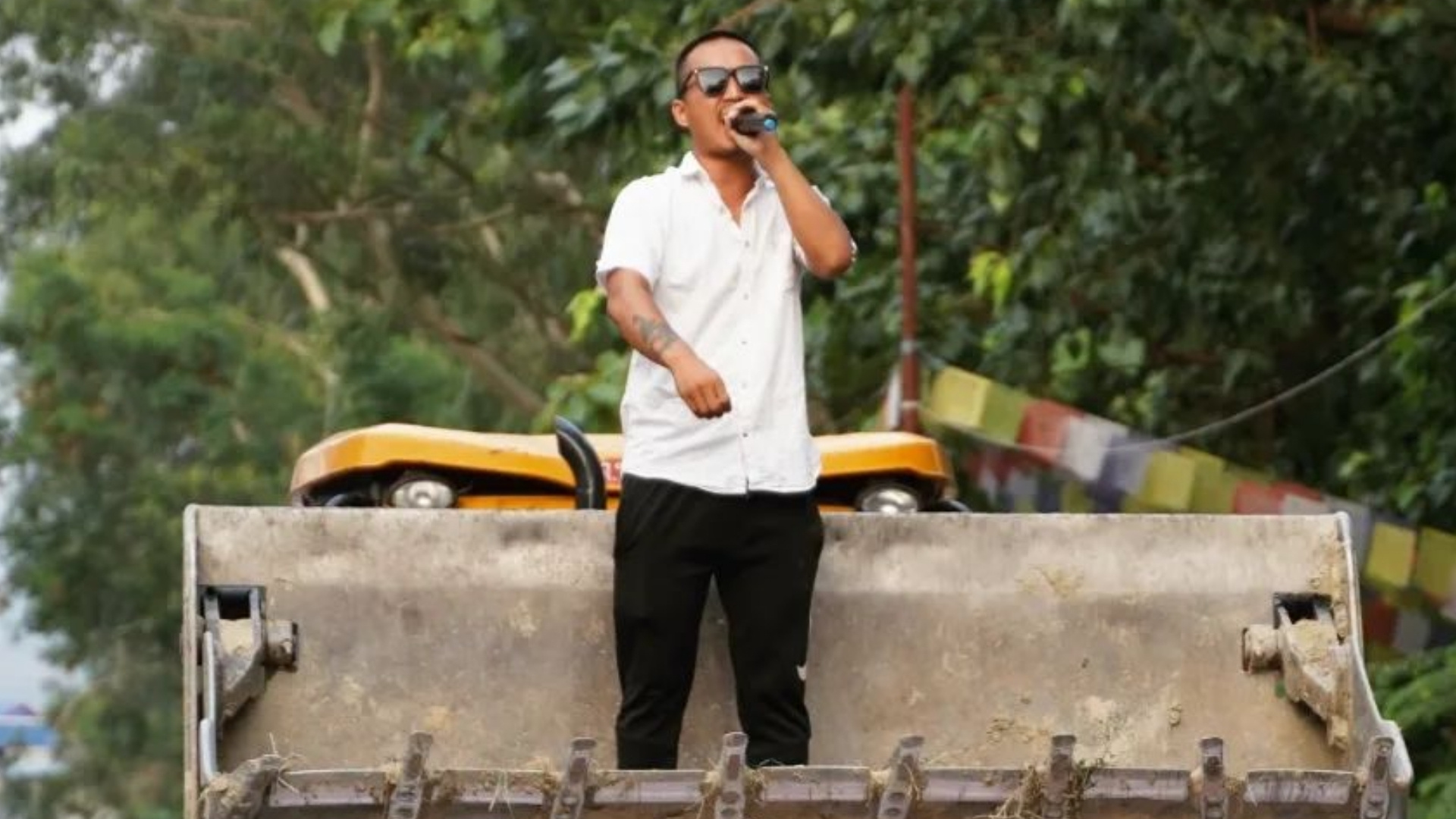
In the chaos that immediately followed September protests, marked by a power vacuum, and a desperate search for a quick fix amid nation-wide shutdown emerged Sudan Gurung from relative obscurity.
Until the early hours of September 8, Gurung was just a volunteer distributing drinking water to the anti-corruption protestors in Maitighar. In the next couple of hours, he stood out as one of the demonstrators. Next, he alongside several protesters groups, all eager to take credit for toppling the government but little accountability for the violence and destruction that unfolded, wrestled for leadership to the country's new political course.
Gurung proved the quickest to entrench himself into negotiations for the next Prime Minister. Some considered him as a de facto leader. Others, as a political hijacker. Quietly every other aspirant yielded to his takeover.
Those groups remain fragmented and conflicted to this day, almost each still vowing to solve the country’s problems in a fashion that they themselves once opposed. Sudan meanwhile stands at forefront, but wants to do that at his own whim.
As negotiations progressed, Gurung appeared to believe he could grab the country’s top executive position. He nearly did everything right with a war-room like office setup but ultimately had to reconcile for Sushila Karki after the process devolved into a discord poll. Even so, he ensured he remained the ultimate behind-the-scenes player.
Beyond threatening the country’s president during negotiation, at a time when public anger and confusion was at peak, Sudan maintained a firm bottomline: scrap the House of Parliament, a stance that many “Gen-Z” protestors, including him blindfoldedly held following instructions from Kathmandu’s Mayor Balen Shah. PM Karki, previously the country’s Chief Justice, agreed to the condition before taking charge and dissolved the parliament immediately after taking the oath.
For all his theatrics, then and since, Gurung’s virality continued to rise. Validation poured in through extensive media exposure, including international coverage from Al Jazeera, where he articulated his ambitions. “I am ready to run for the office if people would choose me,” he said of the upcoming election, while also adding that he wouldn’t accept election results if the old guard won it.
In the interview taken almost three weeks after the protest, he appeared in the same Hami Nepal uniform that he wore during the protest. Pointing at it, he said, “it still bears stains of blood of youths killed in the protest.” Gurung has continued the ritual since, using the blood and bodies of the deceased as an emotional appeal. At the same time, his aggression and volatility during his negotiations and media encounters are accompanied by glaring contradictions, and a conspicuous sense of pride in the influence he wields.
After publicly agreeing for Sushila Karki as the interim prime minister, it took Gurung only two days to demand Karki’s resignation. A few days later, his attendance at a reception marking Constitution Day at the premises of the burnt Sheetal Niwas, the President’s residence, sparked a wave of criticism.
In his defence, he explained that he attended the reception after learning that political leaders would be present, saying he didn't want them to hold their heads high. He further claimed that he did not sit at the same level as them, instead stayed in the rain, and did not drink any tea or water that he considered impure. Gurung invoked similar appeal before when he described his attendance at the president’s office for talks.
Sudan would later go on to assert that he recalibrated his stance on scrapping the constitution at the time of crisis, which he could have done but chose not to, to ensure that the state exists and to prevent potential foreign interventions. It reflected the extent of power Gurung believed he wielded at the time.
That was not all. Gurung has made threatening calls to authorities addressing himself with honorific ‘ji’ and others in a dismissive tone. He would instruct public officials to tell everyone that ‘Sudan ji’ is coming for them. Additionally, he attended a Home Ministry-related meeting as an “expert”, a step many viewed as an overreach. By then, many protestors had begun their own political fronts, while largely remaining silent about Gurung’s conduct.
Gurung’s high showed little signs of waning. He issued a public ultimatum for resignation to the Home Minister Om Prakash Aryal, who mediated during the early negotiations, just after one and a half months since Aryal assumed the position. It is crystal clear Aryal’s ascend as home minister hasn’t sat well with Gurung. The real reason behind his animosity remains unknown. Somehow, he feels betrayed and is adamant that it was Aryal’s advice that derailed their demands.
Sudan however fails to acknowledge they had no specific demands to begin with, or slightest of clarity in what they truly wanted, and that they themselves must have known better. Perhaps the discontent stems from the selection of ministers where he couldn’t assert his influence.
A leaked audio recording later revealed that Gurung was actively involved in blocking Rakhsya Bam’s name while the new government was seeking representatives on behalf of the protestors. Yet he argues he has no voice on such matters. For everything else, he places the blame squarely on Aryal. To this day, he continues to publicly attack Aryal, labelling him as incompetent, without elaborating where he went wrong.
Statements coming from him instead clearly reveal a striking ignorance of and indifference to the meaning and principles of laws, political processes, institutions, and the constitution. His arguments and demands are equally devoid of rationality, appearing to stem from his domineering mindset.
One is that, for him to allow the upcoming elections, Rabi Lamichhane, Mayor Balen and Kulman Ghising must join hands, a condition that is neither in the government’s control nor that of any other authority or in any one of those individuals alone. Alternatively, as a last resort, he is ready to scrap the current government and reinstate the lower house and form a new government, on the condition that all that equation guarantees 70% representation to “them” at both the law making houses.
His admirers who resonate with him for his explicit expression of distaste towards political leaders argue that his way is the ultimate way to teach lessons to political leaders.
In another incident, Gurung trespassed CPN(UML) politician Kishan Shrestha’s under-repair residence in Jitpur, during his absence. Shrestha’s residence was set on fire during the protest. Sudan allegedly threatened the workers there over a dispute involving local Gen-Z youths, a matter that demanded legal channels rather than Gurung’s intervention.
Beyond his hooligan-styled acts, his politics rests on projecting himself as a messiah. Give any opportunity and he invokes those who died in September, repeatedly referring to them as his younger brothers and sisters, using their suffering in shielding his irrational demands with an emotional appeal.
As he speaks, he spews more nonsense. Most recently, he responded to former Prime Minister Oli, saying he wasn’t “wearing bangles” in response to Oli’s comments after winning the UML convention. Oli had stated that the country should be brought to standstill if the UML leadership is to be touched.
This string of unchecked rhetoric since September has amplified his influence. Yet the PM validated Gurung as her “elder son”, pampering a figure keen on micromanaging her. The PM bears responsibility here, to take clear stances on constitutional and administrative boundaries rather than appeasing him or any other protestors. Meanwhile, Gurung’s indulgence is in full display in boastful claims such as “no one can stop him from entering Singha Durbar”, “a government we made possible” and “we would not allow elections”. Other protesters are gradually realising the danger, reflecting that the PM should rein in her “elder son.” But their calls are not strong enough.
Gurung is now one of the key figures behind the recent Rabi-Balen-Kulman alliance, who joined hands to merge into the Rastriya Swatantra Party (RSP) with an agreement that Balen would be the party’s next prime minister candidate. That candidate already has Gurung’s back now, in recognition for his role in bringing the trio together. For Gurung, it can mean a significant validation for his future misadventures.
Before reaching this milestone, Gurung performed his ritual once again. On his social media account, he posted a picture of the final rites of a protestor and swore on the cold feet of the deceased that he would fight for an alternative to this country, without seeking any personal benefit.
So far, Gurung hasn’t formally joined the party, but his political ambitions are no longer a secret. His journey is yet to unfold but Gurung is already on his next assignment having announced a national unification campaign, under which he has launched The Civilian Force, an app that he claims is designed to address citizens' problems.
The app is a grievance handling platform, where citizens could register their problems with artificial intelligence developing solutions for them in accordance with the prevailing laws. In Sudan’s own words, a “shadow government” in Kathmandu will then take the matter to the center.
The problem with this is that the country has already devolved its powers and responsibilities for the same. It just hasn’t proved fully effective yet. However, Sudhan and his team will get a job: to continue exercising as a shadow intermediary to power centers, a role where he has excelled so far.
Read More Stories

NEPSE falls nearly 75 points as market sentiment wavers
The stock market was unable to maintain the gains seen on Tuesday, slipping...
India has begun its long-delayed population census. Here's why it matters
India has begun the worlds largest national population count, which could reshape welfare...
The United Nations has called on Israel to repeal a law passed by...


Business + Finance + Economy + Tech + Environment + Nepal & South Asia + In-depth Analysis + News + Investigation + Research + Expert Opinion + Anatomy of Complex Issues.