Kathmandu Traffic Crisis | Urban Mobility | Citizen Responsibility & Urban Governance
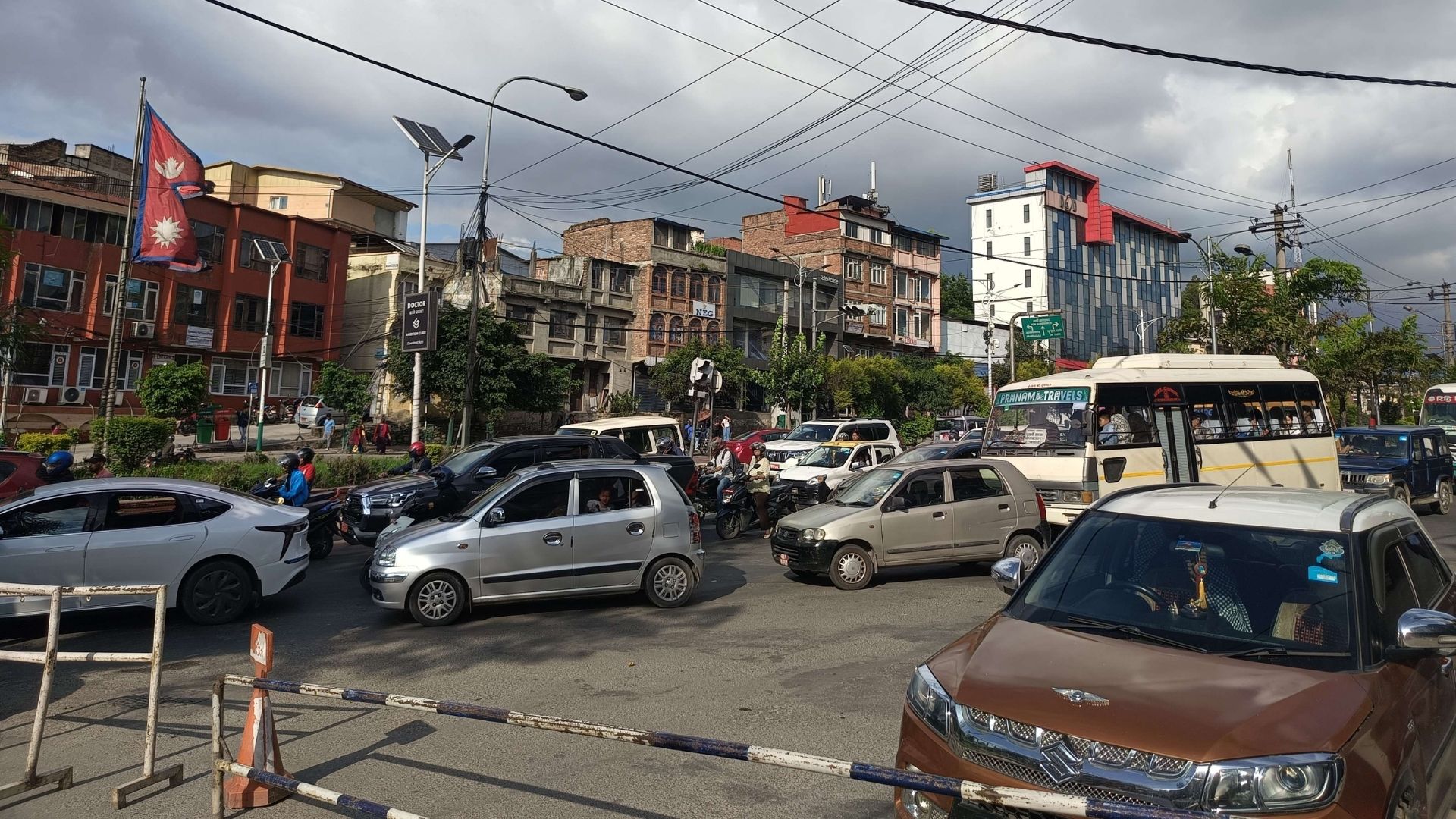
“Time is money,” they say. But in Kathmandu, time burns in traffic. Each day, commuters lose over 9,000 hours stuck on the roads. With 1.8 million vehicles choking narrow streets, the city bleeds NRs 116 billion a year in wasted fuel and lost productivity. In the Great Kathmandu Jam, the clock doesn’t tick; it stalls.
The problem is so persistent, it has somehow suppressed the frustration. Spend enough time here, and the daily traffic begins to feel less like a crisis, more like a comedy of errors. An absurd orchestra of honking horns, crawling buses, and drivers trading silent glances that say, “Here we go again”. It’s no longer rage. Just tired eyes and quiet resignation.
As the evening light starts to fade, an invisible director yells “Action!”, and the entire city lunges into the streets. It’s not rush hour, it’s a ritual. Commuters pour out—all swept into a mass exodus driven by some unspoken urgency. Everyone’s in a hurry, yet no one knows why, or when they’ll get there.
On top of this great drama, the ever-present pollution has made the air so dense one can even chew it. In retrospect, it is only fair that everyone is in a rush and traffic is simply beyond manageable. Who wants to marinate in these exhaust fumes post-hard day work? A recent report suggests an average loss of three years in life span due to pollution. Of course, existing in such toxicity with a feeble mask is beyond consideration for many.
Somewhere between Jamal and Jawalakhel, the jam turns oddly intimate. A rider might lock eyes with a stranger on the next bike, exchange a nod, maybe even a tired joke. For a moment, they become comrades in this engine-powered still life. If the standstill drags on long enough, a Momo discount code might even be shared.
And somewhere in all this, blinking unnoticed like a prop from a forgotten play, stands the traffic light—a sophisticated signalling device built to manage traffic, oddly out of place in the capital. As of April 4, 2025, there are only 69 traffic lights installed at various intersections of the Kathmandu Valley. Many of these are either non-functional or yet to be fully automated. Due to the absence of consistently operational, automated traffic signals, traffic management in the Capital still depends heavily on manual signalling. So far, around NRs 35.6 million has been invested in traffic light installations across the Valley.
A traffic jam is perhaps the only time when the presence of a traffic police officer is quietly appreciated. They try their best—raising their arms signal like a human traffic light—and for a moment, every eye follows their gestures, because those hands hold the authority that the broken signal lacks. But that’s only at major intersections.
What about the gallis, those narrow inner roads, where the mess spirals, and no traffic police is anywhere in sight?
That’s where our real unsung hero steps in. Enter the middle-aged dai, who climbs off his bike and lifts his arms like he’s conducting a citywide orchestra. No badge. No whistle. No official title. Just a man, tired of waiting, trying to restore some order. It’s funny, yes, but also quietly heroic. Which ironically screams “If you want something done, it is up to you.” On a personal note, those people should get some recognition, a round of applause, perhaps.
Based on a 2023 study across urban intersections, each person loses roughly 120 hours annually in unproductive time due to congestion. That’s equivalent to 15 working days wasted per commuter. This is where an average daily commuter has this guilt-ridden thought, wishing for an ambulance. A morally questionable hope, but an honest one: at least its presence might finally make the jam move. A high-speed loophole through a city built on shortcuts and lane cuts.
Humour aside, there’s a quieter truth: Kathmandu’s traffic is a mirror. It doesn’t just show broken roads; it reflects how we think and behave as a society.
We say we want order, but often act in ways that create chaos. People blame the government, yet run red lights. They demand better systems, but try to cheat them whenever possible. We want rules, but still admire the rebel who cuts through traffic for five minutes and somehow makes it work. Irony rides a pillion on every bike.
Perhaps, the answer is not just building more flyovers, adding cameras, or installing smart traffic systems, though all of that is important. Maybe it also starts with small, everyday choices: stopping when we’re supposed to, letting ambulances pass, respecting footpaths, lanes and zebra crossings, and not honking like it will solve everything.
Because somewhere between the smoke and the standstill, the jokes and the frustration, the city is quietly asking us: Is Kathmandu stuck because the roads are broken or deep down we’re all waiting for someone else to do what’s also quietly our responsibility?
Read More Stories

NEPSE falls nearly 75 points as market sentiment wavers
The stock market was unable to maintain the gains seen on Tuesday, slipping...
India has begun its long-delayed population census. Here's why it matters
India has begun the worlds largest national population count, which could reshape welfare...
The United Nations has called on Israel to repeal a law passed by...


Business + Finance + Economy + Tech + Environment + Nepal & South Asia + In-depth Analysis + News + Investigation + Research + Expert Opinion + Anatomy of Complex Issues.