Sugarcane farmers’ protests | Kathmandu | Agriculture & Rural Economy | Subsidies | Governance & Acc
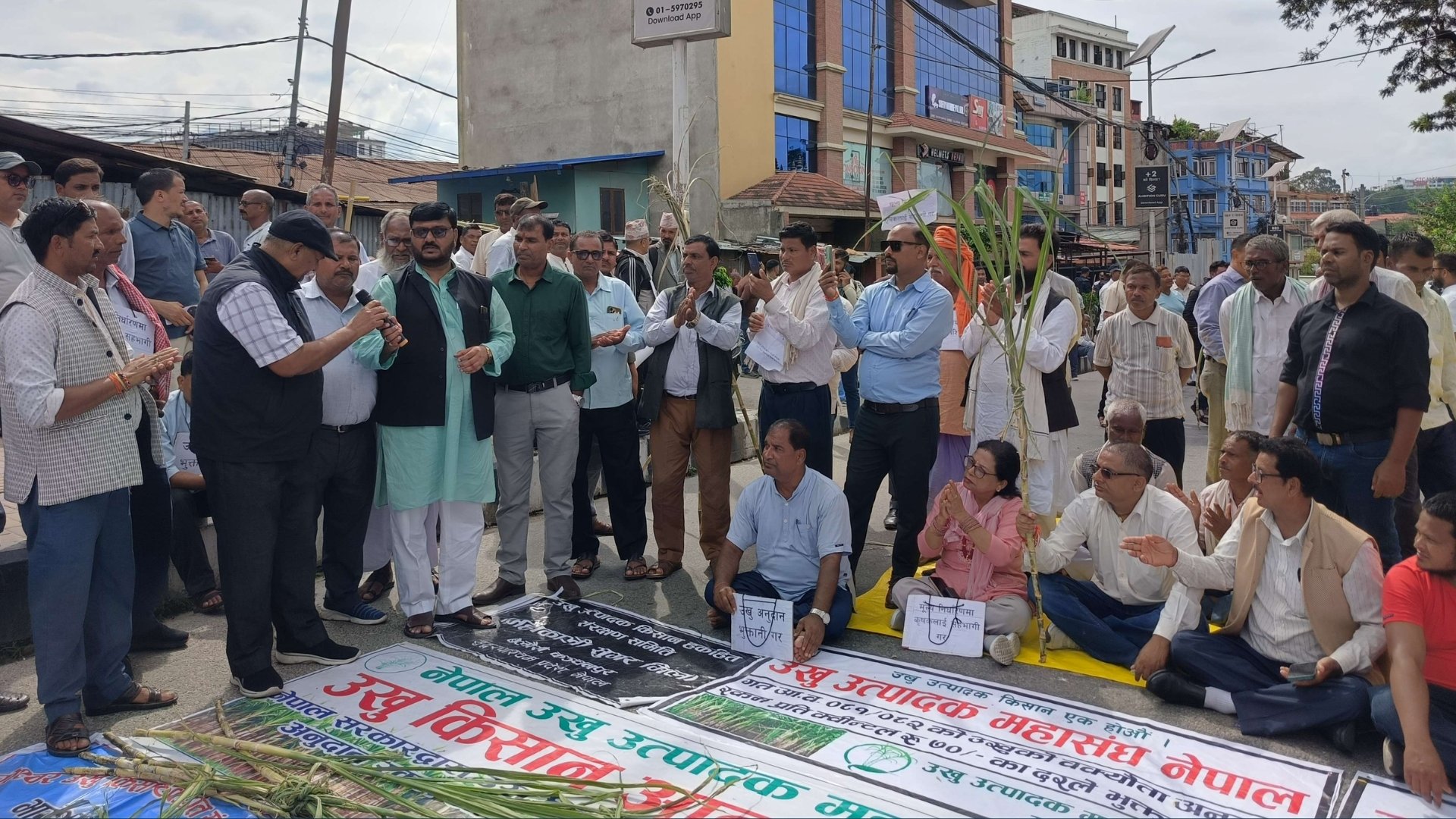
Sugarcane farmers from across the country have once again converged in Kathmandu, launching a series of protests to demand the government fulfil its commitments regarding crucial subsidies and long-overdue payments. The demonstrations, which began on August 24 at Maitighar Mandala, highlight the persistent struggles faced by the country’s sugarcane growers.
Farmers, representing districts such as Mahottari, Sarlahi, Bara, Sunsari, and Nawalparasi West, are demanding the immediate restoration of the sugarcane subsidy to its previous rate of NRs 70 per quintal, a figure maintained in the last fiscal year. A central grievance also centres on the approximately NRs 1.6 billion in unpaid dues they claim the government owes them in subsidies from last year. After weeks of demonstrations at their home districts, farmers were forced to come to Kathmandu.
The current wave of discontent was ignited when the Ministry of Finance, on July 7, decided to slash the sugarcane subsidy by half—from NRs 70 to NRs 35 per quintal—for the current fiscal year (2025/26). The Cabinet had endorsed the reduced subsidy, citing the country’s strained financial situation, even though the Ministry of Agriculture and Livestock Development (MoALD) had pushed to retain the NRs 70 rate.
After weeks of delay, the finance ministry has now released NRs 754.93 million, which the MoALD says will be transferred into farmers’ bank accounts through district treasury and comptroller offices by August 28. Officials had earlier cited “technical reasons” for the delay, which left farmers without support during peak harvest transactions and compelled them to travel to the capital to press their demands.
Farmers’ groups have warned that unless the government restores the subsidy and clears pending payments, they will escalate their protest by August 30.
Talks have meanwhile begun between farmers’ representatives and government negotiators at Singha Durbar. On Tuesday, a team led by Lalan Kumar Singh, deputy director general of the Department of Agriculture, along with officials from the agriculture and industry ministries, sat down with farmer leaders. The talks followed the formation of a four-member dialogue committee under the coordination of Singh.
This year’s protests are far from an isolated event.
In December 2023, farmers in Sarlahi staged demonstrations demanding a minimum support price (MSP) of NRs 750 per quintal for that season’s harvest and the release of pending subsidies. In July 2021, they marched to Kathmandu after sugar mills failed to clear an estimated NRs 300 million in dues. The current MSP stands at NRs 585.
Such recurring protests underscore the structural nature of the problem: farmers are forced to leave their fields and travel to Kathmandu almost every year to wrestle with overdue payments or defend subsidies that keep shrinking.
The cycle is wearyingly familiar—delayed government action, mounting farmer frustration, road blockades, support from opposition leaders, hurried negotiations, and temporary settlements. Yet the fundamental issues remain unresolved. Rising production costs, inadequate state support, and repeated subsidy cuts threaten the viability of sugarcane farming as a livelihood.
On the other hand, its cultivation area has shrunk from 78,609 hectares in 2017/18 to 64,354 hectares by 2020/21, with production falling from 3.67 million tonnes to 3.18 million tonnes in the same period. By 2022/23, it had reduced to 61,771 hectares. A 2023 study found that approximately 80% of sugarcane growers are not paid on time and in full, highlighting the structural nature of delays in the sector. Such retreat signals a broader collapse of incentive as farming becomes less viable.
As protests intensify, the government faces renewed pressure to move beyond stopgap measures and deliver a credible, sustainable solution to safeguard the future of Nepal’s sugarcane sub-sector and the livelihoods tied to it.
Read More Stories

NEPSE falls nearly 75 points as market sentiment wavers
The stock market was unable to maintain the gains seen on Tuesday, slipping...

India has begun its long-delayed population census. Here's why it matters
India has begun the worlds largest national population count, which could reshape welfare...

The United Nations has called on Israel to repeal a law passed by...


Business + Finance + Economy + Tech + Environment + Nepal & South Asia + In-depth Analysis + News + Investigation + Research + Expert Opinion + Anatomy of Complex Issues.