Digital Communication in Gen Z Protests | Digital Dynamics of Nepali Society
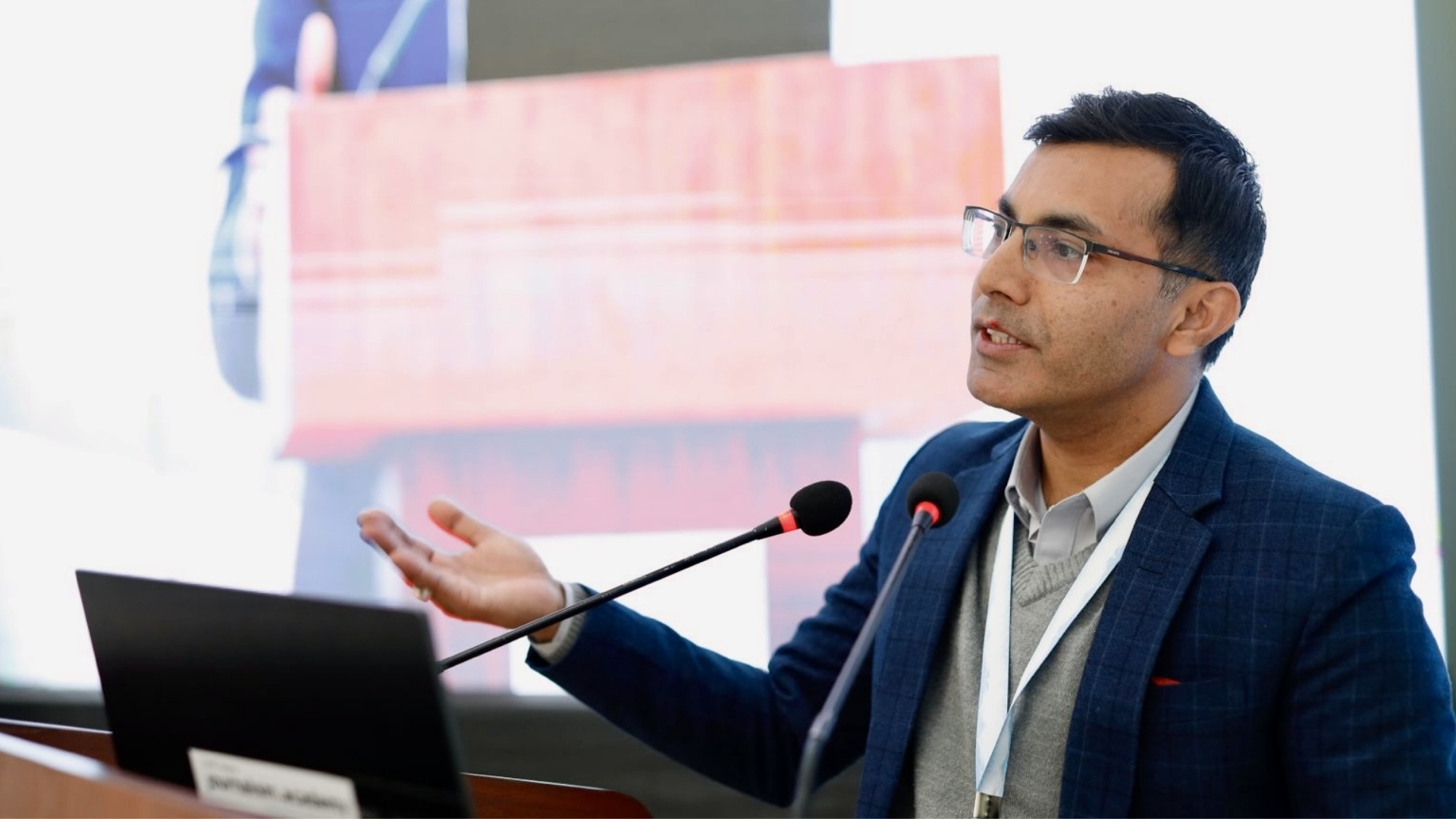
In the wake of recent widespread protests that escalated into violence, I sat down with Lekhanath Pandey, a seasoned Kathmandu-based journalist, Assistant Professor of Journalism at Tribhuvan University, and public commentator, to analyse the complex web of factors that led to the turmoil.
His insights, drawn from years of covering Nepal’s media and political landscape, reveal a movement muddled by digital misinformation, quickly hijacked by various interest groups, and ultimately rooted in a deep-seated communication crisis within Nepali society. From fake TikTok accounts to the failure of institutional media, Pandey explores how a protest initially driven by youth frustration became a chaotic free-for-all, and what it signals for the country’s future.
After the protests were announced, a viral message urged students to join in school or college uniforms with ID cards, claiming international law would protect them from police brutality. Some students actually turned up in uniform, believing it.
the_farsight’s investigations traced the claim back to a fake TikTok account impersonating Nepal Police. Not only did it put children at risk—something Nepal’s Constitution and the Children’s Act explicitly prohibit—it also showed how quickly disinformation could reshape protest dynamics. What does this episode tell us about the protest and the larger communication environment?
The biggest weakness of digital communication is this: it’s hard to believe, hard to ignore, hard to verify, but easy to deflect responsibility. Whoever pulls the strings, especially in a crisis, can always say “That wasn’t me”. When used strategically, digital tools can become a form of hybrid warfare—attacks from unidentified sources against a target. It’s a double-edged sword.
Teenagers, for example, are an inherently vulnerable group. They are emotionally driven and tend to believe what they see on platforms. Gen Z has grown up entirely in a digital landscape, so their default mode is to trust what circulates online. That makes them easy to mobilise. And this is not unique to Nepal. Globally, external forces exploit digital communication. Take the US presidential election in 2016—investigations pointed to Russian networks intervening in American democracy. In our case, the same applies on a smaller scale. Students may have joined protests with good intentions, but the way communication tools were weaponised shows a more complex picture.
Think about it: the same elements that provoked destruction in the name of protesters could also have been behind fake “police” handles calling on students to come out. This needs more research, but it’s plausible. Manipulation didn’t start only on the streets of Kathmandu—it began from the outset, within what we might call the organic channels of communication.
Beyond manipulation, what other weaknesses did you see?
Digital and information literacy is a big gap. Emotionally charged content circulates quickly and gets the most attention, but that’s exactly the kind of content to be most cautious of.
There’s also a generational factor. Nepal hasn’t seen violent protests on this scale for at least ten years—not since the 2015 constitution was adopted. A teenager who was 15 then is only 25 now. For many in Gen Z, this was their first encounter with violent protest. They didn’t know what it meant. They believed what they saw, they came to the streets, and many were caught off guard.
Among the killed on September 8, most of the victims were under 30, very much in the Gen Z bracket. By the following day, September 9, more victims were in their thirties and forties.
What does this tell us? Gen Z did show up in significant numbers, but their families pulled them back after the eventful first day. Many went home, some ended up in hospitals, but the demographic participation shifted quickly. Older groups, more seasoned and perhaps with different intentions, dominated the following day.
This again suggests infiltration. Other interest groups appear to have entered the protests through digital tools, creating the impression that “the police are with us” or that students would be immune. They had completely different goals. One example is never enough to prove this, but if we find multiple cases, then the argument for infiltration becomes stronger.
You mentioned the role of digital tools and infiltration. Can you expand on how social media shaped the protests and the behaviour of participants?
I’ve long argued that social media, paradoxically, can slow down real change. People often vent their emotions and frustrations online instead of taking action in the streets. Many who should have protested in person at the right place were content posting a status on social media and moving on with their day. This meant that there wasn’t sufficient public pressure against bad politics and governance. If these people had come to the streets, the situation could have been more violent, and the government’s incompetent leadership would have been exposed sooner. I’ve made this assessment repeatedly.
In fact, I remember telling a student back in 2017–18, “If Facebook were shut down for five days, Nepal could see a shift in power.” At the time, the government had a two-thirds majority. Our dependence on social media is immense; the average Nepali spend much of their day online, mostly on Facebook. When people suddenly have nothing to scroll through, restlessness and frustration take over. That’s a critical trigger.
And how did this play out during the actual protests? On the first day, the protest grew spontaneous but remained uncoordinated. Sudan Gurung appeared on September 8, saying he was only volunteering. Two days later, he was negotiating with the state with unclear demands.
Let’s break this down into a few parts. First, this was a headless, faceless protest. Such protests are always susceptible to hijacking. Multiple stakeholders can use or misuse it to serve their own interests.
The public had genuine discontent, and the youth came to the frontlines. The movement was charged with emotion. It was not only the youth; their parents also participated. That created a consolidated force on the streets. The initial Gen Z protesters didn’t have demands like removing KP Oli from his position as prime minister. Their goal was simply to express frustration through street protests.
Once crackdown began, other actors, including new political parties and old royalist forces, entered to pursue their own agendas. Various political forces exploited this energy. The youth themselves had a limited presence on the second day of protests. Urban youth involved in the revolt on the first day were mostly gone by the next day. The second day was dominated by other stakeholders. Planning a protest normally takes six months, yet this unfolded within hours and across the entire country. The scale of this mobilisation suggests that no single stakeholder could have achieved it acting alone.
This also explains the shifting demands. The youth movement itself had no clear ideology. Their agenda was about good governance, which every government, official, and conscientious citizen desires. Since there was no overarching ideology, other stakeholders could take ownership. This explains how new demands appeared, such as calls for a directly elected executive, or a Hindu state or the return of the monarchy, and even the scrapping of the constitution.
Society’s collective conscience also seems weakened. Earlier, people would react even to a dead dog in the village. I live near President Ram Chandra Paudel’s private residence in Bohoratar. During the recent protests, around 15 people came to set his house on fire while about a hundred neighbours watched silently. No one stepped in, not even to pour water to stop the fire. Had the neighbours acted, they could have stopped those 15 individuals.
At Singha Durbar, the day after the initial protests, there were 10,000 employees—add another 10,000 who are assistants, drivers of the employees—capable of intervention against a mob of around 2,000 who showed up to torch the central administration complex of the country. This shows deep-seated public anger, resentment, and decline in personal responsibility across society.
We need to analyse it from multiple angles: political science, sociology, and technology. Modern technology has created a network society where information spreads instantly. Networked communication today can both inform or mislead, fuelling populism worldwide. For example, Donald Trump’s rise would not have been possible without such networks. In Nepal, similar dynamics apply. Public perception can be shaped rapidly, influencing events like protests and institutional attacks.
How do you see the role of mainstream media during this period?
I have been critical of the media for some time, but this is not the moment to attack it. The media invests little in content, and the industry is struggling. Yet, it has a basic responsibility. Our media should report on the failures of old leaders, their inability to deliver, and their involvement in corruption. For instance, Kantipur has reported extensively on issues ranging from Bhutanese refugees to other social concerns, and other outlets have followed suit. That is fine.
During elections, the media also shapes perceptions. Recently, I read a report suggesting that some so-called “heavyweight” leaders, deemed obsolete, should not even contest. But it’s the same media that create a positive environment for heavyweight leaders, influencing public perception. At the same time, it must report leaders’ statements responsibly. Leaders are publicly accountable, and their voices deserve space. But if a leader intentionally says something questionable, the media should flag it and raise doubts.
Fact-checking is essential. The media should not simply convey information as it comes and leave verification to others. For instance, if a leader is rumoured to have large amounts of money stored at home, the media cannot simply take their denial at face value. They must verify on the ground and report accordingly. If it turns out to be false, it should be reported as such, based on field evidence or eyewitness accounts. Failure to do this risks media credibility, just as leaders’ integrity.
Gen Z protest has to have a safe landing, yet the negotiations seem centred on position of power, while social media polarisation shows confusion—with some even saying, “This is not what we came to the streets for.” Where should civil society and the media step in, especially when the environment seems to be paving the way for the return of the same old leadership? What should be the way forward?
Civil society and the media are not very different. Both are institutions of democracy. In a democratic system, they must be strong, vocal, and critical. In recent years, neither has truly played that role. Political parties did not allow the media or civil society to remain independent, both of which are supposed to check and balance the government. But parties—especially the left, though Congress is not exempt—turned journalists and civil society actors into cadres, building clubs, unions, and forums under their control. Instead of holding power accountable, many became extensions of party agendas.
At one point, there were around 14,000 journalists affiliated with political parties. Their reporting naturally avoided putting their parties in a tight spot. In rare cases, one side criticised the other, but there was a tacit understanding not to rock the boat too hard. When coalition governments keep changing every six months, why criticise today if you might be in the ruling alliance tomorrow? That culture hollowed out civil society voices.
Even universities, think tanks, and ideological centres inside parties, spaces that should have fostered discourse, remained silent. Parties stopped being forums of debate; they became clubs for rotating chairs. In such a setup, governance slides toward elected authoritarianism because the critical voices that sustain democracy vanish.
This vacuum emboldened misgovernance. And in the end, it erupted in the form of headless, faceless protests led largely by teenagers. If an organised political or ideological force had led, there would at least have been something concrete on the table for negotiation. Instead, everyone now says “we need reforms,” but nobody explains how or where to begin.
All institutions, civil society, media, universities, even the judiciary, must rethink their roles. Take the courts: when confusion erupted about whether they supported social media bans, they could have clarified immediately through a spokesperson.
This moment is a turning point. If civil society, media, and institutions do not seize it to reinvent themselves, we will simply return to old patterns. We risk even greater violence and deeper crises of integrity and independence.
Our society seems to have a certain value system—we don’t really disagree, we hate outright. If we don’t like something, it’s “go away” rather than dialogue. With the rise of social media, has this culture been perpetuated? Or was it always part of our value system, merely reflected and amplified online?
Our society has always been built on hierarchical communication. We never really practised dialogue. Take families: fathers and sons barely communicate. A father assumes the son knows nothing; the son, once he grows up, dismisses the father as old and out of touch. Meaningful discussion is scarce.
There is distance between mothers and daughters, in-laws when it comes to genuine conversation. Even historically, was there dialogue between king and subject? Between leaders and citizens? Forget that—even between leaders and their own cadres. Our society simply never learned it. Structurally, our society has always been hierarchical, even in cultural institutions and religious texts.
Social media disrupted this. Suddenly, it created bottom-up communication. A child now posts something online, and the parent has to react. The command of communication shifted. But it also created problems. Information concentrated with the young—those who had networks, exposure, and access. But knowledge and wisdom, which require experience and context, did not transfer across generations. There was no intergenerational dialogue. Now the real issue is that while social media broke hierarchical communication, it did not replace it with meaningful negotiation or dialogue.
This lack of dialogue extends to parties, too. One significant contribution of this Gen Z movement is that it might finally push for intergenerational dialogue inside political parties.
The problem with social media, however, is that information is mistaken for knowledge. To create knowledge, information must be processed, analysed, and contextualised. Wisdom comes at an even higher level. Enlightenment beyond that. But for many on social media, especially on TikTok, raw information itself is treated as the final truth. There’s no intervention, no critical interpretation.
Read More Stories

NEPSE falls nearly 75 points as market sentiment wavers
The stock market was unable to maintain the gains seen on Tuesday, slipping...
India has begun its long-delayed population census. Here's why it matters
India has begun the worlds largest national population count, which could reshape welfare...
The United Nations has called on Israel to repeal a law passed by...


Business + Finance + Economy + Tech + Environment + Nepal & South Asia + In-depth Analysis + News + Investigation + Research + Expert Opinion + Anatomy of Complex Issues.