Party Manifesto | Political Agenda | HoR Election 2026 | Janamat Party
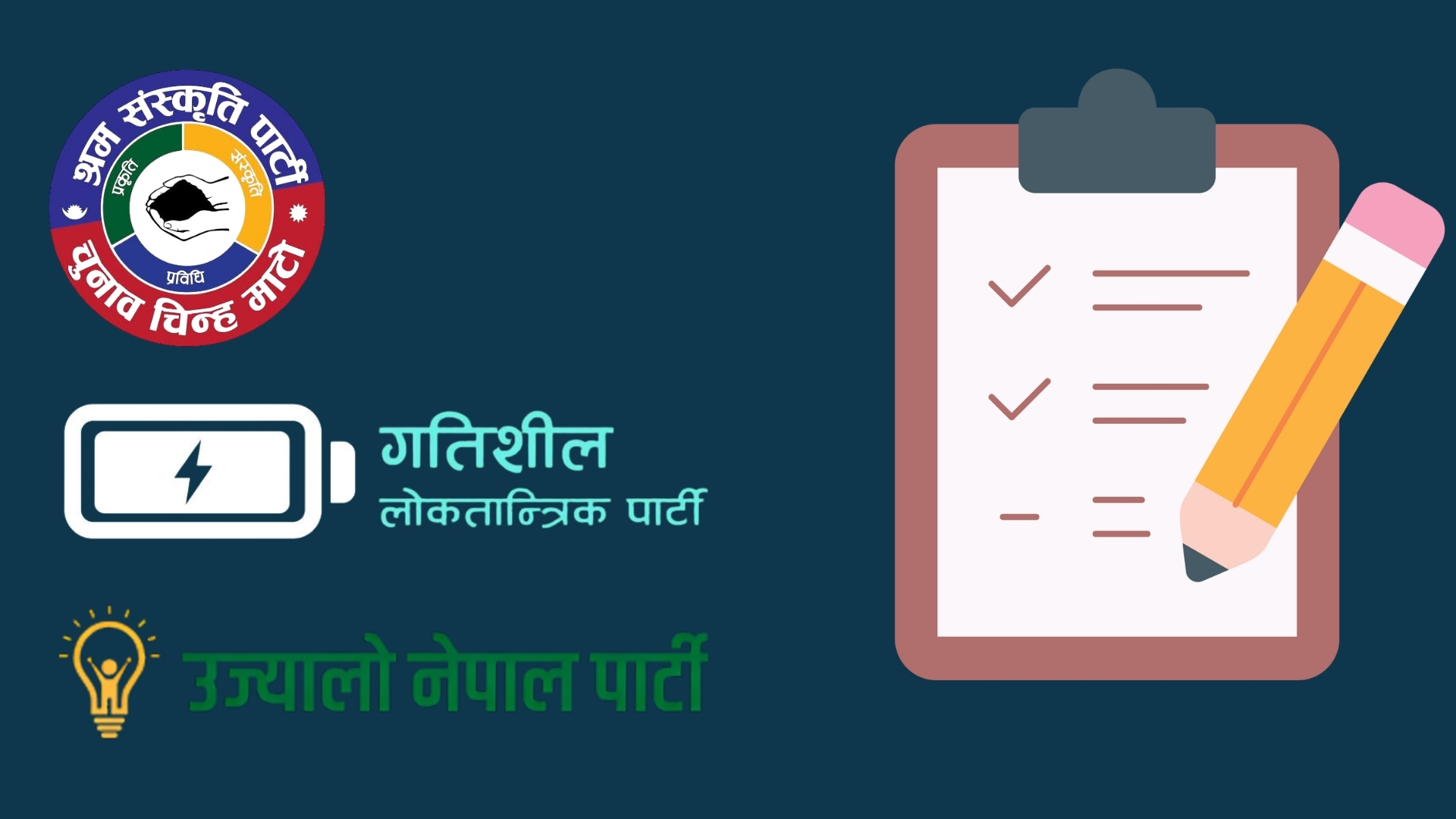
The manifestos of the three emerging parties, Ujyalo Nepal Party, Gatisheel Loktantrik Party, and Shram Sanskriti Party, have sharply contrasting economic and social agendas, each promising structural transformation but through different routes: export-led expansion, sectoral restructuring, and labour-centred self-reliance.
Ujyalo Nepal: Big numbers, export push
Ujyalo Nepal Party, led by Kulman Ghising, frames the coming decade as one of “rapid development,” anchored in measurable economic expansion. It pledges to raise the country’s GDP to $70 billion by 2030 and $111 billion by 2035, alongside exports of $20 billion within a decade.
Hydropower sits at the centre of its strategy. The party promises 12,000 megawatts by 2030 and 25,000 megawatts by 2035, positioning electricity exports to India, Bangladesh and China as a revenue engine projected to generate $5 billion annually. A proposed “People’s Hydropower Fund” would channel export earnings into a national prosperity fund.
Employment targets are equally ambitious: up to 1–1.5 million jobs annually, with unemployment reduced below 5% by 2035. Youth skill development, IT training for 600,000 young people, and a $1 billion startup fund form part of the jobs strategy.
On social policy, the party promises free university education, vocationalising 50% of Grade 12 curricula, mental health counselling in every ward, and at least one specialist doctor in every local health facility.
It also commits to reducing poverty from 20.1% to below 10% by 2035 and expanding social protection, including affordable housing for 100,000 families annually and land distribution to landless and marginalised communities.
Tourism is another pillar, with a target of up to five million visitors and $10 billion in tourism revenue by 2035, alongside 13 proposed smart cities and major highway upgrades.
Gatisheel Loktantrik: Sector-by-sector restructuring
The manifesto of Dr Dinesh Raj Prasai-led Gatisheel Loktantrik Party reads like a technocratic blueprint. It sets a ten-year goal of expanding the country’s economy to $100 billion, the only plausible one among most of the manifestos released.
The party identifies agriculture, tourism, IT, manufacturing, mining, education, health, and energy as priority sectors. In tourism, it aims to attract five million visitors over a decade while generating three million jobs, redesignating Kathmandu as the political capital, Bhairahawa as the economic capital, and Pokhara as the tourism capital.
Its IT vision is particularly aggressive: $6 billion in IT exports by 2035 and 400,000 high-skill jobs, backed by a zero-rated VAT regime for IT exports, digital special economic zones, AI and cybersecurity training, and a nationwide digital highway.
Energy policy includes 12,000 megawatts of clean energy within five years and a longer-term shift toward 100% renewable energy by 2045.
In agriculture, land would be pooled into cooperative clusters, with farmers becoming equity shareholders in processing units to reduce middlemen and stabilise incomes. The model reframes farming as an enterprise rather than a subsistence.
Socially, Gatisheel links economic growth to measurable development indicators. It pledges to raise Nepal’s Human Development Index to 0.8 within a decade and ensure marginalised communities reach at least 0.75.
The party pledges essential health services to prioritise children under five and citizens above 75, while education reform proposes consolidating 27,000 secondary schools into 7,000 digitally equipped institutions with AI-supported learning.
The party also promises an inclusive social security system and diaspora engagement measures, including overseas voting rights and dual citizenship incentives.
Shram Sanskriti: Labour as development doctrine
In contrast to the export-heavy and tech-driven visions of the other two and almost all the mainstream parties, the Shram Sanskriti Party, led by Harka Raj Rai, centres its economic philosophy on “labour culture”, making compulsory labour and volunteerism the backbone of national development.
Its economic agenda prioritises self-reliance, import substitution, and domestic production. Agriculture receives top budget priority, with policies aimed at transforming subsistence farming into both subsistence-plus and export-oriented production. The party advocates “one village, one industry,” expansion of agro-processing units, herbal production, and mining and metal processing to reduce imports.
A “scientific, progressive tax system” would redistribute from wealthy groups to lower-income citizens. The party also proposes limiting land fragmentation, regulating urban land plotting, and guaranteeing housing rights while curbing speculative land practices.
Industrial policy emphasises small and medium enterprises alongside large industries, with industrial zones in every municipality. The party pledges to direct youths toward production, construction and innovation rather than political mobilisation.
On social policy, Shram Sanskriti advances a welfare state model focused on labour dignity and equality. It promises health and education insurance, allowances for senior citizens, single women and persons with disabilities, special reservations for endangered and marginalised communities, and protections for gender identity and sexual orientation diverse citizens.
Education reform would sharply reduce theoretical coursework in favour of practical labour-based learning, with students spending four days a week in production, construction, agriculture, arts or innovation. The party also proposes mandatory six-month military training after Grade 12 before higher education enrolment.
Across sectors, the party repeatedly emphasises ending dependency on foreign aid and loans by mobilising domestic labour and natural resources.
Three roads, one promise
All three parties promise prosperity, jobs and social justice. But their methods diverge.
Ujyalo Nepal bets on hydropower exports, digital governance and headline macroeconomic targets. Gatisheel Loktantrik prioritises sectoral restructuring, institutional metrics and digital transformation. Shram Sanskriti seeks moral and economic revival through compulsory labour, domestic production and redistribution.
Read More Stories

NEPSE falls nearly 75 points as market sentiment wavers
The stock market was unable to maintain the gains seen on Tuesday, slipping...
India has begun its long-delayed population census. Here's why it matters
India has begun the worlds largest national population count, which could reshape welfare...
The United Nations has called on Israel to repeal a law passed by...


Business + Finance + Economy + Tech + Environment + Nepal & South Asia + In-depth Analysis + News + Investigation + Research + Expert Opinion + Anatomy of Complex Issues.