Election Survey | Election Code of Conduct | Press Freedom | HoR 2026
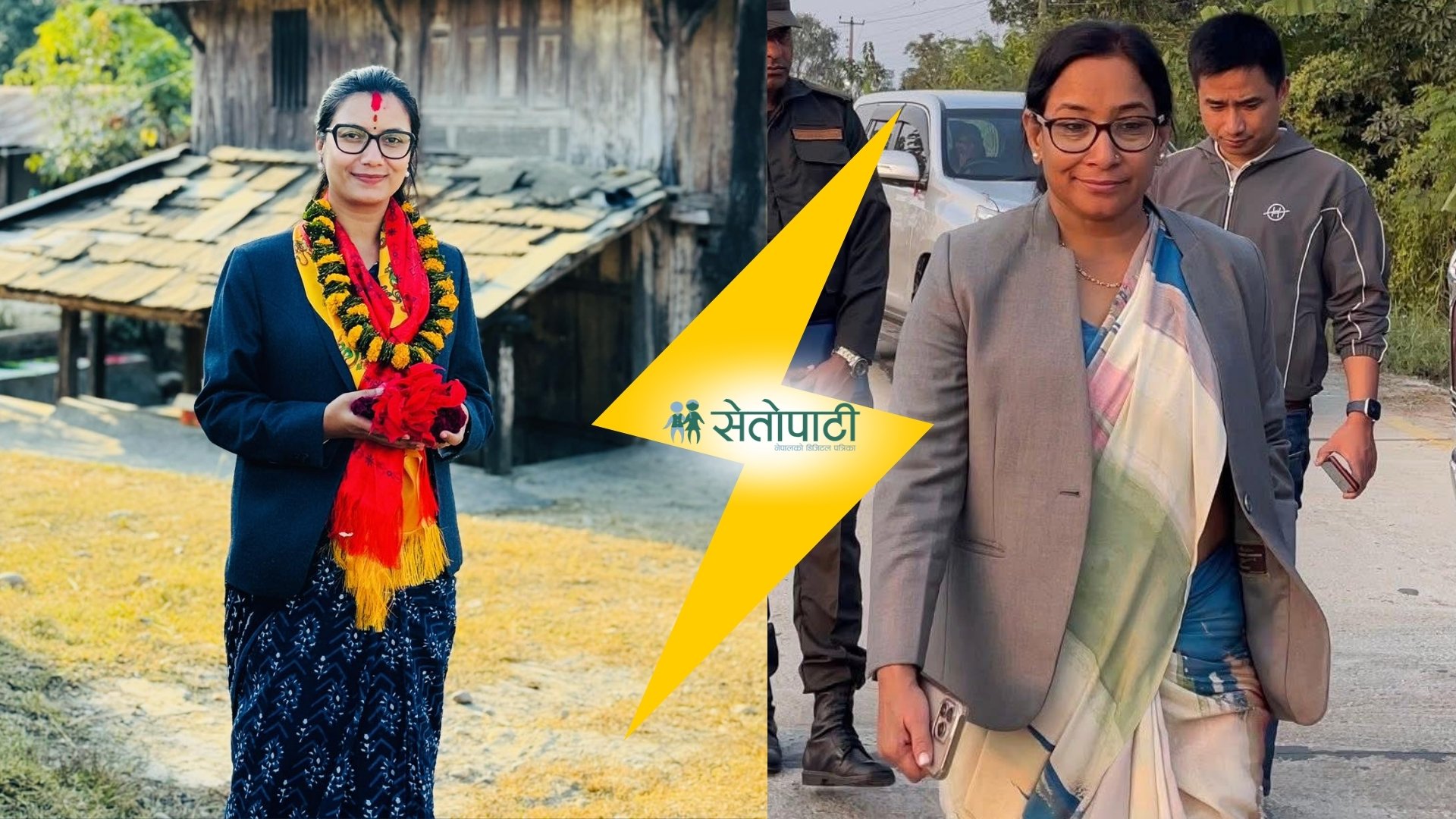
Online news portal Setopati has once again ignited debate over election reporting after publishing a constituency-level “election analysis” that projected a clear winner during the campaign period. The coverage has prompted questions about compliance with the Election Code of Conduct and the limits of press freedom.
The controversy centres on Setopati’s analysis of Chitwan–3, where it reported that Rastriya Swantantra Party candidate Sobita Gautam will win the federal election scheduled for March 5.
The original headline stated unequivocally that “Sobita Gautam will will in Chitwan-3, Renu Dahal second”. After criticism from readers and media observers, the outlet revised the headline to: “Sovita Gautam highly likely to win in Chitwan–3*,” indicating a strong possibility of victory rather than certainty.
Not the first time
Setopati has conducted similar exercises in past election cycles. In its editorial defence on Tuesday, the outlet notes that it first published election analyses during the 2017 local elections and later expanded the format in 2022 to cover multiple metropolitan cities and parliamentary constituencies. During the previous parliamentary elections, it says it spoke directly to voters in 21 constituencies and published analytical pieces based on those conversations.
According to the outlet, earlier analyses also prompted letters from the Election Commission and the Press Council Nepal, asking for clarification and removal within 24 hours. Setopati says it responded each time formally and that no further action was taken.
What made this cycle different, however, was the headline’s assertive framing. Critics argue that explicitly declaring a winner crossed a line. Setopati itself acknowledged that it failed to maintain “institutional restraint” in the headline, which it later revised.
The analysis in question
In its Chitwan–3 piece, Setopati reported that it spoke to around 900 voters on what it described as a random basis. It published percentage breakdowns of voter preference, reporting that 46% supported Gautam, 23% backed Nepali Communist Party candidate Renu Dahal, 13% supported the Nepali Congress candidate, and smaller shares favoured others, with 9% undecided.
The article stated that Gautam would secure the highest votes and that the ranking between first and second place was unlikely to change. Although the piece included a disclaimer that it was “not a scientific survey,” it presented aggregated percentages and projected the likely winner.
The code provision at issue
The dispute revolves around a clause in the Election Code of Conduct, 2026, issued by the Election Commission that prohibits conducting or publishing vote surveys or announcing their results from the date of nomination filing until voting concludes.
Many argue that Setopati’s reporting falls squarely within that prohibition because it measured voter preference, aggregated responses into percentages, and projected an outcome.
Supporters of the outlet counter that what it published was journalistic analysis based on voter interviews, not a formal survey.
In its seven-point editorial defence, Setopati grounds its position in Article 19 of the Constitution of Nepal, which guarantees freedom of expression and prohibits prior restraint on publication except through reasonable restrictions imposed by law.
The outlet argues that such restrictions can be imposed through legislation. It maintains that the Election Code of Conduct is not “law” within the meaning of the Nepal Law Interpretation Act, 1954 and therefore cannot constitutionally restrict media publication.
If the Commission believes otherwise, Setopati says, the final arbiter would be the Supreme Court.
This constitutional framing shifts the debate from compliance with the code to whether the code itself can lawfully limit media content.
Democracy versus compliance
The episode has triggered a broader debate about the role of media in elections.
Setopati argues that speaking to hundreds of voters helps capture the public “pulse” and prevents election coverage from becoming a one-sided relay of candidates’ claims. It says voters have the right both to keep their choice secret and to publicly declare it. Publishing such responses, the outlet contends, strengthens democratic discourse.
It also argues that mature democracies such as the United States, European countries and India allow pre-election surveys and exit polls, suggesting that Nepal’s prohibition is out of step with democratic practice. However, in India, the survey and exit poll results cannot be published before the polling concludes.
Critics respond that democracy also entails adherence to existing rules. Even if the clause is debatable or constitutionally suspect, they argue, it remains binding until amended or struck down by the courts. Selective compliance, they say, risks undermining institutional norms.
Some observers also question the methodology. If the analysis is not scientific, they ask, how can it assert with confidence that one candidate will win? Publishing precise percentages and firm projections, they argue, blurs the line between anecdotal reporting and formal polling.
Meanwhile, others argue that the country’s relatively low digital literacy and highly charged political environment make the electorate more susceptible to effects such as jump-on-the-bandwagons to support a more popular candidate or sympathy effects to support the weaker ones from pre-election projections.
Influence and impact
Interestingly, Setopati’s own editorial acknowledges that such analyses may influence voter behaviour. It describes scenarios in which undecided voters might align with perceived front-runners, shift strategically, or offer sympathy votes to trailing candidates.
The outlet argues that such information ultimately assists voters and candidates by providing clarity and correcting internal “bubble” perceptions. Critics see this as implicit recognition that projections can shape electoral dynamics, reinforcing the rationale for temporary restrictions.
The institutional question
At the heart of the controversy lies a basic question: can a media house decide for itself that a regulatory provision is unconstitutional and proceed to disregard it?
Setopati’s position is that constitutional rights supersede a code issued by a constitutional commission. Opponents argue that until a court invalidates the clause, compliance is the safer institutional course.
For now, the dispute remains a live one. The Election Commission has previously written to the Press Council Nepal regarding similar analyses, though no punitive action has followed.
As campaigning continues, the episode has reopened an enduring debate about the boundaries between election integrity, media freedom, and the rule of law in Nepal’s evolving democratic practice.
Whether the issue ultimately lands before the Supreme Court or remains a recurring flashpoint each election cycle may determine how those boundaries are defined in the years ahead.
Read More Stories

NEPSE falls nearly 75 points as market sentiment wavers
The stock market was unable to maintain the gains seen on Tuesday, slipping...

India has begun its long-delayed population census. Here's why it matters
India has begun the worlds largest national population count, which could reshape welfare...
The United Nations has called on Israel to repeal a law passed by...


Business + Finance + Economy + Tech + Environment + Nepal & South Asia + In-depth Analysis + News + Investigation + Research + Expert Opinion + Anatomy of Complex Issues.