International relations | globalisation | security | regional | multilateralism | open economy
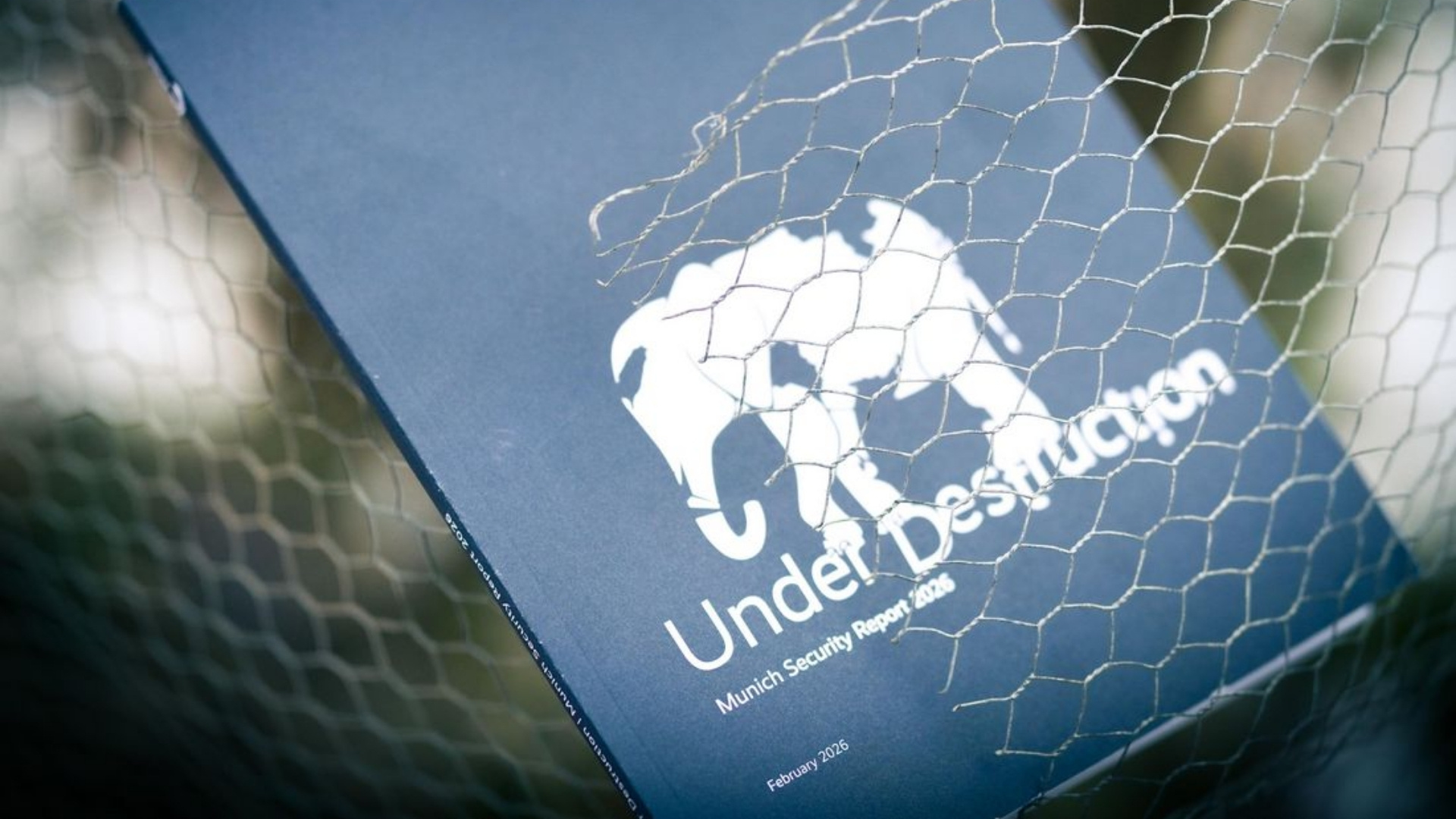
One of the world’s leading annual gatherings on international security, the Munich Security Conference (MSC), concluded this mid-February generating a global attention. Most European leaders at the conference talked about Europe’s strategic autonomy, which intends to build its own security architecture independent of the US. In contrast, the US Secretary of State, Marco Rubio, called for greater Trans-Atlantic unity in these unpredictable times.
Founded in 1963 as the Munich Conference on Security Policy, the MSC has evolved into a premier forum for discussing global security trends and challenges.
The 2026 Munich Security Report argues that the international order is no longer merely eroding, it is actively being dismantled. The report identifies a shift from reformist politics to what it calls “wrecking-ball politics”, marked by delegitimisation of institutions and escalating policy conflicts. Key trends include rejection of multilateralism, retreat from universal norms, the rise of personalist leadership, and the weaponisation of sovereignty.
Europe’s strategic dilemma
Europe faces growing strategic anxiety due to Russian aggression, hybrid warfare, and reduced US security credibility. Recent U.S. rhetoric, exemplified by the Greenland dispute, has heightened tensions. European leaders now confront a critical choice: maintain U.S. engagement or pursue genuine strategic autonomy. In other words, Europe is entering a post-certainty era.
In an ongoing debate about the status of the US-led post-1945 world order, the report claims that the order is being passively weakened through efforts of active dismantling by the powers that actually created it.
“Demolition Men” politics
The report introduces the concept of “Demolition Men” politics, in which leaders prefer institutional rupture over reform and portray governance structures as obstacles rather than assets. Globally, political leadership is thriving on hostility toward bureaucratic systems by framing disruption as the new normal, signaling a crisis of trust in democratic governance. This phenomenon is fueled by perceptions of institutional paralysis and cultural backlash against liberal modernity.
Destruction becomes politically attractive when reforms appear impossible, a dynamic described in sociological terms as Zerstörungslust (lust for destruction). The report highlights the United States as a key system disruptor, particularly under Donald Trump, whose policies have weakened the three pillars of the post-1945 order: i) multilateralism and international institutions, ii) the open global economy, and iii) liberal democratic solidarity.
The three pillars in decline
First, UN bodies, the WTO, WHO, and climate frameworks face weakening as the US withdraws (so far 66 institutions) from or defunds institutions. This shift undermines global governance and transforms the U.S. from an “institution-builder” to an “institution-skeptic.”
Second, the once-open global economy is increasingly constrained by U.S. tariff weaponisation and transactional trade deals, signaling a departure from WTO-centered trade and rules-based globalisation toward a more anarchic, power-driven system.
[Read also: The world is remaking under the new US: Trump’s 100 days]
Third, hostile U.S. rhetoric toward Europe, greater deference to autocratic leaders, and deprioritisation of democracy promotion have fractured Western unity. The report terms this crisis “Westlessness”, this meaning a condition in which the West is no longer united by shared normative foundations.
Indo-Pacific and Global South dynamics
In the Indo-Pacific, regional allies are operating without NATO-style institutional guarantees and facing threats from a rising China. Uncertain US commitments fuel fears of a transactional US-China deal, driving hedging behaviors and regional fragmentation.
For the Global South, reduced Western dominance presents both opportunities and risks. Some countries welcome strategic autonomy, yet trade shocks, aid cuts, and economic coercion increase vulnerabilities. Without normative guidance, multipolarity may lead to instability, leaving small, resource-dependent states at a disadvantage while strong powers gain leverage.
The structural risk assessment identifies the most dangerous long-term threat. This is especially for Global South countries. This is because the normalisation of rule erosion amplifies the risk of degrading territorial integrity, leading to jungle trade rules.
For a small state, multilateral norms are of utmost necessity, but with such risk, they will become optional. The system turns from a rules-based formal order to a power-based bargaining arena. In this scenario, SIDS, LLDCs, and LDCs member countries will face an increasingly difficult situation. Basically, strong states, resource-rich actors, and coercive powers get the advantage, while small states, development, dependent states, and norm, dependent actors become the losers.
Understanding report from theoretical lense
This report raises vital theoretical questions for International Relations, such as: if Hegemonic Stability Theory collapses, does the order collapse? Another interrelated theory relevant to this report is Liberal Institutionalism. The report asks: can institutions survive without hegemonic commitment? Further, based on realism, the report points out that countries moving in pursuit of their own vested interests results in a power-based order. Finally, the report shows a precarious situation for global south countries in which constructivism is underperforming based on the Constructivism theory. This theory considers a dissolving normative consensus in the current scenario.
Europe’s strategic response
The concept of strategic autonomy was first articulated by French President Emmanuel Macron in 2017, proposing a self-reliant Europe less dependent on US defense, technology, and economic support. Similarly, in March 2023 speech on EU-China relations at the Mercator Institute for China Studies and the European Policy Centre, European Commission President Ursula von der Leyen stated EU-China relations are not black and white and emphasised de-risking, not decoupling, from China.
At the same time, US pressure on NATO to increase European defense spending has prompted member states to commit to raising budgets to 5% of GDP by 2035, signalling an evolving European security posture.
Evaluation of the Munich report
The report shows several strengths. These include clarity, as seen in its clear discussion of “wrecking-ball politics,” empirical grounding (including the Munich Security Index), and regional differentiation. The report has a balanced tone that is serious but not alarmist. However, there are limitations due to its heavy US-centric focus and its limited attention to China’s structural role. The report offers a limited exploration of long-term systemic adaptation scenarios by inadequately examining financial system resilience.
The report does not claim that the international order has collapsed; rather, it portrays a transitional phase where political incentives favor destruction, while reconstruction remains uncertain.
Read More Stories

NEPSE falls nearly 75 points as market sentiment wavers
The stock market was unable to maintain the gains seen on Tuesday, slipping...

India has begun its long-delayed population census. Here's why it matters
India has begun the worlds largest national population count, which could reshape welfare...

The United Nations has called on Israel to repeal a law passed by...


Business + Finance + Economy + Tech + Environment + Nepal & South Asia + In-depth Analysis + News + Investigation + Research + Expert Opinion + Anatomy of Complex Issues.