Nepali Congress | Second Special General Convention | Struggle for Party Leadership
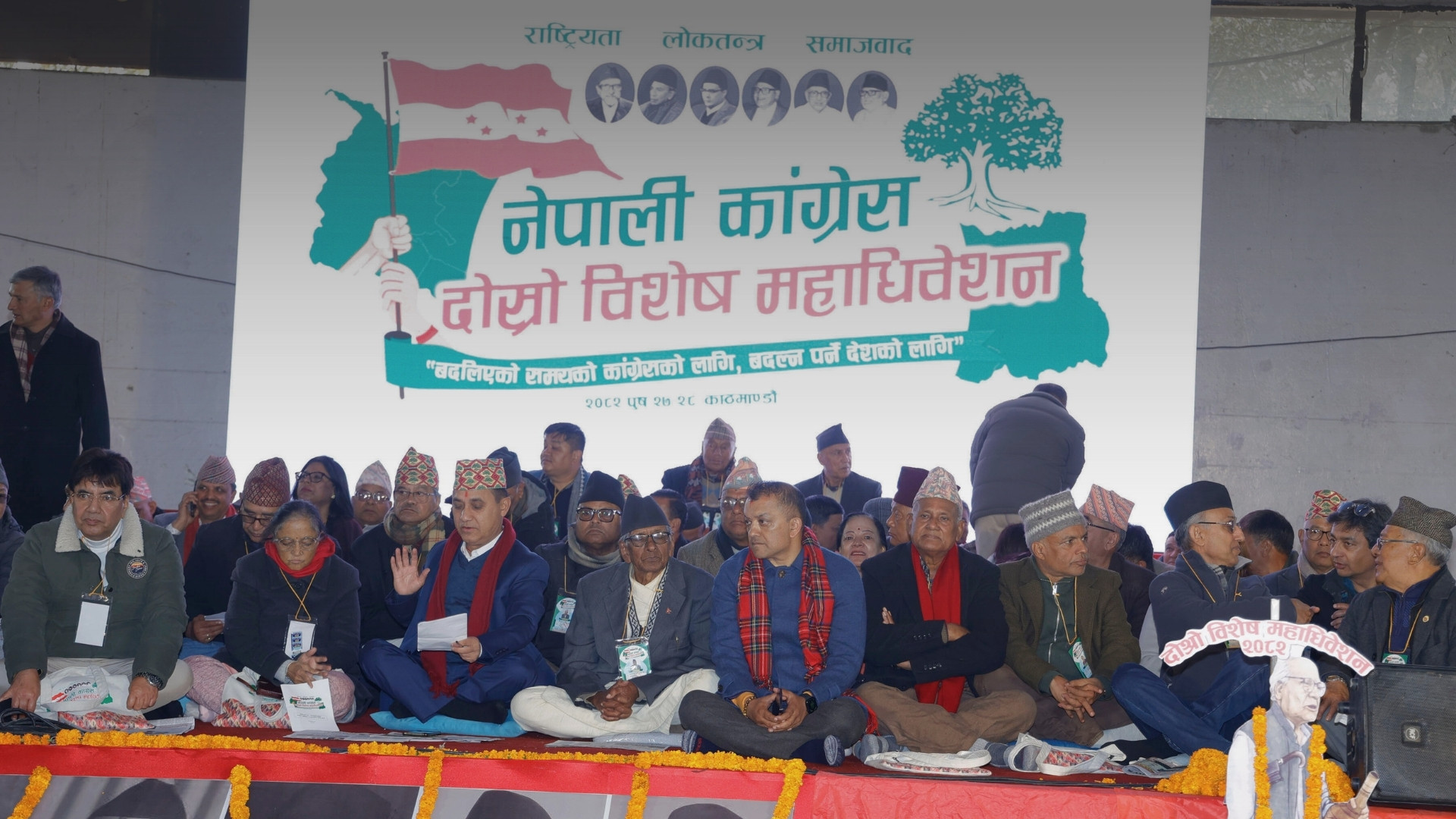
As the country’s oldest democratic party and one of its most enduring political forces for nearly eight decades, the Nepali Congress is on the brink of a split. In the currently dissolved House of Representatives, it partnered with CPN-UML to form the government, which fell apart amid nationwide anti-corruption protests in September 2025. During those protests, the party suffered significant damage. Its central office in Sanepa and 48 district committee offices were vandalised or set on fire.
Party President Sher Bahadur Deuba and his spouse, Dr Arzu Rana Deuba, who was then Minister for Foreign Affairs, were physically assaulted at their residence and required medical attention. Many other leaders’ residences were also attacked.
Amid this turmoil, general secretaries Gagan Kumar Thapa and Bishwa Prakash Sharma began pushing for internal transformation in the party. They designed programmes to modernise structures, improve accountability, and revitalise grassroots democracy.
After more than 50% of delegates signed a petition demanding a special general convention under Article 17(2) of the party statute, the reform camp moved forward with its plan. What began as a push for reform turned into a high-stakes struggle over leadership, statute changes, and the unity of the party.
Here is how things unfolded.
As of January 14, 2026, Thapa filed his nomination for party president, Sharma and Pradeep Poudel for general secretaries. The convention was extended beyond its original schedule to continue deliberations on leadership selection and organisational reforms, reaching negotiations with the establishment faction led by Deuba.
Additionally, an 8-point proposal circulated during talks between reform and establishment leaders as a compromise framework, focusing on transitional leadership arrangements and party unity, including forming a parliamentary board to decide upon election ticket distribution and formally recognising Thapa as the party’s prime ministerial candidate.
The establishment faction questioned the special convention’s legitimacy and took disciplinary action against reform leaders, including suspending General Secretaries Gagan Thapa and Bishwa Prakash Sharma and Joint General Secretary Farmullah Mansur for five years.
In response, leaders from the reform faction indicated that a party meeting will be held under the leadership of Gagan Thapa at the central office in Sanepa within a week. In that meeting, they reportedly plan to work on reversing disciplinary actions taken against the reform leaders and consolidate organisational decisions made at the special convention.
Read More Stories

NEPSE falls nearly 75 points as market sentiment wavers
The stock market was unable to maintain the gains seen on Tuesday, slipping...
India has begun its long-delayed population census. Here's why it matters
India has begun the worlds largest national population count, which could reshape welfare...
The United Nations has called on Israel to repeal a law passed by...


Business + Finance + Economy + Tech + Environment + Nepal & South Asia + In-depth Analysis + News + Investigation + Research + Expert Opinion + Anatomy of Complex Issues.