School Education | Private Investment | Underprivileged & Meritorious Students | Scholarships
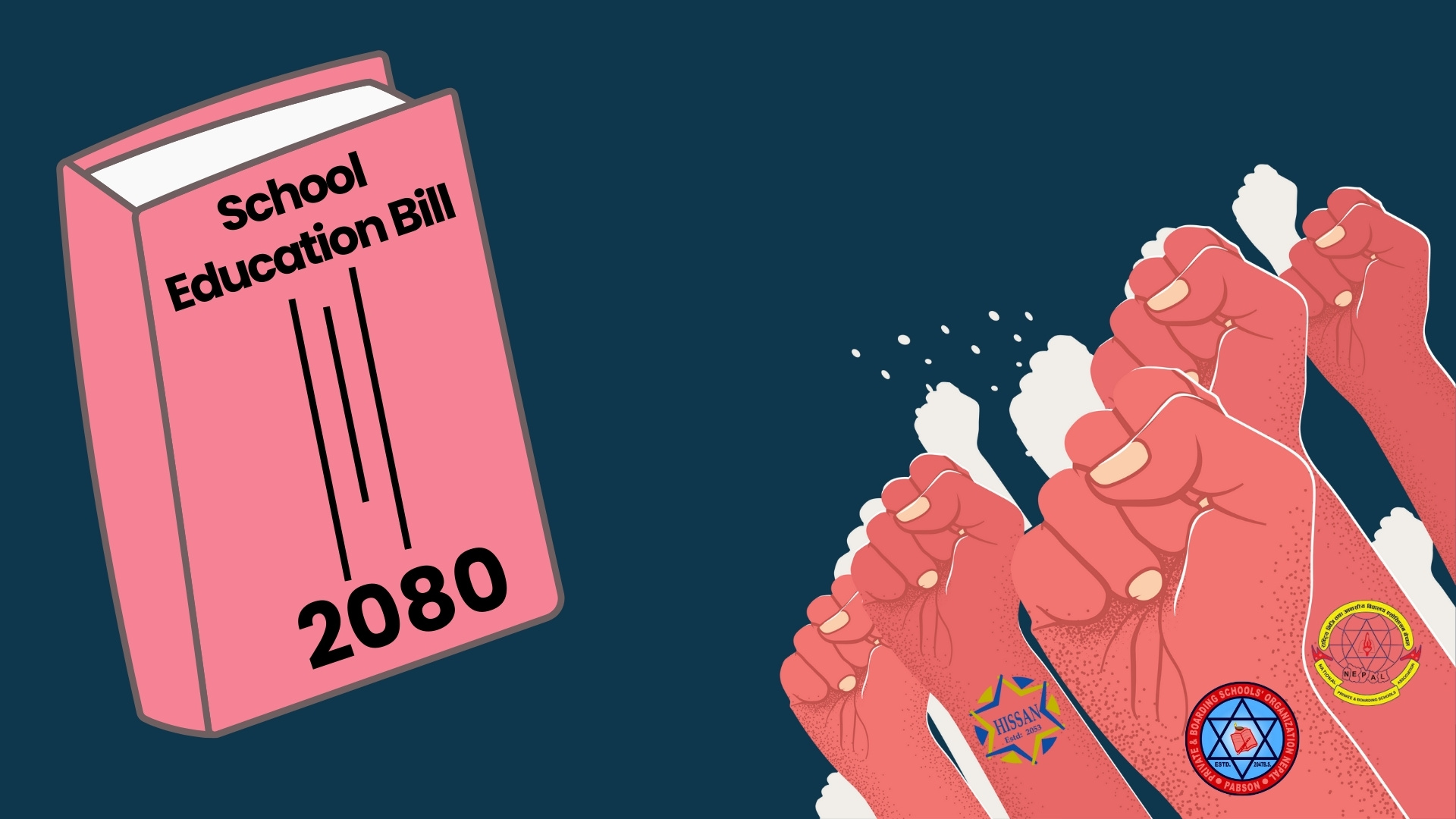
Private schools held a protest on Monday against some of the provisions in the School Education Bill 2080 which is currently registered at the Parliament after approval from the parliament’s Education, Health and Information Technology Committee.
Private and Boarding Schools’ Organisation Nepal (PABSON), the National Private and Boarding Schools’ Organisation Nepal (N-PABSON), and the Higher Institutions and Secondary Schools’ Association Nepal (HISSAN) organised the protest where key representatives such as investors, principals and teachers participated demonstrating at New Baneshwar.
Private schools are particularly concerned about provisions requiring them to offer ‘full’ scholarships to students and that schools can turn into non-profits under trusts models.
According to the bill, schools must provide full scholarships to a certain percentage of their students based on total enrolment. Those with up to 500 students must offer scholarships to 10% of their students, 12% for schools with up to 800 students and 15% for schools with enrolment higher than 800. These scholarships must be equally divided between underprivileged or marginalised students and meritorious students.
Among their key demands is the removal of the word ‘full’ in the proposed scholarship provision, which also requires schools to cover non-educational materials such as uniforms, stationery, educational materials, food/snacks.
Private schools say that the two provisions on non-profit and full scholarships go against the law and spirit of the Company Act. Although the provision doesn’t mandatorily require schools to turn non-profit, schools are demanding the clause be removed entirely.
Speaking on this at a recent event, Nepali Congress General Secretary Bishwa Prakash Sharma reportedly stated that "it is against the policy of the 'open market economy with social justice' adopted by the country" further stating that the non-profit provision is a complete discouragement to the private sector, which should be removed and amended through the parliamentary process.
Additionally, school associations are demanding that they should retain the authority to manage scholarships instead of handing it over to the local levels, while its oversight can be ensured by forming a transparent committee with the participation of municipal representatives.
They also want repealing provisions of the Scholarship Act, 1964 and the Scholarship Regulation, 2003 that provide for a 45% reservation scholarship, and the amendment made in 2020, which allows only community students who studied in community schools from grades 6 to 10 to pursue higher education and CTEVT programs,which they say are discriminatory.
The associations have announced a series of protest programs for this week and threatened to shut down schools if the government fails to meet their demands.
However, some provisions are neither new nor compulsory. While the current bill does not mandate a 'non-profit' status, the requirement to provide scholarships is not new. The Compulsory and Free Education Act 2075 mandates that private schools operate in a service-oriented and welfare-focused manner by providing scholarships of 10% to 15% of their student population. The act however did not specify these must be full-scholarships.
Presently, some seven million students are enrolled in schools from grades 1 to 12, our estimates suggest. Last academic year, there were altogether 7,010,808 students [see chart below] while the total number of schools were 35,447.
Chart 1: Level-wise total number of students in calendar year 2081
66.2% were enrolled in community schools, while 33.8% in institutional (private) schools. Among the total number of schools, 77% were community and 23% private.
Based on the figures and accounting for the absence of exact distribution of private school sizes, we estimate around 3.5 million students can get the planned scholarships.
In the calendar year 2081, a total of 1,552,168 community school students received various types of scholarships (including residential, non-residential, Dalit, female students, students with disabilities, marginalised groups, etc.).
For the fiscal year 2024/25 (2081/82), a total of NRs 1.83 billion was allocated for school education and NRs 50 million for technical education under the scholarship program.
Read More Stories

NEPSE falls nearly 75 points as market sentiment wavers
The stock market was unable to maintain the gains seen on Tuesday, slipping...

India has begun its long-delayed population census. Here's why it matters
India has begun the worlds largest national population count, which could reshape welfare...

The United Nations has called on Israel to repeal a law passed by...


Business + Finance + Economy + Tech + Environment + Nepal & South Asia + In-depth Analysis + News + Investigation + Research + Expert Opinion + Anatomy of Complex Issues.