Week in Politics | Persona-based Electioneering | Polarisation | Legacy parties | New forces
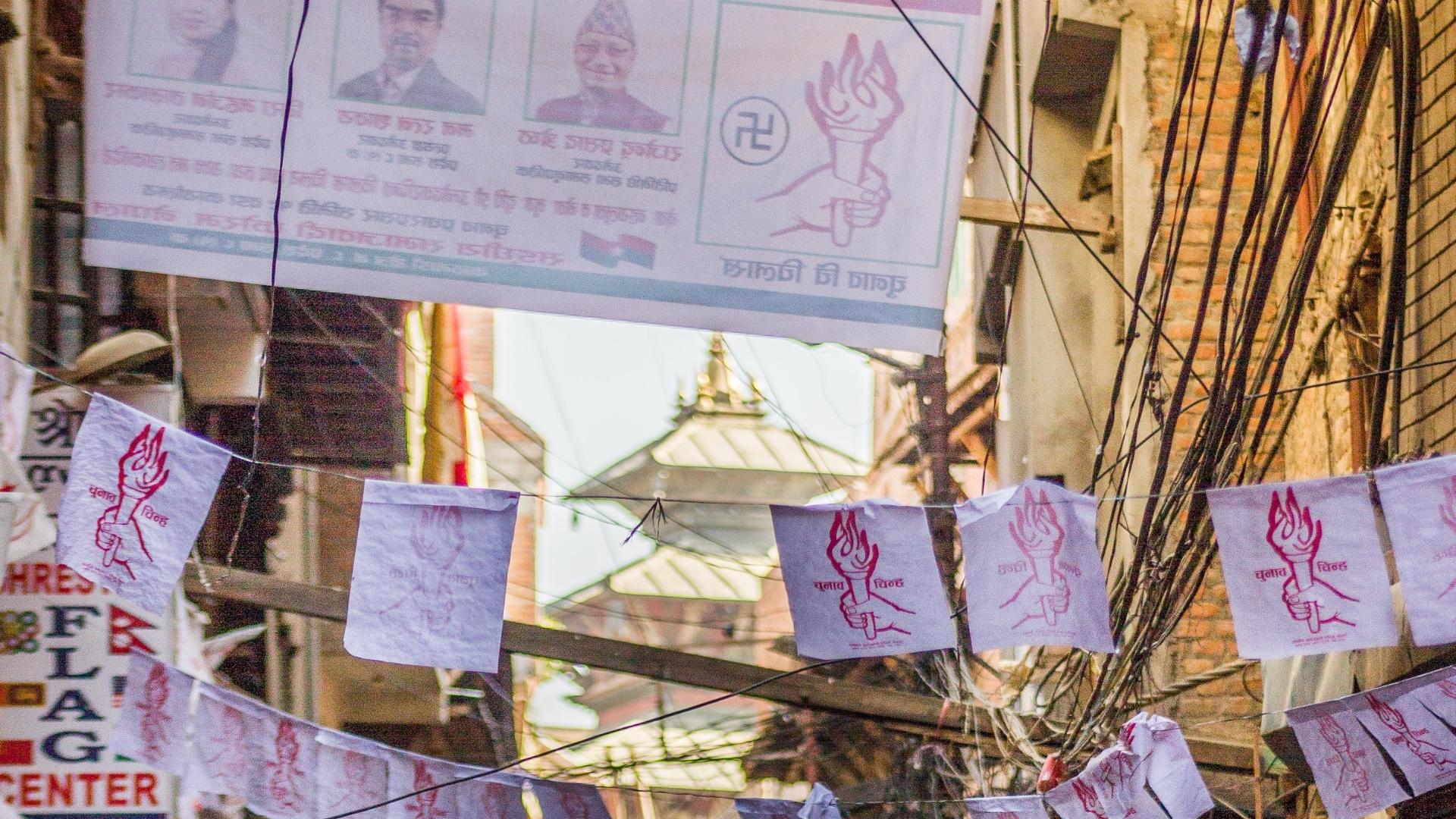
Since January 20, the day parties formally entered the phase of nominating first-past-the-post candidates, Nepal has seen a surge in electioneering, both on the ground through rallies and online via a heightened digital push.
What has unfolded since nomination day reveals a familiar pattern: established leaders sharpening polarising language, new political forces leaning heavily into symbolism, and a media ecosystem increasingly driven by virality rather than scrutiny.
To begin with, the anti-incumbency factor has posed a challenge for legacy parties. On the other hand, the same factor is broadly cited by emerging political forces, though without convincing answers on how they would “fix things” if they ascend to power. Nevertheless, a common pattern in this election, whether among old or new forces, is that political narratives centre around individual personas rather than institutional platforms.
The Rastriya Swatantra Party (RSP) appears to enjoy a greater visibility, or what digital spaces call “craze”, than the Kulman Ghising-led Ujyalo Nepal Party and the Harka Raj Rai-led Shram Sanskriti Party. The arrival of Balendra Shah in the RSP has given the party an edge in the new force race.
The RSP has declared Shah as its prime ministerial candidate, signalling the party’s ambition to position itself as a credible national alternative.
Meanwhile, the leadership transfer in the Nepali Congress (NC) to Gagan Thapa has garnered extensive media attention and a renewed hope for those who see his rise as a democratic challenge to the old establishment, a moment the party last experienced when Sher Bahadur Deuba rose to the presidency in 2016.
NC has declared Thapa as its prime ministerial candidate, emphasising generational leadership transfer while remaining rooted in party traditions.
While the electioneering this time tilts towards a broader meritocracy and economic prosperity over established leaders in constituencies, a tone set by the RSP at their Janakpur rally on January 19, the party has yet to establish itself in terms of practice and concrete policies, navigating a maze of “development” narratives. Like morning shows the day, the party’s proportional representation list and personality-driven politics are susceptible.
KP Sharma Oli’s return to CPN-UML leadership underscores his survival instinct amid political uncertainty. The party has declared Oli as its prime ministerial candidate, reaffirming his central role in the party’s national campaign. He is challenged by Shah in his home constituency, Jhapa-5, for the March 5 polls.
The RSP’s Janakpur rally, which drew the party’s largest crowd and was widely amplified across the country, remained the talk of the town for nearly a week. In response, Oli played the first card from his electoral politics deck.
Oli returned to centre stage with remarks widely criticised as racist and dismissive towards Madhesh and Madhesi communities, portraying the plains districts as dirtier and their cultural practices as inferior to those of his home constituency in Jhapa. In particular, his comparison involving “guintha” (cow dung cakes) to imply backwardness triggered widespread backlash as demeaning to the Madhesi community.
In what appears as counter to Oli, locals in Gaurigunj, which lies in Jhapa-5 constituency, gifted “guintha” to Shah’s wife, Sabina Kafle, campaigning for him and the party on January 28.
Civil society voices and commentators accused Oli of reinforcing long-standing stereotypes at a moment when Madhesh remains electorally decisive.
This episode unsurprisingly follows a long-observed pattern in Oli’s politics: when politically isolated or preparing for a comeback, he relies on rhetoric that asserts cultural and political superiority over the plains while vying for votes from hill communities, who constitute a significant portion of the population in his home constituency.
As previously analysed by the_farsight, this strategy echoes his earlier responses to Madhesi and Tharu protests, where dismissive metaphors and minimisation of dissent prioritised majoritarian constitutional delivery over negotiation. This time, the language differed, but the impulse was similar: to consolidate a base by standing against Madhesh, rather than engaging with it, amid other forces competing to appease the electorate.
In the Janakpur rally, senior RSP leaders framed Madhesh as central, not marginal, to national politics, repeatedly invoking themes of dignity, state neglect, and youth frustration. Shah’s speech, delivered in his now-familiar blend of defiance and moral certainty, was interpreted by supporters as a rebuke to traditional parties, while critics questioned the absence of policy depth. While he claimed his Madhesi identity, he also asserted that voters should vote for the RSP not because the party’s prime ministerial candidate carries the identity of Madhesi but because he is competent.
The media, however, largely abandoned interrogation in favour of amplification, with clips of Balendra’s speech circulating widely, reinforcing a trend where everything he posts, says or does is treated as headline-worthy in the chase for views.
Around the same time, a linguistic controversy involving UML leader Mahesh Basnet briefly, but tellingly, exposed the fault lines of identity politics. Basnet’s use of the term “chhauda,” rooted in native language contexts, contrasted with the Nepali term “chhaaura,” triggering debate over cultural hierarchy, intent, and everyday prejudice.
Some outlets framed the issue as a linguistic misunderstanding, while others pointed to how language becomes a political tool, especially when spoken by those in power, to reinforce social dominance. Coverage was uneven, with much of the media focusing on simply outrage while ignoring why such terms resonate differently across communities.
Parallel to these developments, Gagan Thapa’s speeches in Sarlahi-4, the constituency he is contesting, have been calibrated to signal generational change while staying within the party’s ideological zone.
Though he addressed institutional reform, economic stagnation, and trust deficits, positioning himself as both an insider and a reformist, his rise has largely been personality-driven. The media has prevented interrogating how his leadership might materially alter Congress’s long-standing approach to federalism and Madhesh.
The period also saw controversy surrounding former independent lawmaker and now RSP leader Amresh Singh, after he made an extreme and emotive statement invoking personal stakes in connection with electoral outcomes involving Balendra Shah in Jhapa-5 and Gagan Thapa in Sarlahi-4.
Singh has used extreme tactics to underscore his views previously as well, notably while delivering his speech at the lower house, where he undressed, accused Sher Bahadur Deuba and his family of corruption, claiming to have all the evidence, which he has not yet.
While political leaders and mental health advocates criticised the remark as irresponsible, much of the media coverage focused on its shock value, raising questions about ethical reporting and the normalisation of extreme language in political discourse.
Amid this, demands for a prime ministerial debate among declared candidates—Oli, Thapa, and Shah—have long been in the social media cycle, portrayed as a key arena for electoral contestation.
Oli and Thapa have expressed interest in a public debate. Shah has declined the idea, reasoning he doesn’t want to share the stage with Oli, whom he chiefly holds responsible for the September 8 and 9 event. Some observers interpret the decision as a reflection of his limited oratory experience against seasoned politicians.
Regardless of whether such a debate ultimately takes place, political analysts note that the practice itself runs counter to the spirit of the country’s parliamentary system, where the prime minister is chosen from among elected lawmakers and remains accountable to parliament, unlike in a presidential system where voters directly elect the head of state or government.
Taken together, developments since January 20 point to a broader pattern in Nepal’s current political moment. Identity-based rhetoric, particularly targeting Madhesh, remains a convenient tool for established leaders like Oli. Newer forces such as the RSP and independent figures like Balendra Shah continue to dominate attention through spectacle and symbolism, aided by a media ecosystem eager for virality.
Meanwhile, substantive questions about federalism, inclusion, economic recovery, and democratic accountability struggle to break through the noise. As campaigning accelerates, the challenge for both politicians and the press is whether Nepal’s politics can move beyond statements that divide and spectacles that distract, towards debates that actually address the fractures they tend to invoke.
And with 35 days remaining until the election, political parties have yet to release their manifestos. Nevertheless, candidates are in full swing campaigning in unconventional ways, while their policy commitments remain absent for voters to scrutinise.
Read More Stories

NEPSE falls nearly 75 points as market sentiment wavers
The stock market was unable to maintain the gains seen on Tuesday, slipping...
India has begun its long-delayed population census. Here's why it matters
India has begun the worlds largest national population count, which could reshape welfare...
The United Nations has called on Israel to repeal a law passed by...


Business + Finance + Economy + Tech + Environment + Nepal & South Asia + In-depth Analysis + News + Investigation + Research + Expert Opinion + Anatomy of Complex Issues.