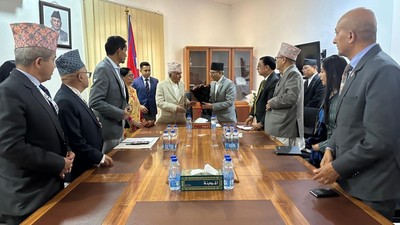
Prime Minister Office | Private Secretariat | Transparency | Nepotism Concerns

Allegations of nepotism and favouritism against the Prime Minister’s Office surfaced on Sunday after several media reports claimed that Adarsh Kumar Shrestha, Chief Private Secretary to PM Sushila Karki, used his position to appoint his wife and other relatives to the secretariat.
Some observers argue that while appointing a spouse based on merit is not illegal, and it is certainly the PM’s prerogative to decide appointments in her private secretariat, the optics of the Chief Private Secretary appointing his own wife do little to bolster public trust. Eventually, it raises questions about transparency and accountability at the highest levels of the executive, a practice the current government pledged to address.
The Nepal Gen-Z Front, a youth-led advocacy group, described the appointments as “a direct attack on ethics, accountability, and transparency,” demanding Shrestha’s removal, revocation of all his appointments, and full disclosure of secretariat personnel and their responsibilities. The organisation warned that ignoring these concerns could erode public trust in a government that campaigned on reform and meritocracy.
In response, the PM’s private secretariat has defended the appointments, framing them in terms of trust, security considerations, and the Prime Minister’s private circumstances, rather than nepotism.
The statement noted that PM Karki, who lives only with her husband, needed a dependable aide capable of close private support and round-the-clock assistance, especially given the couple’s advanced age.
The secretariat, in the case of Shrestha, rejected claims that other appointments were influenced by family ties, cautioning against assumptions based on surnames or ethnic backgrounds.
It instead boasted the government’s lean staffing of a total of 20 staff: just two advisers appointed despite seven permitted and four (including an unpaid private physician) out of permitted 19 expert staff, and 14 of the 41 private secretariat positions.
While the press release, issued by PM’s press coordinator Ram Bahadur Rawal, does not list names, the PMO website identifies three officials: Ajaybhadra Khanal as chief adviser, Govinda Narayan Timilsina as public relations adviser, and Adarsh Kumar Shrestha as chief private secretary.
Citing the Prime Minister’s Adviser and Secretariat Management Procedure (2074, Eleventh Amendment 2081), the PMO clarified that the PM has full authority to appoint the Chief Private Secretary, while other secretariat hires are processed through the private secretariat.
The statement concluded with an appeal to maintain focus on the government’s stated priorities, such as clean, impartial, and fear-free elections, urging the public and media not to be swayed by controversies that could divert attention from transparency and good governance.
Yet, while the PMO stresses that only 20 staff are working in the secretariat and emphasises to focus on transparency and good governance, it has publicly named just three of its secretariat members on its website, and one implicitly through the statement on November 24. Usually, the website of the Office of the Prime Minister and Council of Ministers publicises all the names.
This lack of transparency leaves space for media speculation, sometimes with serious consequences, as seen in the case of Nepal Electricity Authority (NEA) former managing director Hitendra Dev Shakya.
Many mistakenly believed his appointment was an act of nepotism, alleging he was the brother of then-First Lady Radhika Shakya. During the September 9 unrest, a mob vandalised and set fire to his residence, reportedly because of this perceived connection, largely due to the shared surname. Observers view he was targeted because the then-KP Sharma Oli administration failed to address the circulating rumours and clarify the facts.
Similarly, in the current interim government, the identities and responsibilities of the remaining 16 PMO appointees remain undisclosed. Despite pledges for transparency and merit-based appointments, this lack of clarity has created an accountability gap paving way for speculations, one that can invite serious controversies and consequences.
Amid ongoing concerns over nepotism and demands for transparency, in early November, the Karki cabinet had approved President Ram Chandra Paudel’s visit to the Second World Development Summit in Qatar, despite the inclusion of his daughter, Abagya Paudel in the delegation. Abagya serves as President’s principal private secretary.
Read More Stories

NEPSE falls nearly 75 points as market sentiment wavers
The stock market was unable to maintain the gains seen on Tuesday, slipping...

India has begun its long-delayed population census. Here's why it matters
India has begun the worlds largest national population count, which could reshape welfare...
The United Nations has called on Israel to repeal a law passed by...


Business + Finance + Economy + Tech + Environment + Nepal & South Asia + In-depth Analysis + News + Investigation + Research + Expert Opinion + Anatomy of Complex Issues.