Political Transition | media narratives | Youth Protests | POLITICS OF APPEASEMENT | bias | interim
A crisp chill has settled over the country, but the air inside the interim government is anything but cool. The monsoon has finally withdrawn, and most Nepalis are turning their attention toward the Tihar and Chhath festivals.
Yet, the season’s calm belies the turbulence beneath. From October 3 to 6, monsoon-induced disasters claimed 53 lives just as the country was wrapping up one of its biggest festivals. Economic losses were again in the billions.
Meanwhile, the wounds from last month’s unrest remain raw, which left 75 dead and reduced several prominent government complexes and their records to ashes.
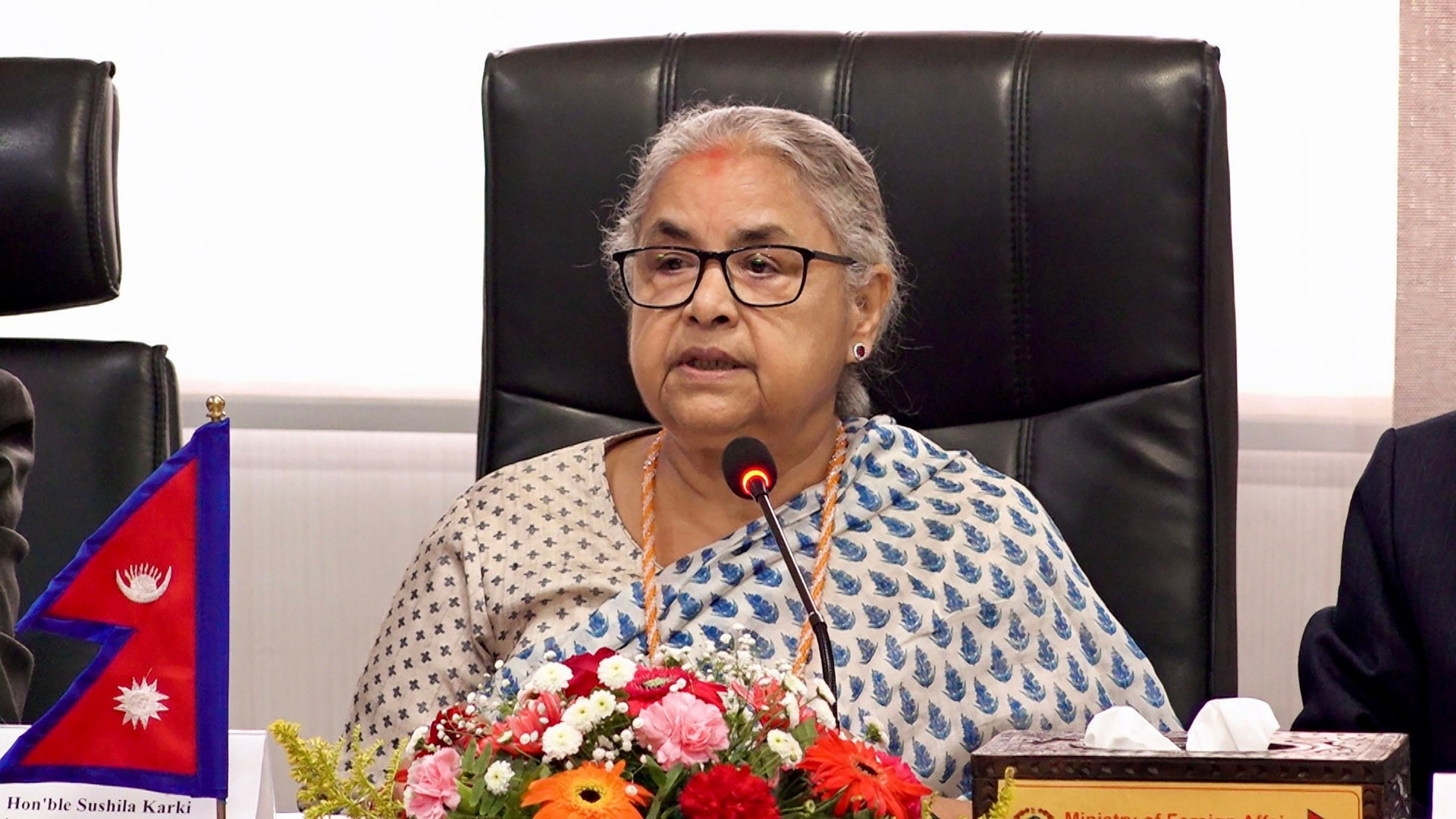
Post-unrest, it’s been 40 days since the appointment of Sushila Karki as the interim prime minister, tasked with leading the country through a delicate transition and holding elections. Acting on her recommendation, the House of Representatives elected in 2022 was dissolved, and a fresh election has been announced for March 5, 2026. A high-level judicial commission has also been formed under former justice Gauri Bahadur Karki to probe the September state killings and protestors violence. Additionally, a national damage assessment is underway, both for public infrastructure and for victims of arson. Over a dozen who lost their lives to arson are yet to be identified. So are the perpetrators.
Almost immediately after her appointment, a new dilemma surfaced: under existing election laws, voter registration halts once an election date is declared—potentially disenfranchising many young voters. To resolve this, the government issued an ordinance amending the provision.
However, challenges and dilemmas for the Karki administration are beyond just legal provisions. She is yet to complete her interim cabinet despite holding the office for over a month now during such a critical period, which she had announced would comprise 11 members. Several ministerial portfolios remain under Karki’s direct oversight, effectively vacant.
Between sentiment and neutrality
Karki’s previous public rhetoric, often framing the fight against corruption as something achievable through swift, decisive action within a handful of days, were among the major reasons behind her public support. Those statements have played their parts in fueling unrealistic expectations that she’d be swiftly dealing corruption with her ‘bold’ moves.
Now, as she navigates complex political terrain with a limited and contested mandate, public expectations still remain high. As a result, even if the government were adhering to due process, the public only sees delay, deepening frustration.
But that’s only a part of the story.
Karki has expanded her cabinet twice, one on September 14, another on 22. The expansion received much fanfare as technocrats took up the positions, aligning with popular demand for experts over politicians. But the inclusion of figures like Kulman Ghising and Mahabir Pun was not merely technocratic, they also have populist undertones.
In times when “one-man-army” philosophy has gained more traction over institutional strength, Ghising emerged as such who fought loadshedding. His perceived role in ending years of power cuts has reinforced his image as a clean and competent leader with proven administrative ability. The tussle with the KP Sharma Oli government over his reappointment as managing director of the Nepal Electricity Authority (NEA), a position he held for seven and a half years before his dismissal, further increased public sympathy for him.
When many mistakenly believed the appointment of Hitendra Dev Shakya as the “brother” of then-First Lady Radhika Shakya vis-à-vis an act of nepotism, which also led to his house set on fire during the protest, public support for Ghising surged with growing calls for him to step into politics. Before his ministerial appointment, one of many groups of protesters conducted online campaigns and staged demonstrations outside the Nepal Army headquarters to support him. Upon assuming office, he quickly transferred Shakya, a move many interpreted as retaliatory.
Karki’s appointment of Mahabir Pun for the Ministry of Education, Science and Technology is also interpreted as a similar undertaking, if not in a classic sense of populism. There was also an attempt to onboard Dr Sanduk Ruit, an internationally acclaimed ophthalmologist—an offer he denied posing a crucial question to the press: who will perform his professional work in his absence?
Home Minister Om Prakash Aryal took over the ministry under similar conditions to Ghising, albeit his circumstances were more opaque. A supporter of Karki since before, and a mediator during the formation of the current interim government, Aryal quickly secured the home affairs portfolio afterwards. Also an advisor to Balen Shah, a behind-the-scenes actor in forming the same government, Aryal’s political ambition may well extend beyond the current interim government, just like Ghising.
The episodes of Ghising and Aryal also highlight how social media had effectively broken hierarchical communication channels: youth groups mobilised quickly, but without meaningful dialogue, leaving their campaign vulnerable to different interest groups.
Karki must be wary of these intentions. Before that her own biases and inkling towards populist approach. As an interim PM, she must resist that impulse moving forward and prevent the use of her office for long‑term political gain or aligning with factions, lest the transitional government loses neutrality.
Managing media narratives
Media coverage, both mainstream and social media platforms, is increasingly mirroring social media sentiment. This dynamic was evident during media's one-sided narrative against temporary restrictions against social media platforms; its immediate portrayal of the events of September 8 and 9 as a popular uprising, without any deeper analysis; the spontaneous call for Mayor Shah and subsequent support for Sushila Karki’s name for an interim government in the immediate aftermath of the September events.
These dynamics have also played out in the Karki government’s cabinet formation as a nod to expertise and a concession to media-driven public mood. During the second expansion, PM Karki had recommended Dr Sangeeta Mishra’s name for the health and population ministry. Anticipating her appointment, Mishra resigned from her post as an additional secretary at the same ministry. However, a media report referenced an ongoing corruption investigation against her, which was formalised by the anti-graft body a few days later. Simultaneously, backlash immediately intensified in social media questioning her loyalty under the guise of nationality, as she holds Nepali citizenship by naturalisation through marriage.
The government backed off without offering clarification.
A similar pattern emerged when a media report floated four potential names for the cabinet last week. One of them, climate activist and filmmaker Tashi Lhazom, faced similar trials and tribulations in the name of nationality, including being tagged as a foreign agent. The other three were also called foreign agents, but their nationality was barely in question.
These developments highlight a complex relationship with political decision making, media influence and public perception. With multiple leaders, conflicting narratives, competing hashtags emerging simultaneously, how PM Karki manages media narratives without leaving the public confused and susceptible to biases and misinformation and how much her administration is ready to give in to public sentiment remains to be seen.
Fragmented protestors, fragmented demands
While cabinet formation has been slow, political demands have surged, some nonsensical, others dangerously fragmented.
Some groups are calling for a directly elected executive head, bypassing political parties altogether—an idea with sweeping constitutional implications that few have studied in depth. Others demand that “corrupt politicians” and “criminal actors”, without trial before the court, be immediately arrested and barred from contesting future elections. In a recent bizarre turn, families of those killed during the protests, backed by protestors, were demanding at least three ministerial positions be reserved for them.
Several factions are also attempting to pre-emptively “set the agenda” for the next House, dictating what laws should be introduced and who should or should not lead them. Some threaten to “rule from the streets” if their demands are ignored.
Youth protestors who are claiming leadership of the protests are still fragmented, but also pushing for representation in the interim government, despite lacking experience, expertise and a coherent structure. Their own lack of clarity as to who actually are real protestors and leaders is causing confusion for both the public and government.
Part of this surge in expectations and demands has to do with Karki’s early rhetoric. Partly, her tendency to appease protestors, rather than taking clear stances on constitutional and administrative boundaries, which has also exposed her to micro-management by protestors.
Amid this climate, the Home Ministry issued a directive to hold off investigations against the perpetrators of September 9 violence until the judicial commission completes its probe. Several detainees accused of arson and looting were released under this directive. The directive was reversed following public backlash to reassert the rule of law and restore confidence of both security personnel and investors and considering upcoming elections.
Still, as the government’s legitimacy largely rests on the two day events of September and youths who played a decisive role in her appointment, her administration may not want to irk their current base—many of whom can see such an investigation could delegitimize the movement and damage its credibility.
Former PM Oli, for his part, has challenged the government to arrest him and called the government unconstitutional. His defiance, coupled with his political clout, has further complicated the fragile calm. As tensions continue to rise, confrontation with opposition groups is likely if they ever come face-to-face. The 2007 Gaur incident must evoke cautions. As such, the government now faces triple tasks, maintaining order, avoiding possible escalations and seeking political consensus for the March election.
In stark contrast, Nepali Congress President Sher Bahadur Deuba has signalled a pragmatic path, which should be a relief and an opening for the Karki administration. Deuba has indicated that his party is inclined to participate in the March 2026 election, urging the government to ensure a free and fair environment. Moreover, he has stepped down from the party presidency, handing over the responsibility to Vice President Purna Bahadur Khadka to hold the 15th General Convention, which will elect new party leadership.
Damage assessment, lost weapons and a demoralised law enforcers
While political debate dominates headlines, the practical consequences of the unrest run deeper. 1,276 firearms, including INSAS and SLR rifles, were looted from police stations during the protests. Roughly 400 have been recovered. The risk these missing weapons pose is severe: if unrecovered, they could resurface anytime in volatile moments, including during election season. Such an atmosphere of fear and intimidation cannot produce fair elections.
Additionally, while police morale is at a historic low, 6,500 fugitives, including individuals convicted of serious crimes, remain at large following the mass prison breaks during the September unrest. In response, residents have formed informal patrol groups to safeguard their neighbourhoods. In times like this, public trust is hard to win back.
Constitutionality of her own government
As Karki’s administration tries to move towards a free and fair election, there are questions surrounding its own constitutional grounding. Some legal experts have branded the interim setup “unconstitutional”, arguing that the president’s move to dissolve the House on Karki’s recommendation violated procedure. Others counter that the interim government was a political necessity, born out of crisis, not ambition. Independent critics call the formation “extra-constitutional”, meaning not against the constitution but outside of the supreme document.
As many as 10 writs have been filed at the Supreme Court, an inevitable course, challenging the validity of the government and demanding the reinstatement of the dissolved lower house.
If the court overturns the decision, the political cycle will begin anew, but not necessarily for the better.
Read More Stories

NEPSE falls nearly 75 points as market sentiment wavers
The stock market was unable to maintain the gains seen on Tuesday, slipping...
India has begun its long-delayed population census. Here's why it matters
India has begun the worlds largest national population count, which could reshape welfare...
The United Nations has called on Israel to repeal a law passed by...


Business + Finance + Economy + Tech + Environment + Nepal & South Asia + In-depth Analysis + News + Investigation + Research + Expert Opinion + Anatomy of Complex Issues.