Nepal Premier League | Lack of Transparency | Racial Discrimination | Governance Irregularities
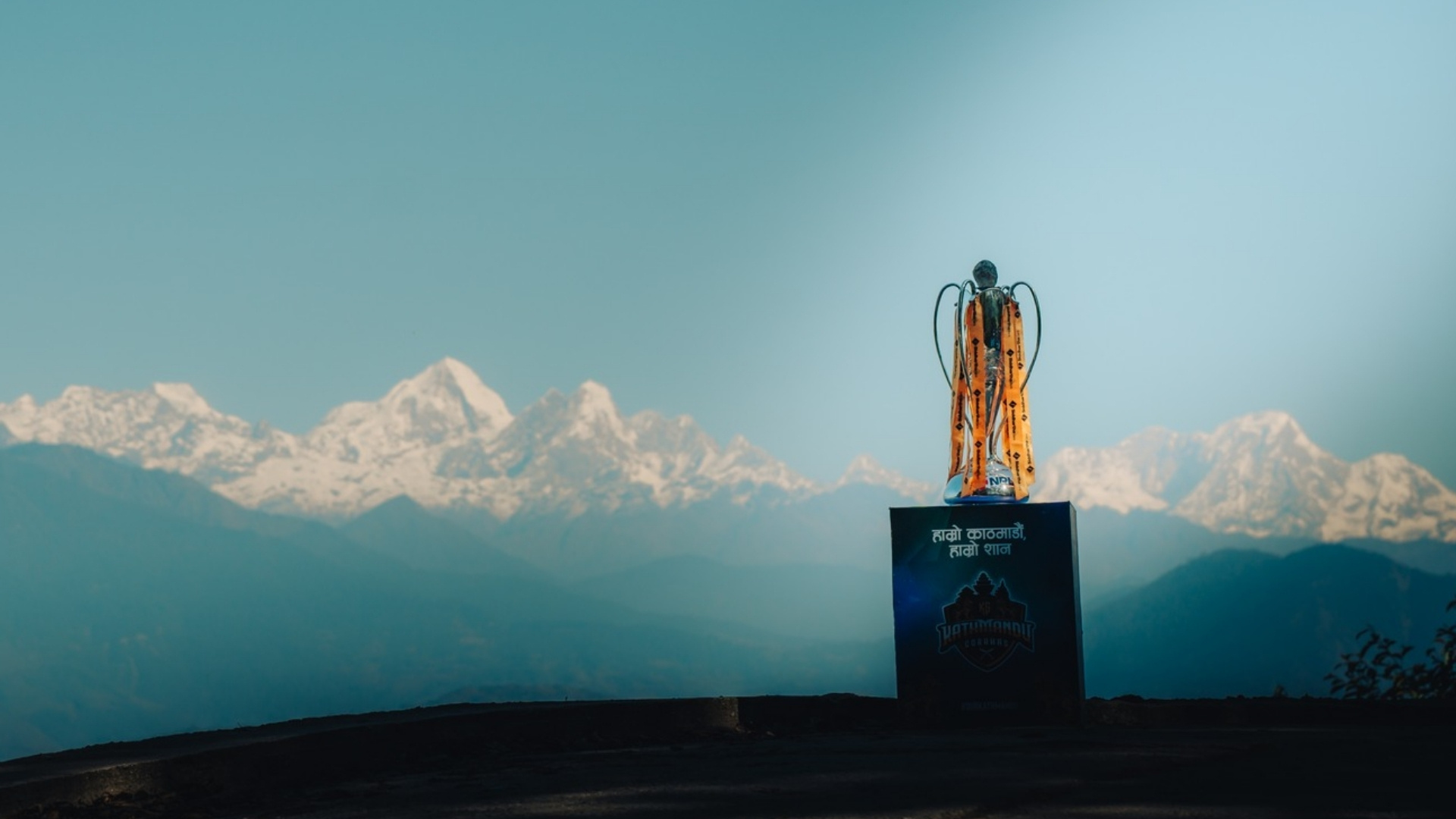
The stage is set for the Nepal Premier League (NPL)’s second season as defending champions Janakpur Bolts clash with Kathmandu Gurkhas on November 17. Fans are ready to flock to the renovated and upgraded Kathmandu venue and tune in online to celebrate what the league proudly calls the ‘Festival of Himalayas’.
For the second season, CAN has sharply raised NPL ticket prices.
General tickets now cost NRs 500 for league matches and NRs 1,000 for the playoffs and final, while premium tickets range from NRs 1,000 to 1,500 on regular days and NRs 2,000 for the playoffs and final. A full season pass now costs NPR 15,000, up from about NPR 4,480 (general) and NPR 8,240 (VIP) last season.
While the price hike signals CAN’s push for stronger commercial returns, it comes amid ongoing questions about financial transparency. With the first season’s audited accounts still unavailable and board members reporting mismatched revenues and unclear expenditures, fans and franchises have little clarity on how these higher ticket revenues will be used.
Inaugural season expectations and impressions
When the league finally launched in 2024, it marked Nepal’s boldest experiment in professional cricket. For the first time, a franchise-based tournament brought together world-class and emerging players on the same field, batting, bowling, and fielding side by side. Beyond the spectacle, it offered a chance to revive domestic cricket, giving young talents hope that cricket could become a viable career path.
The opening ceremony at the Tribhuvan University International Cricket Ground beamed across South Asia through Star Sports, and eight province/city-based franchises took the field amid fireworks and music. Nepali cricket enthusiasts had long watched leagues such as the Indian Premier League and the Big Bash from afar, imagining a tournament of their own, and finally, that dream became reality.
Yet beneath the spectacle, the debut season also exposed some of Nepal’s deepest structural and social fissures, raising questions of racism, transparency, and regulation that would linger long after the final ball was bowled.
From halted leagues to a reboot
The NPL’s arrival marked a reset after years of failed experiments. Earlier attempts, such as the Everest Premier League and Pokhara Premier League, had sought to professionalise the country’s domestic cricket scene but were repeatedly halted. Governance disputes within the Cricket Association of Nepal (CAN), financial irregularities and even the International Cricket Council’s suspension of CAN between 2016 and 2019 crippled those ventures.
The NPL was meant to break that pattern.
Organised by CAN in partnership with Indian marketing firm Seven3 Sports, the league featured eight franchises that collectively paid licence fees of NRs 168.89 million.
Teams spent NRs 59.25 million at auction on 62 players, with marquee players valued up to NRs 1.5 million each. The tournament carried an estimated economic impact of NRs 800 million, underscoring just how large the stakes had become for Nepal’s cricket economy.
Racism and the uneasy spirit in the stands
But the league’s latent promise of inclusivity, which Prime Minister Sushila Karki described in her social media accounts as “a festival that binds all Nepalis together in the spirit of unity. It is a matter of national pride,” was violently undercut after the final match in December 2024.
Bipin Yadav, a supporter of the Janakpur Bolts from Madhesh’s Siraha district, told the_farsight he was attacked by a mob of 50 to 60 people outside the TU Ground simply for wearing his team’s jersey. They allegedly assaulted him with metal rods and pipes, looted his belongings, and even after he filed a complaint, police reportedly encouraged a cash settlement rather than pursuing charges.
Videos that went viral showed Bolts supporters being chased and beaten while chants of communal slurs rang out. The National Madhesi Commission publicly condemned the attack as “racial, communal and discriminatory,” urging legal action.
As the_farsight wrote, the assault was “not an unfortunate consequence of fan rivalry, but clearly a medium and chance for the racist group to demonstrate what they think of an entire community—of Madhesis in this particular event.”
Yet CAN has remained silent, failing to issue a public statement or initiate disciplinary proceedings despite the ICC’s anti-discrimination code mandating such steps. The absence of official accountability has since raised doubts about whether Nepal’s cricket administrators understand racism as more than just a public-order issue.
Money, numbers, and missing transparency
Financially, the numbers dazzled. Ticket prices ranged from NRs 300–700 for the opening match to NRs 500–1,000 for the final; season passes sold at over NRs 8,000. The event had an impressive sponsor lineup: Siddhartha Bank (title sponsor), Ncell, Omoda, KFC, Vivo, Red Bull, Soaltee, Dream11, and Khalti.
For months after the tournament, CAN did not publish a detailed financial statement. By mid-2025, news outlets reported that the board had not yet approved the expenditure report. Later, in August 2025, CAN released an income-expenditure summary showing total income of NRs 276.9 million; total expenditure of NRs 201.5 million; and a revenue of NRs 24.65 million after sharing revenue with franchises and provinces.
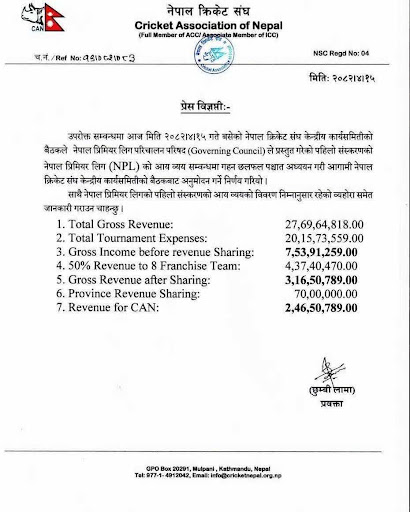
While these figures suggested a financially successful debut, CAN has yet to publish a full audited report, still raising questions of transparency.
Fresh concerns resurfaced just days before the second season, as a detailed investigation by Ukaalo, a non-profit news outlet, revealed that CAN’s board had still not approved the first season’s accounts.
According to the report, the NPL’s governing council, led by CAN Secretary Paras Khadka, submitted only a title-wise summary of income and expenditure, which prompted board members to demand a full breakdown.
The report also highlighted mismatches between contractual revenue commitments and the amounts CAN claimed to have received, along with expenditures categorised under vague headings such as “slot cost,” “production cost,” “digital and creatives,” and “social media activation.”
Several board members told Ukaalo they had been excluded from key decisions, including the allocation of broadcasting, production and ticketing rights, and they said the second season’s dates were announced on NPL’s social media pages before the board met to review the first season’s financials.
While these figures suggested a financially successful debut, CAN has yet to publish a full audited report. Without showing revenue distribution, franchise obligations, and player payments, transparency remains incomplete. Additionally, another investigative piece by Ukaalo revealed that foreign payments to players, coaches, and commentators made in foreign currency bypassed clear oversight by the Nepal Rastra Bank.
Meanwhile, the National Sports Council formed a task force to probe first-season financials and governance, citing these structural concerns. However, the CAN has reportedly not fully cooperated with the investigation, while a complaint lies with the anti-graft agency CIAA.
These disclosures reinforce the notion that the NPL’s governance arrangements, especially around procurement, foreign-exchange payments, and audit oversight, were fragile.
Players left waiting
Nepali cricket has long been haunted by delayed or missing player payments, notably during the Nepal T20 League in 2022, when players publicly accused organisers of non-payment. The NPL’s organisers claimed to have avoided those pitfalls, but with no publicly audited payroll or franchise-payment breakdown, no one can confirm whether all salaries were paid in full and on time.
Broadcast and advertising: Reach versus regulation
Even before the first match, the NPL’s international broadcast deal sparked a domestic storm. The decision by CAN to partner with Star Sports India without calling bids drew sharp criticism from three major industry bodies: the Advertising Association of Nepal (AAN), the National Advertising Association of Nepal (NAAN), and the Media Alliance Nepal. They called the deal “illegal and against national interest.”
Their joint statement argued the contract bypassed the required approval process of the Advertisement Board, violated media-law prohibitions on foreign advertising inflows, and excluded domestic broadcasters and agencies, thereby undermining the local media economy.
The controversy deepened when the Advertisement Board issued a formal warning to CAN for allowing unauthorised, betting-linked advertisements during the tournament and fined two partner agencies, Brand Digital Logic Pvt Ltd and TCM Sports & Marketing Pvt Ltd, and temporarily barred them from advertising.
For the second season too, the bid invitation for domestic broadcast rights did not follow existing procurement laws, let alone the process was transparent. Section 14(4) of the Public Procurement Act, 2007, mandates at least 30 days’ public notice for national vendors.
However, CAN invited bids for exclusive domestic broadcast rights on November 4, just 13 days before the season opener, with submissions due by 12 PM on November 11. On November 13, CAN issued a revised notice amending the bid terms: the broadcast rights would no longer be exclusive, following Star Sports’ agreement to participate. The bidding deadline was subsequently shortened, giving applicants only a single day to submit their proposals.
A blockbuster shadowed by silence
Despite the turbulence, the NPL succeeded in proving Nepal’s appetite for professional cricket. According to CAN estimates, the league’s total economic value approached NRs 800 million, with over 60,000 in-person spectators and millions of online viewers.
Yet the same league that united fans around the game also revealed how deeply the country still struggles with social discrimination and weak governance. The assault on Bolts fans after the final remains unaddressed, the financial audits remain only partially public, tender-process irregularities stand uninvestigated, and the broadcast deal still polarises the media sector.
If the league is to become more than a glittering annual event, CAN must prove it can confront not just cricketing challenges but the deeper moral and institutional tests that define Nepal’s sporting future.
Read More Stories

NEPSE falls nearly 75 points as market sentiment wavers
The stock market was unable to maintain the gains seen on Tuesday, slipping...
India has begun its long-delayed population census. Here's why it matters
India has begun the worlds largest national population count, which could reshape welfare...
The United Nations has called on Israel to repeal a law passed by...


Business + Finance + Economy + Tech + Environment + Nepal & South Asia + In-depth Analysis + News + Investigation + Research + Expert Opinion + Anatomy of Complex Issues.