
Week in NEPSE: Jan 4 - 8
This week, NEPSE edged higher, moderately upward from last week, rising by 1.15%.
The NEPSE index closed the week at 2,640.54, up from 19.62 points from the previous week. Trading opened weak on Sunday, with the index slipping to 2,610.63, while rebounding sharply on Monday and Tuesday.
The index peaked midweek, closing at 2,649.3 on Tuesday after touching an interweek high of 2,662.66, as turnover surged to NRs 7.12 billion. However, the momentum was short-lived.
NEPSE price movement [Jan 4 - 8]
Profit booking on Wednesday pushed the index down to 2,635.94. On Thursday, the market gained slightly, but trading activity slowed to NRs 4.91 billion, the lowest of the week, showing caution amongst investors.
Weekly turnover amounted to NRs 28.7 billion.
Index highlight
Alongside the main index, the sensitive and float indices, which track strong and actively traded shares, also performed well this week.
Index performance (% change)
The development bank and finance led the rally, up from 2.83% and 3.49%, respectively. Manufacturing and processing also rose by 1.83%, while banking, hotel and tourism, and hydropower posted steady gains of around 1-1.3%. While other sectors, including insurance, mutual funds, trading, and others, posted a smaller increase of under 1%.
Stock in focus: gainers and losers
This week saw rotation among the sectors, with gains and losses spread among bank and financial institutions, hydropower, microfinance, manufacturing, and listed debentures.
On the gainer’s side, Wean Nepal Laghubitta (WNLB), Narayani Development Bank (NABBC), Jeewan Bikas Laghubitta Bitiye (JBLB) from the banking and financial institutions side frequently appeared among the top gainers. Sagar Distillery (SAGAR), Shreenagar Agritech Industries (SAIL), and SY Panel Nepal (SYPNL) from the manufacturing and processing sector also showed strong buying at multiple points.
While hydropower stocks like Sanvi Energy (SANVI), Ruru Hydropower (RURU), and Three Star Hydropower (TSHL) recorded mixed results, with some days in the top gainers, while others in the top losers.
Top 5 gainers and losers over the week
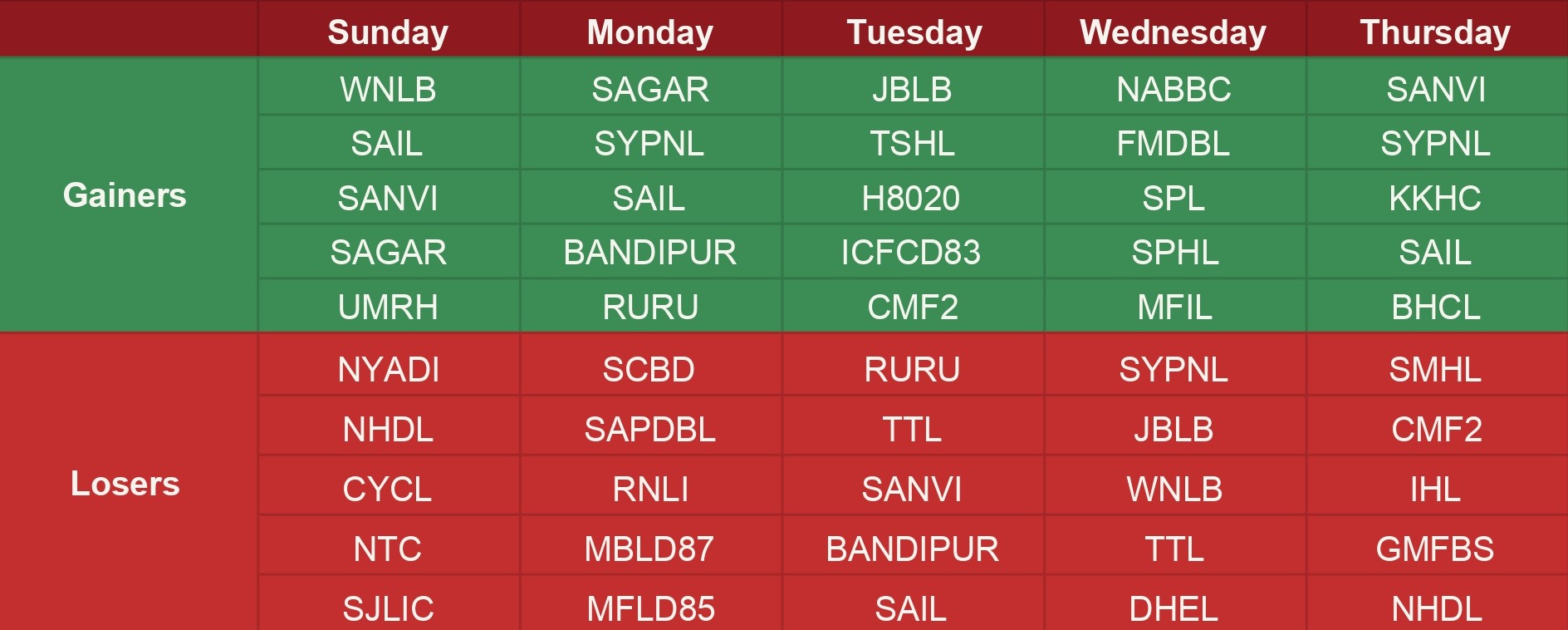
On the losing side, SY Panel Nepal (SYPNL), which repeatedly appeared on the list of top gainers, slipped to the list of underperformers on Wednesday. Other stocks, such as WNLB, SAIL, SANVI, and RURU, that appeared on the gainers' list, also appeared on the list of underperforming stocks.
Market watch: News, policies, and listings
SEBON to extend lock-in period for PE/VC investment
The Securities Board of Nepal (SEBON) has reportedly begun preparations to tighten regulation on Private Equity and Venture Capital (PEVC) investment by extending its lock-in period.
A committee has been formed to study the existing Specialized Investment Fund Regulation and review the lock-in period from the current one year to two years.
A while ago, the High-level Economic Reform Advisory Commission had recommended increasing the lock-in period.
Under the current rules, companies outside the PEVC framework have a three-year lock-in period, which applies to founders’ shares in sectors such as hydropower, hotel and tourism, manufacturing and processing, investment, and others, excluding bank and financial institutions.
Mutual fund seed capital rules set for revision after SEBON Board nods
SEBON has decided to ease seed capital requirements for mutual funds, under a proposed amendment to the Collective Investment Scheme Regulation, 2067.
Under the proposed framework, the 15% seed capital requirement will continue to apply to a fund manager’s first scheme. For subsequent funds, the requirement may be reduced to 10% or 5%, depending upon the manager's experience and performance.
The adjustment has been approved at the SEBON board level, but has not yet been implemented, as official meeting minutes and formal regulatory notification are still pending.
Inflation eases to 1.63% in the first five months
Nepal’s inflation stood at 1.63% y-o-y in mid-December 2025, driven by a 2.05% drop in food prices, while the non-food and service prices rose by 3.75%, shows the NRB’s recently released five-month statistics
Other macroeconomic updates from NRB show:
External sector: Exports jumped 58.2% to NRs 116.51 billion, while imports rose 15.8% to NRs 766.19 billion, widening the trade deficit to NRs 649.68 billion. Remittance surged 35.6% to NRs 870.31 billion.
Foreign exchange reserves increased to NRs 3,201.47 billion, which is now enough to cover 21.7 months of merchandise imports.
Fiscal sector: The government expenditure reached NRs 564.46 billion, with recurrent expenditure at NRs 398.05 billion, capital spending at NRs 33.87 billion, and financial management at NRs 132.54 billion.
While total revenue mobilisation stood at NRs 406.30 billion, including NRs 382.23 billion in tax revenue.
Monetary sector: Broad money (M2) expanded 12.9% y-o-y, deposits rose by 13.9%, and private sector credit grew 6.6%. The interest rate declined further, with a weighted average inter-bank rate at 2.74% with commercial lending at 7.26%.
Capital market: Stock market capitalisation in mid-December 2025 stood at NRs 4,368.17 billion, down from NRs 4,449.11 billion from the same month the previous year.
However, non-performing loans in BFI climbed to 5.26%, while NRB absorbed NRs 24,621.05 billion in net liquidity, reflecting excess liquidity and stress in asset quality in the banking system.
Nepal tightens rules on money laundering and terrorism financing
While pressure mounts on Nepal to exit from the FATF grey list for not doing enough Nepal published several of its amended rules on money laundering and terrorism financing in the Nepal Gazette this week. The government now requires individuals and businesses to reveal more information about ownership, finances, and legal history.
Under the amended Asset (Money) Laundering Rules, banks, insurance companies, casinos, real estate businesses, gold and silver traders, and other reporting entities must now:
The government has also tightened provisions against terrorism financing. Now, if the UN publicly lists an individual or group as terrorists, the Ministry of Home Affairs can freeze their assets immediately, without prior notice. Previously, authorities had up to 24 hours to act. The new rules also allow innocent third parties to claim compensation if their assets are affected by such freezing orders.
These updated requirements stem from implementation measures introduced in 2025 and published in the national gazette this week.
Read More Stories

NEPSE falls nearly 75 points as market sentiment wavers
The stock market was unable to maintain the gains seen on Tuesday, slipping...

India has begun its long-delayed population census. Here's why it matters
India has begun the worlds largest national population count, which could reshape welfare...
The United Nations has called on Israel to repeal a law passed by...


Business + Finance + Economy + Tech + Environment + Nepal & South Asia + In-depth Analysis + News + Investigation + Research + Expert Opinion + Anatomy of Complex Issues.