Week in NEPSE: Dec 21-24
This week, the NEPSE index dipped further.
The market opened at 2,614.64 on Sunday (Dec 21), touching the intra-week high of 2,616.25 on the same day, before sliding mid-week to reach a low of 2,568.94 points on Tuesday (Dec 23). It closed the week with a slight recovery to 2,585.87 on Wednesday (Dec 24) with limited price movement.
NEPSE price movement [Dec 21-24]
Similarly, the market turnover declined throughout the week, from NRs 4.53 billion on Sunday to NRs 3.22 billion on Wednesday, reflecting reduced trading activity.
Index highlight
While the headline index slowed down, falling by 0.9% from Sunday, the sensitive index and the sensitive index inched up, indicating that fundamentally robust stocks remained relatively stable even as overall participation weakened, as shown by the decline in the float index.
Index performance (% change)
Among the sectors, the trading sector rose by 0.84%, while banking, non-life insurance, mutual funds, manufacturing and processing, and other sectors posted a modest gain.
On the downside, losses were observed in development banks, life insurance, investment companies, hydropower, microfinance, and finance companies. The development bank index declined 1.40% while life insurance fell by 1.87%, the steepest among the sub-indices.
Stock in focus: gainers and losers
This week, SY Panel Nepal (SYPNL) stood out as a prominent gainer, topping the list on Sunday, Monday, and Tuesday, and extending its post-IPO momentum. By Wednesday, however, the lead shifted to Infinity Laghubitta Bittiya Sanstha (ILBS), while NHPC, HIMSTAR, SBL, and other stocks were featured among top gainers.
Alongside equities, trading activities of debentures were notably high during the week, with several debentures repeatedly appearing on the top gainers list. Debentures such as: Citizen Bank Debenture 2086 (CIZBD86), Nepal SBI Bank Debenture 2089 (SBID89), Kumari Bank Debenture 2086 (KBLD86), and Nabil Bank Debenture 2082 (NBL82) frequently appeared on the top gainer list. This trend points to a risk-averse mood in the stock market, as investors prefer fixed-income instruments offering predictable returns over a volatile equity market.
Top 5 gainers and losers over the week
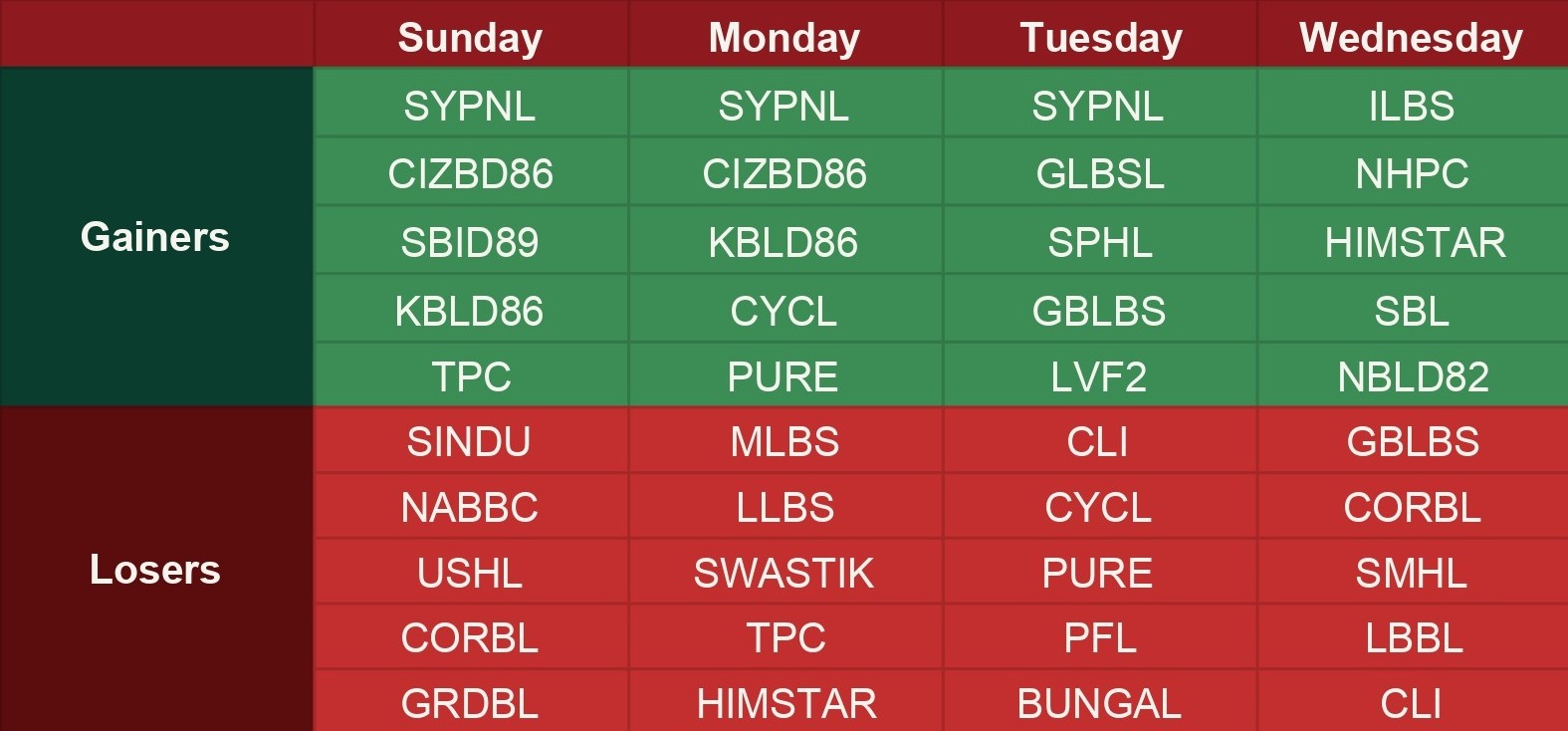
On the losing side, several stocks that had shown strength the previous week moved into decline. Sindhu Development Bank (SINDU) and Upper Sanghe Hydropower Limited (USHL), which appeared earlier among the top gainers, featured on the losing list at the start of the week. Not to mention, Swastik Laghubitta Bitiya Sanstha (SWASTIK), last week’s dominant gainer, appeared among losers on Monday, marking a change in trend.
Market watch: News, policies, and listings
The Banking Sectoral Reform Committee has released a report for sectoral reform
The Nepal Rastra Bank (NRB) has released its Banking Sector Recommendation Committee Reform Report, outlining several measures to tackle problems facing Nepal’s banking sector, including rising non-performing loans (NPL) and weak credit growth that continue to slow post-pandemic recovery.
The report highlights the NRBs' regulatory shortcomings, citing the uniform application of stringent rules irrespective of an individual bank’s risk profile, governance standards, or performance records, which creates a disproportionate operational burden—resulting in excessive directives and policy inconsistencies. To tackle this, it recommends adopting a risk-based three-tier supervisory framework that grants the top-tier institutions more autonomy. While also mandating 50% independent directors on bank boards and restricting lending to major shareholders.
The report highlights conflicts of interest stemming from the dual role of bankers and business persons or industrialists and recommends prohibiting loans to board members, promoters, or shareholders who hold stakes over 0.5% unless fully secured by their deposits. It also suggests implementing a provision in the existing BFIs Act to convert promoter shares of BFIs that have operated for more than ten years into ordinary shares.
The report calls into question the policy’s effectiveness, pointing out that NRB’s priority sector lending directive has also led to higher NPL. The report proposes selective loan restructuring policies and simplified small business loans, up to NRs 500,000 in rural areas and NRs one million in urban areas. It also encourages targeted lending to IT, startup, and high-growth sectors.
For rural development, proposed initiatives include the “NRB in Rural Areas” program with financial expert teams mentoring local enterprises, and annual financial literacy and entrepreneurship programs. Banks are urged to adopt cash-flow-based lending rather than rely solely on collateral.
The task force recommends market-driven mergers and acquisitions, with NRB acting as facilitator rather than imposing decisions. To prevent international sanctions, NRB is tasked with a two-year action plan to strengthen Anti-Money Laundering and Countering the Financing of Terrorism (AML/CFT) compliance and mitigate grey-list risks.
Capital market reforms include removing NRB representatives from NEPSE boards, easing NRN investment restrictions, introducing green bonds, and liberalising margin lending to boost market liquidity.
The report additionally outlines several proposals for modernising the broader financial ecosystem:
NRB continues to absorb excess liquidity
This week, in a bid to rein in surplus liquidity, Nepal Rastra Bank raised NRs 20 billion through an 84-day deposit auction and a further NRs 27 billion via sixteen 16-day deposit auctions, drawing participation from all categories of BFIs.
NRB issues its first set of directives for cooperative banks; sets minimum paid-up capital at NRs 2.5 billion
NRB has issued its first nine-point directives governing licensed cooperative banks permitted to conduct limited banking activities.
The directive has set the minimum paid-up capital at NRs 2.5 billion, raised exclusively through ordinary shares. It also requires the cooperative banks to maintain primary or Tier-1 capital of at least 4.5% and a total capital fund of at least 8.5%. Moreover, monthly reports on capital adequacy must be provided to NRB 15 days before the month's end.
For corporate governance, banks must maintain a board of a maximum of nine members, with 33% women and two independent directors. Likewise, a cooperative must prepare financial statements according to Nepal Financial Reporting Standards (NFRS) or International Financial Reporting Standards (IFRS), where applicable, and publish quarterly financial indicators in national newspapers within 35 days.
On risk management, cooperatives must also appoint a Chief Risk Officer to oversee credit, liquidity, operational, and market risks. Similarly, NRB has directed that loans provided to single obligators cannot exceed 15% of total member contribution or 20% of the previous quarter's total ordinary shares, whichever is lower. All loans must be classified as Pass, Sub-standard, Doubtful, or Loss, with minimum provisions applied according to risk.
Liquidity and operational norms have been tightened as well. Banks must maintain a compulsory reserve ratio of 2%, a minimum liquidity ratio of 20%, and a statutory liquidity ratio of 4%. Interest rate spreads are capped at 6%, with penal interest for late payments limited to 2% per annum.
Other miscellaneous provisions include:
The National Cooperative Bank is the only cooperative bank in Nepal at the moment.
Read More Stories

NEPSE falls nearly 75 points as market sentiment wavers
The stock market was unable to maintain the gains seen on Tuesday, slipping...

India has begun its long-delayed population census. Here's why it matters
India has begun the worlds largest national population count, which could reshape welfare...

The United Nations has called on Israel to repeal a law passed by...


Business + Finance + Economy + Tech + Environment + Nepal & South Asia + In-depth Analysis + News + Investigation + Research + Expert Opinion + Anatomy of Complex Issues.