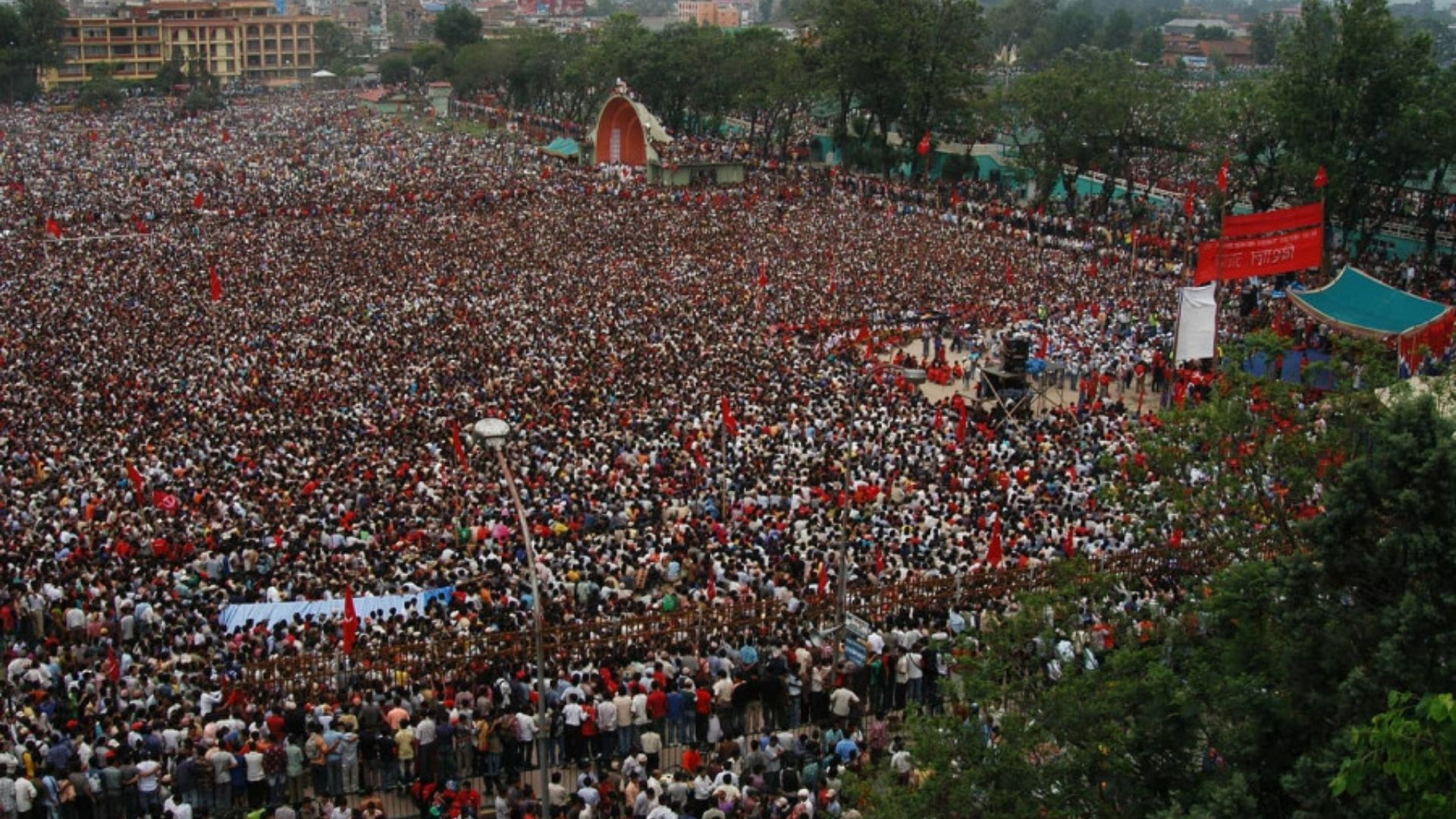
Political parties are organised groups that identify with a set of political beliefs and act as a bridge between the people and the state. In a democracy, the idea of ‘of the people, by the people and for the people,’ is embodied through these institutions. In principle, parties are expected to reflect public aspirations through participatory decision-making. In practice, Nepal’s political parties have increasingly become closed-door cartels.
The Political Parties Act 2017 is the primary legislation governing political parties in Nepal. Article 269(4)(b) of the Constitution mandates that political parties hold internal elections every five years, reinforcing the principle of intra-party democracy.
Despite these legal guardrails, a terminal decay persists in internal democratic norms within the major political parties of Nepal.
Role of parties in Nepal’s democratic history
The roots of Nepal’s political parties lie in resistance against the autocratic Rana regime, beginning with Prachanda Gorkha (1927) and the Praja Parishad (1938). Subsequent formation of the Nepali Congress (NC) and the Communist Party of Nepal (CPN) catalysed the 1951 revolution, overthrowing the Rana Regime.
Following the transition period, the country’s first parliamentary election took place in 1959 for a total of 109 seats in the house. The NC won 74 seats, while the Nepal Rashtrabadi Gorkha Parishad won 19, and the CPN won four seats.
However, this parliament was short-lived as King Mahendra imposed a Partyless Panchayat system in 1960, banning all political parties. For the next 30 years, political parties existed as resilient groups operating largely underground. While leaders directed strategy from exile in India, grassroots cadres mobilised across the country, laying the foundations for the eventual restoration of democracy.
The ban on political parties ended with the People’s Movement of 1990, which restored multiparty democracy. The 1991 elections institutionalised party competition, with the Nepali Congress and the CPN-UML emerging as dominant forces.
However, multiparty competition entered a new period of turbulence when the Maoist insurgency began in 1996. In 2006, the existing Seven Party Alliance and the Maoists signed the Twelve-Point Agreement, paving way for the Maoists to accept multiparty parliamentary democracy under a federal republic state structure.
From the political awakening in 1927 to the federal democratic republic, parties dismantled autocracy, restored democracy, and redefined the state. Yet, they face an internal democratic deficit today. Across parties, institutional dysfunction has often been driven by elite self-interest, leading to erosion of internal democracy. As a result, a political culture of splits and disciplinary action against different voices within parties has taken precedence over the institutionalisation of intra-party democratic norms.
Notably, parties across the ideological spectrum practised centralisation of power during the 30-year partyless Panchayat period, when they had to operate underground or in exile in India.
Intra-Party democracy in the Nepali Congress
The Nepali Congress statute embeds strong principles of intra-party democracy through a bottom-up, multi-tier elected structure that creates formal spaces for deliberation, dissent, and participatory decision-making. In recent decades, a power-centric and dissent-averse political culture steadily eroded the party’s core values, fostering informal centralisation and creating structural challenges to its democratic credibility.
The statute mandates a general convention every four years. In its formative years, leadership within the Nepali Congress rotated via formal means of conventions, namely amongst Matrika Koirala, BP Koirala and Subarna Shumsher.
Nepali Congress – General convention timeline since the restoration of democracy
- Eighth convention (1992) → President: Krishna Prasad Bhattarai
Gap: 32 years (party banned under the Panchayat system)
- Ninth convention (1996) → President: Girija Prasad Koirala
Gap: ~4 years (regular cycle)
- 10th convention (2001) → President: Girija Prasad Koirala
Gap: ~5 years (political instability)
- 11th convention (2005) → President: Girija Prasad Koirala
Gap: ~4.5 years (royal takeover period)
- 12th convention (2010) → President: Sushil Koirala
Gap: ~5 years (post-conflict transition)
January 2016 - The party adopts provisions for a two-term limit for party and district presidents
- 13th convention (2016) → President: Sher Bahadur Deuba
Gap: ~5.5 years (constitution promulgation phase)
- 14th convention (Due: Mar 2020, held: Dec 2021) President: Sher Bahadur Deuba
Gap: ~5 years 9 months (four postponements; exceeded statutory timeline)
While long gaps between general conventions during the Panchayat era existed due to systemic political repression, post-1990 delays in conventions reflect a growing divergence between statutory timelines and party practice.
Post-1990, top leaders have constantly resorted to blame games to evade conventions. For instance, during the 90s and early 2000s, Sher Bahadur Deuba frequently accused Girija Prasad Koirala over delay in internal elections, leading to increased tensions.
In 2001, the Deuba government’s decision to extend the state of emergency due to the Maoist insurgency, despite the party leadership’s objection, led to his expulsion from the party and eventually a split. This turn of events institutionalised factionalism and normalised disciplinary action as a substitute for democratic dispute resolution. The party formally reunified in 2007, but the episode left a lasting imprint on internal trust, leadership norms, and the practice of intra-party democracy.
In recent years, Deuba, while he was at the helm, faced constant criticism for not being able to organise the convention on time as the 14th General Convention was delayed by nearly two years beyond the statutory deadline after being postponed four times.
His leadership increasingly sought to suppress internal dissent, as evidenced by disciplinary action taken against 23 leaders for failing to support official party or alliance candidates in the 2022 elections. This was in a backdrop where the decision to enter into an electoral alliance with the then CPN (Maoist Centre) was taken unilaterally.
Furthermore, the lack of diversity among the Central Committee office-bearers underscored the party’s failure to meaningfully internalise the spirit of intra-party democracy in line with constitutional principles. Of the former unified party’s 14 office-bearers, Mahalakshmi Upadhyay Dina was the only woman, highlighting a major gap in democratic inclusion.
The culture of taking statutory principles for granted has proliferated to an extent that, in recent years, leaders have even suggested merging with a small party to bypass legal obligations for timely conventions.
The Nepali Congress: Transition through crisis
The September 2025 protests against a nationwide social media ban exposed deep fissures within the Nepali Congress. As public anger called for a political “reset,” the party split sharply between the establishment led by Sher Bahadur Deuba and a reformist bloc spearheaded by General Secretaries Gagan Thapa and Bishwa Prakash Sharma. The reformists warned that heading into the March 5 elections under the old guard would be electorally disastrous. Deuba’s camp resisted an immediate convention, citing instability and the risk of losing control over candidate selection.
With the party constitution mandating the 15th General Convention by mid-December 2025, reformists invoked Article 17(2), which allows a Special General Convention if backed by 40% of delegates. On October 15, they submitted signatures from 2,488 representatives, about 54%, effectively blocking any delay.
The establishment struck back by suspending Thapa, Sharma, and Joint General Secretary Farmullah Mansur for five years on January 14, 2026, framing the move as an attempted split. But the Special General Convention went ahead at Bhrikutimandap from January 11–15 with majority support. On January 15, Gagan Thapa was unanimously elected party president. A day later, the Election Commission recognised his faction as the legitimate Nepali Congress, awarding it the party name and the “Tree” symbol. Barred by term limits and politically cornered, Deuba opted out of the March elections, closing a three-decade chapter in the party’s leadership.
The Communist Movement in Nepal: CPN-UML and Internal Party Democracy
In 1949, the Communist Party of Nepal (CPN) was established in Kolkata under the leadership of Pushpa Lal Shrestha with the primary aim of restoring ‘complete’ civil liberties captured by the Ranas. CPN emphasised the need for a constitution based on full freedom, democracy, and economic rights for the common people. Almost four years on, Man Mohan Adhikari was elected general secretary in the party’s first convention in 1953.
In the following years, the party would go through a series of splits and come together as a result of persistent factionalism rooted in unresolved structural contradictions. This continuous factionalism reflected the tension between revolutionary Marxist–Leninist–Maoist ideologies and the pragmatic demands of parliamentary politics, exacerbated by the larger national/global context, the role of monarchy in the country and the regional/global direction of communist movements.
The Post-Democratic Interlude (1949–1960)
Post democracy, two streams of the communist movement appeared in Nepal—one inspired by the Soviet Model and the other by Mao in China, creating factions along the same lines.
A group was led by K J. Rayamajhi, the main leader of the pro-Soviet camp. In the second convention in 1957, Rayamajhi, with his conciliatory approach towards the monarchy, succeeded Man Mohan Adhikari as the general secretary. But due to the party’s poor performance in the first general elections in 1959, winning just four of the 109 seats, rifts within the party appeared and support for Rayamajhi weakened.
The 1960 royal military coup triggered the first major split within the CPN. Rayamajhi welcomed the king’s dissolution of parliament, viewing it as advantageous given the party’s weak parliamentary presence. While Pushpalal Shrestha’s camp, rooted in inspiration from the Chinese model, favoured a united front with the Nepali Congress. Meanwhile, a third path saw Mohan Bikram Singh’s supporters reject both positions and call for a Constituent Assembly election.
The Panchayat Period (1960-1990)
During the Panchayat period (1960–1990), the communist movement operated largely underground, oscillating between clandestine organisation and episodic mass mobilisation.
This period saw intense intra-party competition, as different factions interpreted Marxist–Leninist principles through divergent strategic lenses. Lack of open political space and deep factionalism culminated in frequent new party formations and repeated splits. The 1962 Banaras Convention led to the expulsion of Rayamajhi from the party and the rise of Tulsi Lal Amatya.
Between the late 1960s and early 70s, radical factions influenced by the Chinese Cultural Revolution and India’s Naxalite movement emerged, most notably the Jhapa uprising, which was militarily defeated in 1971. Its failure prompted a rejection of imported dogmas and the search for a distinct Nepali path to socialism, leading to the formation of CPN-Marxist–Leninist or CPN-ML in 1978, led by CP Mainali.
During this period, parallel conventions took place with factions who rejected MALE’s path, claiming the validity of their own. For instance, in 1974, a fourth convention was held in Banaras, India, under the leadership of Mohan Bikram Singh. This was later rejected by the CPN-ML convention in 1989.
Through the 1970s–80s, CPN-ML consolidated organisationally, eventually embracing multiparty politics. Meanwhile, the CPN (Fourth Convention) split further into CPN (Masal, Mohan Bikram group), CPN (Masal, Mohan Vaidya group), and CPN (Unity Centre). These newly formed parties adhered to Maoist lines and boycotted the 1980 referendum.
Alongside this, Pushpalal, rejecting both royalist accommodation and Maoist dogmatism, formed CPN (Pushpalal) in 1972. Amid continued factionalism, CPN (Marxist) was formed in 1988 through the merger of CPN (Pushpalal) and Nepal Communist Party (Manandhar), a splinter group from the Rayamajhi faction formed in the 1970s, adopting a moderate left line and accepting mass politics.
In 1989, CPN (ML) held its Fourth National Convention in Siraha, rejecting the divisive 1962 fourth convention held under the leadership of Mohan Bikram Singh, where it advanced a clear position on the united people’s movement and endorsed multi-party competition. The convention elected Madan Kumar Bhandari as general secretary.
Following Bhandari’s rise, a United Left Front was formed and, in cooperation with the Nepali Congress, the 1990 People’s Movement was launched, leading to the restoration of multiparty democracy.
Post restoration of democracy and formation of UML
In the changed context, CPN-ML and CPN (Marxist) unified on January 6, 1991, forming CPN-UML. Under the leadership of Madan Bhandari, the party formally adopted Janatako Bahudaliya Janbad (People’s Multiparty Democracy) in 1993.
Timeline of general convention since the restoration of democracy
- Fifth (1993) → President: Man Mohan Adhikari | General Secretary: Madan Kumar Bhandari
Gap: ~2 years (post-1990 democratic transition)
- Sixth (1997) → General Secretary: Madhav Kumar Nepal
Gap: ~4 years (parliamentary instability period)
- Seventh (2003) → General Secretary: Madhav Kumar Nepal
Gap: ~6 years (insurgency and royal intervention)
- Eighth (2009) → Chairman: Jhala Nath Khanal | General Secretary: Ishwor Pokhrel
Gap: ~6 years (post-conflict transition)
- Ninth (2014) → Chairman: K. P. Sharma Oli | General Secretary: Ishwor Pokhrel
Gap: ~5 years (constitution-drafting and coalition churn)
- 10th (2021) → Chairman: K. P. Sharma Oli | General Secretary: Shankar Pokhrel
Gap: ~7 years
Primary Source: History Section of CPN UML’s Website
UML and intra-party democracy today
Since being nominated the party president via the ninth general convention in 2014, KP Oli has largely resorted to consolidating power while silencing critics and shrinking democratic space within the party.
Following the 10th General Convention in November 2021, Oli secured the election of most office-bearers and central committee members unopposed, and subsequently pushed for unanimous leadership selection at district conventions. While districts largely complied, this strategy faltered at the provincial level, with Lumbini leading dissent and others following.
In 2021, during UML’s first statute convention, Oli played a major role in establishing a rule that set an age limit of 70 for leadership positions within the party and a two-year term limit. This advocacy for strong intra-party democracy and establishment of a collective leadership system was an astute political move, not ideological, to restrict competition. Oli’s political manoeuvre unfolded right before the September protests as he dismantled the very rules he introduced and scrapped the limits to consolidate power.
Moreover, during the 2020 dissolution of the House of Representatives, internal tensions within the party peaked as the Madhav Kumar Nepal faction voiced dissent and eventually split into CPN (Unified Socialist). Meanwhile Oli expanded the Central Committee to 1,501 members, further controlling the decision-making process.
In 2024, the party expelled Bhim Rawal from its membership and suspended Binda Pandey and Usha Kiran Timilsina for six months following criticisms of a unilateral decision by the party president to accept donations for building a party office from Min Bahadur Gurung, the owner of Bhatbateni Supermarkets.
More recently, Oli’s move to remove a dissenting proposal put forward by Standing Committee member Karna Thapa, focusing on the state of intra-party democracy within the party, amongst others, was seen as a serious crisis of democracy within UML. This action violated Article 77 of the CPN-UML statute, which guarantees the right to dissent.
Additionally, limited diversity amongst office-bearers reflects the UML’s failure to meaningfully internalise the spirit of intra-party democracy envisioned by the constitution. As a result of the recently concluded convention, only Padma Aryal is a female office-bearer out of the total 19, while 14 belong to the Brahmin-Chettri group, underscoring a serious deficit in democratic inclusion.
The Maoist movement and intra-party democracy in the erstwhile CPN (Maoist Centre)
The CPN (Fourth Convention) formed in the 1970s with its Maoist ideologies, was the parent group of the revolutionary CPN (Maoists) and later the People’s Liberation Front. In the following two decades, Nepal’s Maoist movement underwent a series of organisational transformations.
In 1983, the CPN (Fourth Convention) split, giving rise to CPN (Mashal) under the leadership of Mohan Vaidya. Six years on, Pushpa Kamal Dahal assumed leadership after Vaidya stepped down.
In 1990, CPN (Mashal) merged with other smaller communist groups to form CPN (Unity Centre). The following year, the United People’s Front was created as the Unity Centre’s overt political wing and contested the first democratic elections in 1991. In 1995, the Unity Centre formally rebranded itself as the CPN (Maoist).
The CPN (Maoist), which emerged from radical left splinter groups, launched the “People’s War” in 1996, which culminated in the Maoists entering mainstream politics following the signing of the 2006 Comprehensive Peace Accord.
In the initial years after the onset of the war, there was room for internal discussions and policy debates within the party as senior leaders put in serious efforts to prevent disagreements from damaging the struggle’s larger goals. This was reflected in larger cohesion in party activities.
The first major fracture appeared in late 2004 due to a leadership clash between Dahal and Baburam Bhattarai. The conflict revolved around strategic differences over the future course of the revolution—whether state power could still be seized through military means alone, or whether a political alliance was unavoidable. The dispute culminated in January 2005, when a Politburo meeting demoted Bhattarai and supporters to ordinary party membership, while imposing restrictions on their movement and communications. This punitive response to dissent underscored the leadership’s intolerance for open disagreement at a critical juncture of the war.
However, as part of reconciliation efforts, Bhattarai was later reinstated and would go on to play an important role in the Maoists’ transition to mainstream politics.
Post-Insurgency politics and the crisis of internal democracy
In the years after the peace process, Maoists deviated from their ideological inclinations as leadership became increasingly centralised under Dahal. Constant shifts in alliances took place as Dahal sought to consolidate power, but these manoeuvres came at the cost of the party’s ability to address public grievances. Following a series of mergers, the lack of space for internal democracy and dissent led to a split in the UCPN (Maoist) in June 2012, as internal tensions escalated and leaders accused Dahal of abandoning the party’s original revolutionary goals.
In 2012, Mohan Vaidya (Kiran) and Netra Bikram Chand (Biplav), along with other hardliners, termed the signing of the Comprehensive Peace Agreement (CPA) as a major mistake and split to form the Nepal Communist Party (Maoist). However, there were further rifts between Kiran and Biplav, leading to a split just over two years after formation in November 2014, with Biplav forming the Communist Party of Nepal (Maoist).
In 2013, tensions resurfaced between Dahal and Bhattarai, largely over disputes concerning key party appointments. Bhattarai resigned as vice-president after clashing with Dahal, whose firm control over decision-making enabled him to push through his preferred selections for the central committee, politburo, and standing committee.
These tensions further escalated in 2015 when Bhattarai’s views on the Constitution increasingly diverged from the party line. While Dahal, alongside the Nepali Congress and CPN-UML, called for dialogue with Madhes-based parties, Bhattarai openly expressed support for their agitations and refrained from all-out celebrations on the promulgation of the constitution, leading to him severing all ties with the then UCPN (Maoist) and also resigning from the Legislature Parliament.
This was another example of Dahal’s astuteness and ability to sideline his opposition within the party and further restrict democratic space. In recent years, Janardan Sharma emerged as the most formidable challenger to Dahal’s 35-year reign, advocating for a transition from a culture of “sycophancy and authoritarianism” to a rule-based, democratic structure. Tensions escalated as Sharma demanded investigations into leadership assets, while Dahal’s camp reportedly sought to sideline him, viewing his calls for direct elections and organisational reform as a direct threat to the established hierarchy.
The crisis reached a breaking point in late 2025 when Dahal utilised a broad communist merger to once again bypass a mandated general convention and avoid internal elections. Labelling the move a survival tactic for leadership entrenchment, Sharma boycotted the formation of the new Nepali Communist Party (NCP). This public revolt ended a 25-year partnership, with Sharma officially splitting from the party to protest the systemic erosion of intra-party democracy. He later went on to form the Pragatisheel Loktantrik Party.
Read More Stories

NEPSE falls nearly 75 points as market sentiment wavers
The stock market was unable to maintain the gains seen on Tuesday, slipping...
India has begun its long-delayed population census. Here's why it matters
India has begun the worlds largest national population count, which could reshape welfare...
The United Nations has called on Israel to repeal a law passed by...


Business + Finance + Economy + Tech + Environment + Nepal & South Asia + In-depth Analysis + News + Investigation + Research + Expert Opinion + Anatomy of Complex Issues.