GenZ | Social media ban Nepal | Youth dissatisfaction | Nepal governance crisis
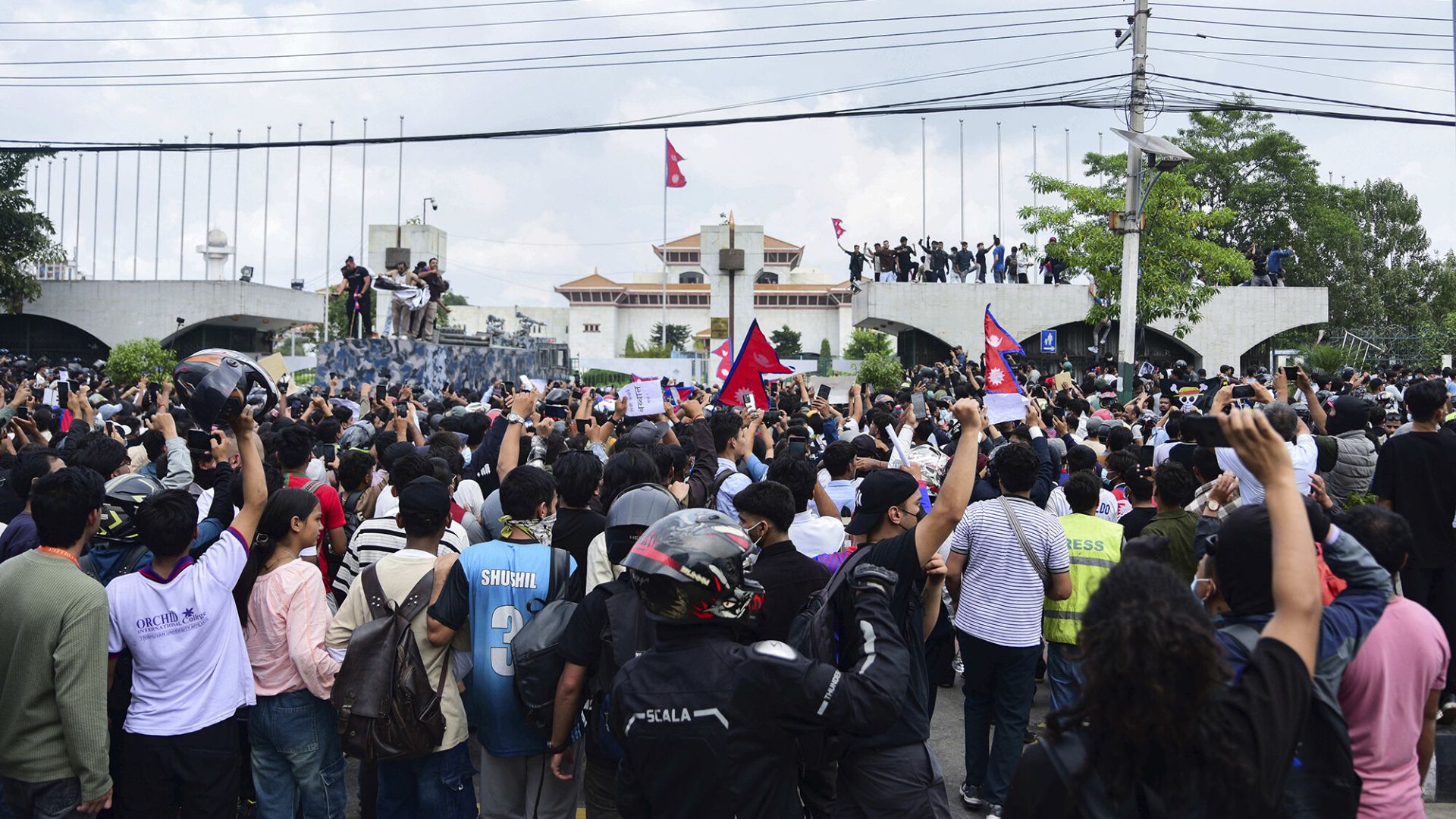
Youth-led protests against corruption and misgovernance on 8 September quickly intensified into disorder and chaos, causing 21 deaths with over 340 people wounded within hours. The protests which were announced by Gen Z, a demographic cohort born between 1997 to 2012, spanned across various cities such as Kathmandu, Pokhara, Birgunj, Bharatpur, Butwal, Janakpur, Nepalgunj, Dang, Dhangadhi and elsewhere.
In the wake of the curfew on the second day of the protest, malicious actors hijacked it—there was widespread dispersal of rioters across Kathmandu valley and other urban areas. On September 9, state and non-state institutions faced an unprecedented destruction in the aftermath. The mob stormed, torched and vandalised the federal parliament building, the Supreme Court, Singhadurbar (central administrative office), and the President’s and Prime Minister’s official residences, and ministers’ quarters in Bhainsepati along with other administrative offices across the country.
Non-state actors, particularly the private sector, faced massive losses as assets of various business leaders, outlets of Nepal’s largest retail chain, media houses, a global hotel chain, and corporate and private properties were vandalised and even set on fire. Even the residences of various political leaders, including current and former presidents, vice presidents and prime ministers were not spared. The second day of unrest saw the death toll rise to 51, with over 2,000 reported injuries.
Political fallout
The near-dystopian turn of events forced Prime Minister KP Oli to resign. With governance vacuum forming, the President, acting as Supreme Commander-in-Chief, called upon the Nepal Army to restore order. On September 12, former Chief Justice Sushila Karki was appointed as interim Prime Minister, after the President's negotiation with protesters and political parties who were then in hiding. The President also dissolved the lower house of the federal parliament and scheduled 5 March 2026 as election date. Some reports claim that the dissolution had the consent of senior party leaders.
The social media ban
Notably, protests on 8 September coincided with the social media ban which had come into force just four days ago. The government had mandated all international platforms to register in the country within seven days, else face ban, which led to restrictions in the use of 26 social media applications, including Facebook, Instagram, X, LinkedIn, and YouTube, among others.
A directive for managing the use of social networks introduced in 2023 requires social media platforms to appoint a local contact person, implement a mechanism for grievance resolution, and enlist with the concerned ministry. Following a Supreme Court verdict which instructed the government to develop necessary legal framework to regulate social media, the government justified the ban to enforce the existing regulation. Dissenters however believed it was against freedom of expression. The ban would have impacted the livelihood of many who relied on these media platforms.
The protestors reiterated that their grievances stemmed from widespread corruption, unemployment, and widening inequality.
The "Nepo Kid" phenomenon
Before the demonstrations, social media platforms, particularly Reddit and TikTok, saw the rise of the “Nepo Kid” trend in Nepal—popular in Hollywood and Bollywood and now trending across Southeast Asia, including Indonesia and the Philippines. The term was used to question the lavish lifestyles of political and bureaucratic elites’ children amid rampant inequality, youth unemployment, and rising public disillusionment.
Thousands marched through the streets on 8 Sep
Thousands of youths voluntarily, without any centralised authority or leadership, poured into the streets of first and second-tier cities of Nepal in what would become a tragic but also a defining moment in Nepal’s contemporary political history. The epicenter was Kathmandu’s Naya Baneshwor, home to the parliament building. The protest had support of the Kathmandu Mayor Balendra Shah and Rastriya Swatantra Party chief Rabi Lamichhane (currently in jail) as well as other influential personalities. Initially peaceful, the protest devolved into tragedy, as state forces responded with tear gas, water cannons, and even live ammunition. The use of excessive force to disperse the crowds near the parliament building has raised serious concerns. According to the United Nations Basic Principles on the Use of Force and Firearms by Law Enforcement Officials, firearms should be used only in the case of an imminent threat of death. Yet state responses to the protest involved violation of human rights, driven either by directives by higher authorities or misjudgment in unforeseen situations.
How international media framed the uprising
8 September
The Associated Press, in its reporting, downplayed the larger agenda of the protest, limiting the coverage as a reaction to the social media ban. While it has consolidated many events of September 8, it failed to capture the fundamental motivation. The coverage syndicated by The Associated Press was carried by Cable News Network (CNN) and Public Broadcasting Service(PBS). The framing of the event explicitly connected the demonstrations to the ban.
By contrast, the British Broadcasting Corporation (BBC) attempted to highlight the concerns of dissenters. Its headline emphasises that the social media ban is not the primary reason highlighting issues such as corruption and a declining economy. BBC cites one instance that “Demonstrators carried placards with slogans including ‘enough is enough’ and ‘end to corruption’”, enabling the global audience to better understand the larger context of the dissent.
While acknowledging Nepal’s robust space for democratic freedom in South Asia, The New York Times framed the social media ban as a suppression of freedom of speech. However, it underscored generational understanding of contemporary politics, the narrative of inequality, and the subjectivity of ordinary youths concerning governance issues.
India-based The Indian Express provided live coverage on the Gen Z protests with the latest developments, but continued to frame the protest primarily as a reaction to the social media ban.
Similarly, Sky News followed the same pattern as other international outlets highlighting “stop the ban on social media, stop corruption, not social media”, thereby reinforcing the narrative that centered on the social media ban. Generally, in the international context, the syndicated context overlooks a broader perspective with specific cultural lens dominating the narrative.
The gap in media coverage
The above mentioned media often overlook the national memory, subjectivity, and local political context of different regions. This trend diminishes nuanced understanding of any significant events that demands deeper analysis. The framing of the September 8 protest primarily around the social media ban reflects a conformist and overly simplistic narrative. In reality, thousands of the youth are motivated to protest because of broader reasons, often existential and political. Social media ban is merely the tip of the iceberg, and also a matter of coincidence. At the core, the Nepali youths are demanding a sense of belongingness and human security that guarantees decent living.
A shift in narrative: Post-9 September
By September 9, most of the international media revised their narrative—shifting away from the social media ban as the fundamental cause of the Gen Z uprising.
CNN acknowledged broader motivations—corruption, unemployment and economic inequality. Its coverage emphasised the destruction of public properties using visuals, framing the demonstrations and riots as disordered and tumultuous.
The NYT framed Nepal as a troubled young democracy with a history of monarchy for over two centuries. It also reported that security forces used live ammunition, rubber bullets, and water cannons on young demonstrators.
Similarly, PBS reiterated the framing used by the aforementioned media regarding socioeconomic and governance challenges. The appointment of Sushila Karki is highlighted as an effort to normalise ongoing chaos and governance issues, appealing to the popular demands of the youth. The interview version of the article notes that nearly 2,000 people leave the country each day, referencing the nationwide problem of youth exodus. Notably, PBS also observes the growing influence of China in the region’s political and economic affairs as a counterbalance to India’s dominance. With the new interim government in place, India, the US, and China are once again competing for influence.
Al Jazeera noted Nepal’s strategic position between India and China, highlighting that the protest will likely have regional consequences, affecting the balance of power and diplomatic approaches in the area. It has emphasised Nepal’s culture of dissent, referencing the movement that ended the Rana regime in 1951, campus agitations over political reforms in the 1970s and 1980s, and the political protest (Jana Andolan I) of 1990 that brought down the Panchayat system, followed by student and civil society protests that laid the groundwork for the abolition of the monarchy in 2008.
Likewise, the Doha-based network mentioned that 56% of Nepal’s population is under 30 years old, compared to 30% in Sri Lanka and 37% in Bangladesh—two South Asian countries that have experienced youth uprisings in recent years. It has also cited World Bank data on various economic indicators. Accounts of political history and demographic data have received significant attention among international audiences.
The BBC featured the demonstrators as politically conscious, covering stories from Gen Z activists. The magnitude of destruction is well documented, including the attack on the government building and international hotel chain Hilton. It also notes the financial losses could go up to $21.3 billion, amounting to half of the country’s GDP while also chronicling the humanitarian and socioeconomic costs of protest, indicating a complex set of problems in its aftermath.
The Indian Express editorial situated the protest as a consequence of Nepal’s flawed political system and institutions. Emphasising the significance of intergenerational consultation in the consolidating democracy, it argues that free and fair elections are crucial for long-term stability.
Similarly, the Indonesian newspaper The Jakarta Times contextualised the protest in Nepal against contemporary regional trends such as the student-led movement of Bangladesh and recent protests in Indonesia. Youth’s involvement in demonstrations across various parts of the globe is seen as interconnected rather than isolated events.
Likewise, the NYT, in a separate piece, depicted the humanitarian and psychological consequences of political unrest. Metaphors such as ‘mob’ and ‘inferno’ evoke violent symbolism. Grassroots opinions highlight lack of public health infrastructures and environmental impacts of the chaos. It also draws attention to the difficulties Nepali citizens face in accessing burn treatment.
As it turned out
While examining the consequences of the past few weeks, Nepal’s Gen Z uprising will continue to persist as the most contested political timeline of contemporary Nepal’s history, given its gravity and swift political ramifications. It is challenging to understand how the situation escalated so quickly from a peaceful protest against corruption and misgovernance to outright hostility. The actions of political stakeholders and the functioning of the state on the first day and the aftermath are subjects of close scrutiny. Equally critical is the investigation of hostile actors and mobs who caused damage to government institutions and corporate sectors across the country.
The international media extensively covered Nepal’s Gen Z uprising. While some news outlets focused narrowly on the immediate cause of the protest on 8 September, it soon became clear that the root cause of the protest and political unrest was the result of frustration against the state institutions and their operationalisation, in view of political and socioeconomic issues. These systemic problems and the psychological anguish associated with them were meticulously reported in the mentioned publications. The international media echoed the pressing concerns of inequality, corruption, and ineffective governance, which characterise dysfunctional or troubled democracies.
Moreover, the state’s response to the protest, the socioeconomic and humanitarian costs, and the historical persistence of dissent were widely acknowledged. Nepal’s Gen Z uprising is poised to become an invaluable resource for political analysts and geopolitical experts across the globe, within the scope of young demographics-led movements in the region and beyond.
Most of the references in this work draw on the perspectives of individual journalists and analysts, which should not be considered as the outlet’s official view.
Read More Stories

NEPSE falls nearly 75 points as market sentiment wavers
The stock market was unable to maintain the gains seen on Tuesday, slipping...
India has begun its long-delayed population census. Here's why it matters
India has begun the worlds largest national population count, which could reshape welfare...
The United Nations has called on Israel to repeal a law passed by...


Business + Finance + Economy + Tech + Environment + Nepal & South Asia + In-depth Analysis + News + Investigation + Research + Expert Opinion + Anatomy of Complex Issues.