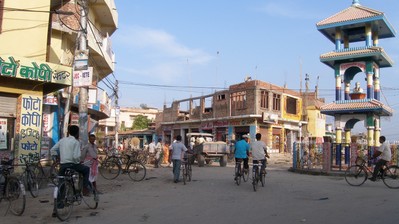
Religious Tensions | Social Media Controversy | Mosque Vandalism | Security
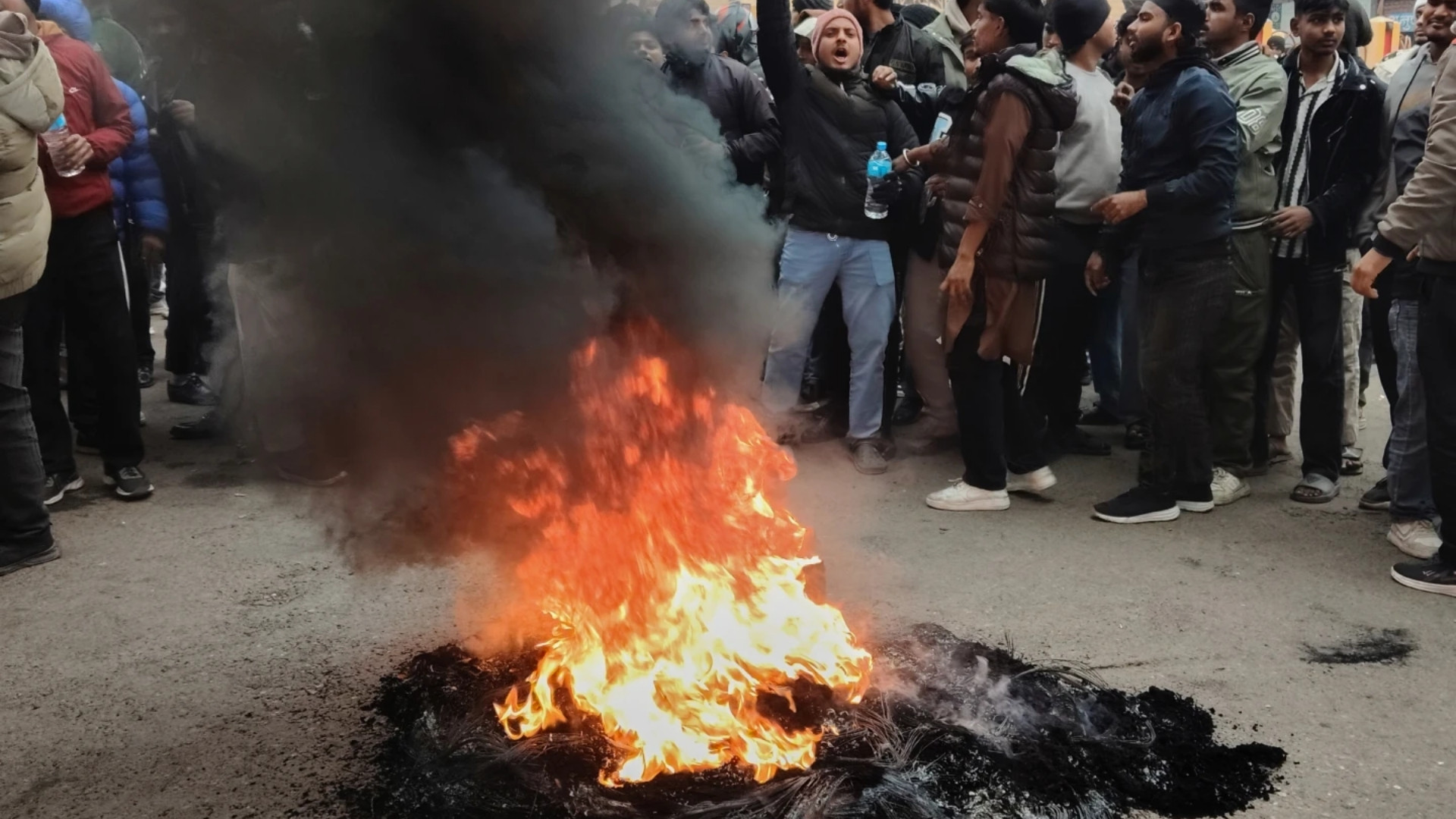
In early January, religious tensions erupted in Birgunj and Dhanusha district of Madhesh Province after two Muslim youths allegedly posted offensive content on social media targeting the Hindu community, setting off a chain of events that escalated into protests, counter-protests, and heightened security measures.
According to authorities, the social media posts by the two 19-year-old men, residents of Sakhuwa Tole in Kamala Municipality, Dhanusha, contained remarks perceived as insulting to Hindu religious sentiments. The posts quickly went viral, triggering outrage in the local community.
On January 3, a mosque in Sakhuwa Madan of the same municipality was vandalised. Reports indicate that documents were thrown around and religious texts were burned during the incident. Police detained a 25-year-old man on January 4 in connection with the vandalism, while investigations continued under Sections 155 and 156 of the Muluki Criminal Code, 2017.
“Three people who spread religious rumours via TikTok and vandalised a mosque are under the custody of Dhanusha Police,” the district police said, warning that anyone posting, liking, sharing, or commenting on content that disrupts religious harmony on social media platforms would face legal action.
The Dhanusha district administration also appealed to residents, organisations, political parties, and media outlets to exercise restraint and help maintain a peaceful environment.
Birgunj unrest and spillover risks
The vandalism in Dhanusha quickly reverberated across Birgunj, a city that has repeatedly witnessed communal tensions over the past four years.
From the morning of January 4, members of the Muslim community staged protests in Birgunj, blocking roads, burning tyres, and demanding accountability for the Dhanusha mosque vandalism. During the unrest, a police station in Chhapkaiya was vandalised. Counter-protests by Hindu groups soon followed, raising fears of a wider confrontation.
As tensions escalated, the Parsa District Administration Office imposed a curfew, followed by prohibitory orders, in parts of the Birgunj metropolitan area on January 5. Markets were shut, movement was restricted, and security patrols intensified. The curfew was later extended after some groups defied the restrictions.
Security forces were placed on alert across all eight districts of Madhesh Province, amid concerns that unrest could spread across the 21 districts of the Terai-Madhes plains.
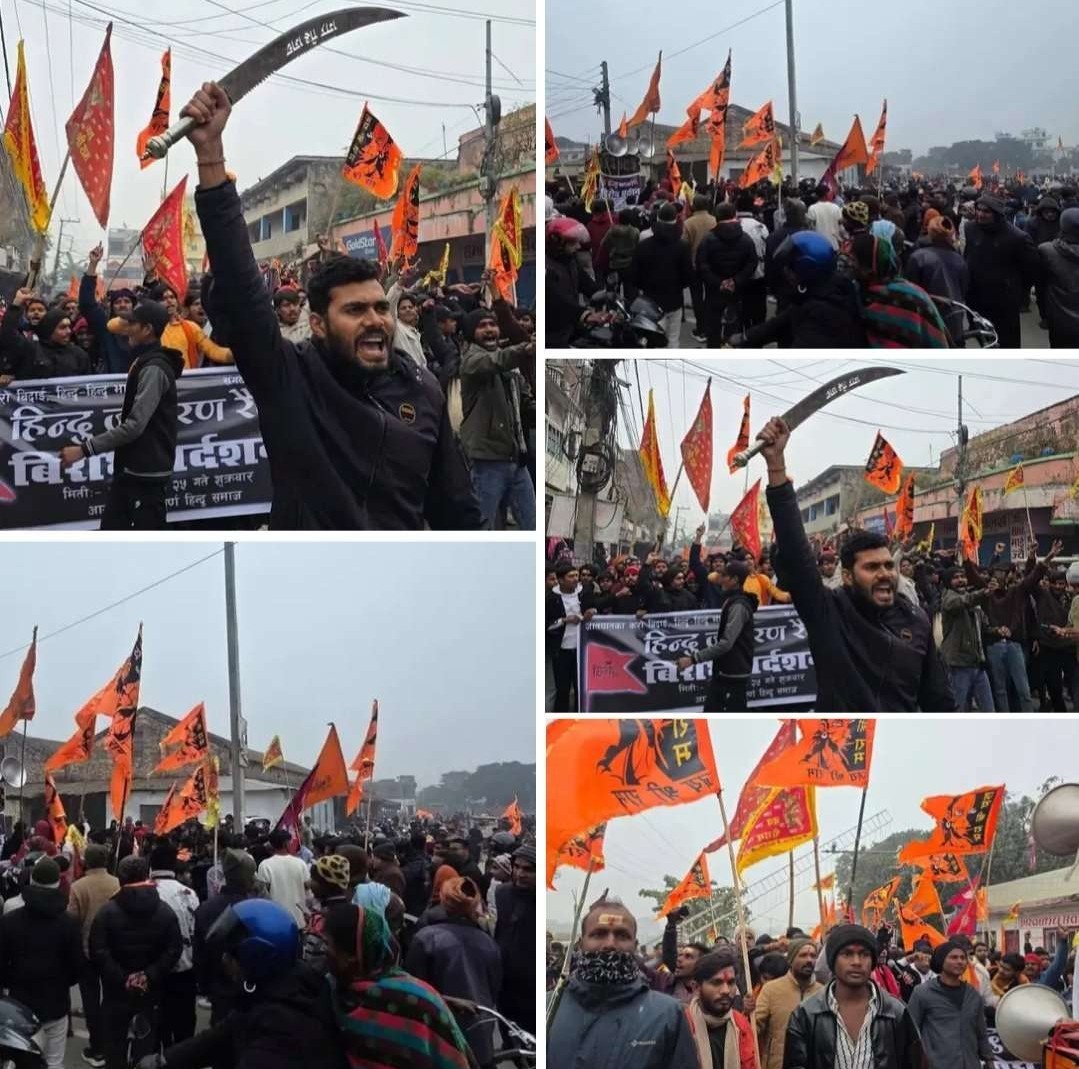
On January 9, youths were seen carrying swords in a rally organised by a Hindu group in Gaur, which they called a “peaceful protest” against provocative slogans chanted by Muslim protesters in Birgunj a few days earlier.
A vulnerable demographic landscape
Madhesh Province is home to a significant Muslim population, comprising around 811,878 people, or 13.27% of the province’s population. Muslims account for approximately 7% of the wider Terai-Madhes plains, numbering about 1.41 million. These figures underscore an overlooked reality: Muslim communities in the plains are neither marginal nor invisible, but an integral part of the region’s social and political fabric.
At the district level, Muslims constitute 22.55% of the population in Rautahat, around 19% in Banke, 18% each in Kapilvastu and Parsa, 15.5% in Mahottari, nearly 15% in Bara, 12% in Sunsari, and close to 10% in Dhanusha, among others.
In many of these districts and urban centres, dense and diverse populations coexist amid long-standing socio-economic stress. Demography here does not determine conflict, but it does shape how grievances, if ignored or mishandled, can rapidly find collective expression.
What complicates this landscape further is the persistence of high youth unemployment and educational deprivation across Madhesh and the wider Terai plains.
In Madhesh Province alone, only 14.5% have attained education beyond the school-leaving certificate, while the literacy rate stands below 64%. The overall unemployment rate is over 20%, and among those aged 15-24, it reaches 33%, the highest among Nepal’s provinces. Among those aged 25-39, unemployment stands at around 19%.
Moreover, education and employment opportunities overlap in the “NEET” category, which measures young people who are not in education, employment, or training. National data show that the NEET rate in Madhesh Province is nearly 37%, the highest among all provinces.
Limited access to quality education, scarce local job opportunities, and the erosion of faith in institutions have left large numbers of young people socially and economically adrift.
Such conditions create fertile ground for radicalisation across communities, where identity-based mobilisation, religious or otherwise, can become a substitute for political inclusion, dignity, and economic mobility.
A review by the_farsight of multiple video reels circulating across social media platforms shows how this provocation is unfolding in real time. Many of the videos contained openly hostile and inflammatory statements directed at rival religious groups. Their comment sections mirrored wider societal polarisation.
A large number of accounts appearing to belong to users from the plains communities posted hate-filled and hostile comments targeting Muslims, while many accounts appearing to belong to users from hill communities directed hostility not only at Muslims but also at another minority group, Christians.
They appear furious over one of the slogans chanted by Muslim youths in their protest in Birgunj.
Provocative slogans, taunts, and religiously charged social media content from different sides have hardened perceptions and fuelled mutual hostility, creating conditions where tensions can rapidly spill onto the streets and beyond.
What often begins as online one-upmanship, daring rival groups to “shut down the city,” or to confront them in their “area”, has repeatedly translated into street mobilisation, particularly in districts with a history of communal flashpoints.
Community leaders and security analysts warn that unless the state ensures an unbiased and even-handed approach, bringing extremists from both sides to court and ensuring visible accountability, a culture of impunity will deepen.
Selective enforcement or perceived bias risks reinforcing grievance narratives, further polarising communities and entrenching long-term instability in the region. So far, observers argue, the government response has largely been reactive, addressing incidents in isolation rather than confronting the deeper drivers of polarisation, including unchecked online mobilisation, youth radicalisation, and inconsistent enforcement of the law.
Security officials also note that youth mobilisation on both sides, driven by provocative slogans and competitive displays of strength on social media, has become a growing concern. Videos and posts daring rival groups to face off or prove their dominance have often spread faster than calls for restraint from elders, religious leaders, or local administrations.
A familiar pattern across Terai-Madhes
The Birgunj–Dhanusha unrest fits into a recurring pattern of religious tensions across Madhesh and the wider Terai-Madhes over the past decade. Such incidents are frequently triggered by festival processions, local disputes, or online provocations, before rapidly escalating through social media-driven mobilisation.
Past incidents show how quickly localised tensions can spiral across districts. In Kapilvastu in 2016, for instance, a dispute during the immersion of a Durga idol passing by a mosque in Basbariya led to one death and the displacement of more than 100 Muslim families.
Government response and preventive measures
Acknowledging the wider risk, the Ministry of Home Affairs (MoHA) issued a ten-point circular on January 6 to all 77 district administrations, emphasising religious and social harmony, particularly in the Terai-Madhes region.
The directive called for coordinated meetings with political leaders, religious figures, civil society, and media; stricter monitoring of cross-border movement; peace rallies involving all communities; and awareness programmes in local languages.
MoHA also ordered the formation of a seven-member District Peace and Social Harmony Committee in each district, led by the Chief District Officer.
The committee is tasked with monitoring potential flashpoints, maintaining dialogue, and preparing an annual calendar of sensitive events and festivals based on past incidents to prevent disputes and conflicts.
A ticking clock
By January 7, Birgunj was slowly returning to normal. Curfews were lifted, markets reopened, and schools and transport services resumed. But officials and community leaders caution that the calm remains fragile.
Without sustained dialogue, clear accountability, and stronger restraint, particularly in online spaces, the city risks slipping back into a familiar cycle of provocation, street clashes, and reactive policing.
The timing is especially sensitive.
As national politics gradually shift toward the upcoming elections, political parties are stepping up mobilisation and messaging across the country. In such a climate, unresolved communal tensions, especially in districts with a long history of religious flashpoints, can be easily amplified, exploited, or quietly left to simmer.
The Terai-Madhes, home to key trade routes, industrial hubs, and major border cities such as Birgunj, Biratnagar, Bhairahawa, and Nepalgunj, is not only politically sensitive but economically vital. Prolonged instability here carries consequences far beyond local law and order, disrupting cross-border trade, transport, labour movement, and investor confidence, while further eroding trust between already polarised communities.
Over the past decade, similar incidents have surfaced across the region, often echoing one another across district and provincial lines. Today, those echoes travel faster, carried by social media that collapses distance and context.
As Nepal edges closer to another electoral cycle, whether the Terai-Madhes remains a stabilising force or becomes a recurring pressure point may depend on what happens next, whether the state, political actors, and community leaders act early to defuse tensions or continue responding only after they spill onto the streets.
While the ministry’s directive is administratively significant, it has yet to fully materialise in the social realities of the Terai-Madhes.
Read More Stories

NEPSE falls nearly 75 points as market sentiment wavers
The stock market was unable to maintain the gains seen on Tuesday, slipping...
India has begun its long-delayed population census. Here's why it matters
India has begun the worlds largest national population count, which could reshape welfare...
The United Nations has called on Israel to repeal a law passed by...


Business + Finance + Economy + Tech + Environment + Nepal & South Asia + In-depth Analysis + News + Investigation + Research + Expert Opinion + Anatomy of Complex Issues.