Second World Summit for Social Development | Doha Political Declaration | Sustainable Growth
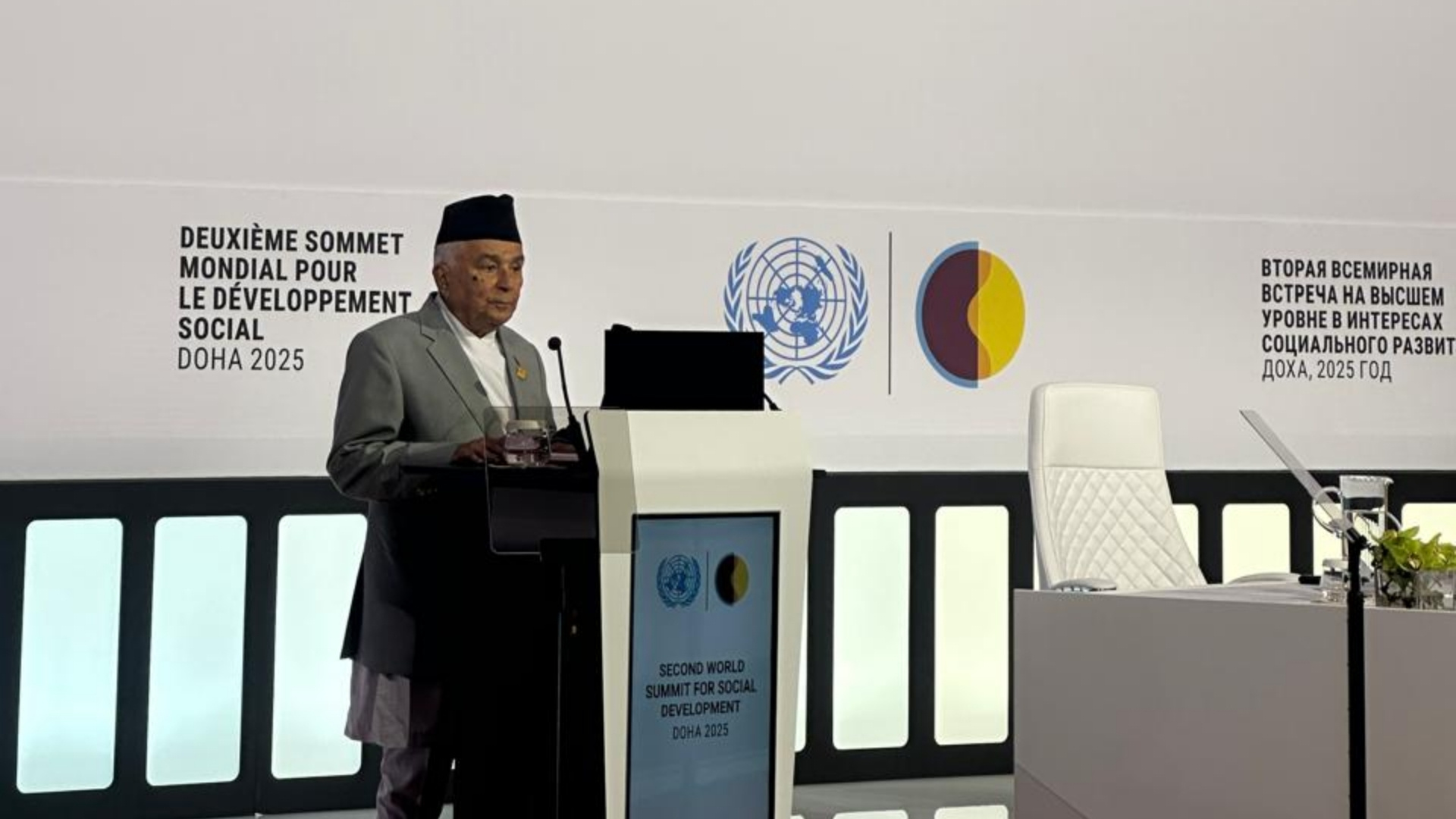
Nepal joined global leaders at the Second World Summit for Social Development this week, participating in discussions around the Doha Political Declaration, an agreed text that has yet to be formally endorsed. The Declaration reaffirms global commitment to inclusive, sustainable economic growth, decent work for all, and the eradication of poverty in all its forms.
President Ram Chandra Paudel, leading the Nepali delegation, emphasised that inclusion, justice, and social protection are the “bedrocks of social development” in Nepal.
Highlighting Nepal’s progress, he noted that poverty has halved since 1995, the country’s trajectory toward the Sustainable Development Goals exceeds global averages, over 95 % of the population has access to clean energy, gender parity has improved, and maternal and child mortality rates have declined. He stressed that global summits gain meaning only when the international community actively supports developing countries’ development efforts.
The agreed text of the Doha Declaration highlights several issues directly relevant to Nepal:
The Declaration reiterates the need to transition informal employment to formal, decent work and to invest in social infrastructure, education, and skills development.
These principles resonate with Nepal’s own challenges. A recent research in eight climate-vulnerable districts shows that extreme weather, declining crop yields, and reduced household income are pushing children into informal, hazardous labour sectors such as brick-making and carpet production.
Nearly 35 % of households reported climate events influenced the decision to send children to work, with female-headed households and marginalised communities disproportionately affected. Crop losses of up to three-quarters and lost farmland further heighten vulnerability, disrupt education, and reinforce cycles of poverty.
For Nepal, operationalising the Doha Declaration could mean targeted social protection programs, climate-resilient livelihoods, skills development, and formalisation of hazardous labour sectors. Experts note that the intersection of climate vulnerability, child rights, and informal labour underscores the urgency of translating these global commitments into concrete action.
As Nepal returns from Doha, the challenge is clear: bridging the gap between international pledges and local realities, ensuring that social protection, inclusion, and decent work reach the most vulnerable, and safeguarding development gains against climate pressures.
Nepal is also set to participate in the 30th UNFCCC COP 30, scheduled from November 10 to 21 in Belém, Brazil. Dr Madan Prasad Pariyar, Minister for Agriculture and Livestock Development, is expected to lead the country’s ministerial delegation to the summit.
Read More Stories

NEPSE falls nearly 75 points as market sentiment wavers
The stock market was unable to maintain the gains seen on Tuesday, slipping...

India has begun its long-delayed population census. Here's why it matters
India has begun the worlds largest national population count, which could reshape welfare...
The United Nations has called on Israel to repeal a law passed by...


Business + Finance + Economy + Tech + Environment + Nepal & South Asia + In-depth Analysis + News + Investigation + Research + Expert Opinion + Anatomy of Complex Issues.