Commentary | Rule of Law | Culture of Impunity | Election Season | HoR 2026
In Nepal’s election season, symbols are never just symbols. They are triggers.
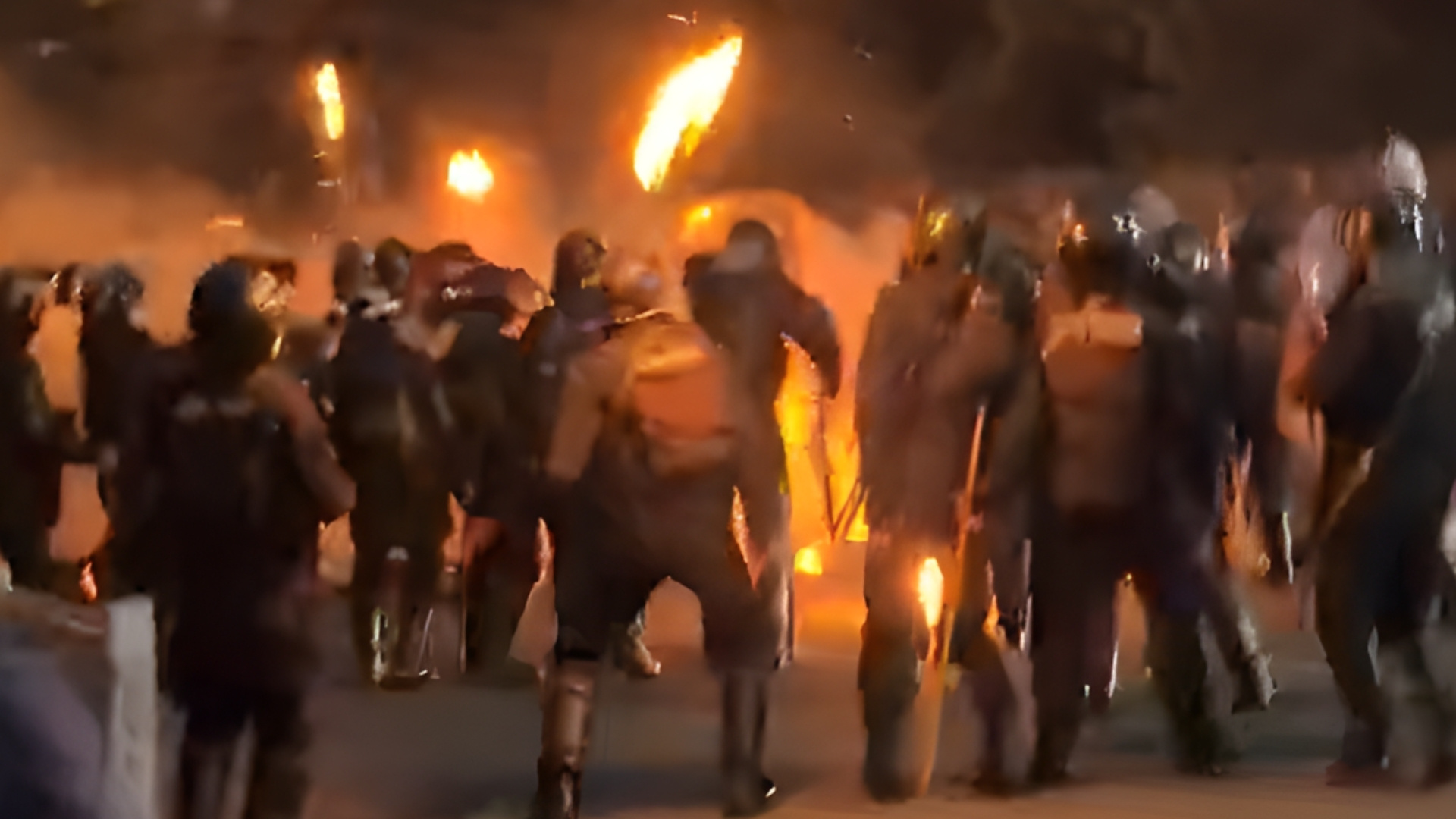
A flag goes up in flames in one district. A bell rings in a Kathmandu suburb. Flaming bamboo sticks cut through the evening air directed at police personnel at Pradarshani Marga. And from a campaign stage, a former prime minister calls for 30 party volunteers at every polling booth.
Taken separately, these incidents may look like scattered flashes of political heat. Taken together, they sketch something more troubling: a politics that is once again slipping into confrontation and a state that appears unwilling, or unable, to enforce accountability consistently.
When symbols become battlegrounds
One of the first sparks came when supporters of the CPN-UML saw their election flags burned by rival activists in the run-up to the March 5 polls. Flag burning is an unmistakable act of provocation. It is meant to wound pride, to incite anger, to invite retaliation.
Retaliation came swiftly. UML supporters burned effigies of leaders associated with the Rastriya Swatantra Party (RSP), including party president Rabi Lamichhane and senior leader Balendra Shah and vandalised an RSP party office. What began as symbolic aggression escalated into physical attacks on political property.
In a functioning democratic system with the rule of law, such incidents would be swiftly investigated under election conduct laws, with accountability on all sides. Instead, the episode dissolved into partisan outrage, with little clarity on consequences.
Soon after, a video surfaced from Gokarneshwar. A group of UML activists were seen entering a bakery and assaulting schoolchildren, reportedly Grade 10 students, for ringing a bell as a rally passed. The bell is the election symbol of RSP. What may have been teenage teasing was met with physical violence.
The optics are stark: minors in school uniforms confronted by party cadres during an election rally. Police said they were verifying the incident. But as days passed, the public saw little sign of swift or visible legal action.
In democracies, symbols are meant to represent choice. Here, they are becoming pretexts for force.
Fire on Pradarshani Marga
If the assault in Gokarneshwar suggested how quickly partisan fervour can spill over, the protest at Pradarshani Marga made the escalation more literal.
The All Nepal National Free Students Union (ANNFSU), the student wing affiliated with UML, staged a protest against the flag-burning incident. Videos showed demonstrators carrying flaming bamboo sticks, some of which were thrown toward security personnel deployed to contain the crowd.
The image of students wielding fire in the heart of Kathmandu is not just theatrical. It reflects how political anger is being choreographed and performed.
Despite visible confrontations, there were no major reports of legal consequences. The contrast is difficult to ignore. When ordinary citizens gather in protest, the state often responds with rapid enforcement. When party-affiliated groups mobilise aggressively, the response appears more measured or muted.
Selective enforcement, whether real or perceived, is the oxygen of impunity.
Thirty at every booth
Into this combustible environment stepped KP Sharma Oli, chair of UML and former prime minister. Addressing party cadres, he called for the formation of a volunteer force to guard polling booths, with at least 30 party representatives at each booth. The stated aim was to prevent malpractice and ensure that no one captures the vote.
In principle, vigilance against electoral fraud is legitimate. In practice, the imagery of dozens of party-aligned volunteers stationed at polling centres in an already tense climate raises difficult questions.
Who ensures that such protection does not become intimidation? Who draws the line between vigilance and coercion? And who enforces it?
Elections are the responsibility of the state’s neutral security apparatus and the Election Commission, not of party-organised formations. When political leaders blur that boundary, even rhetorically, they risk normalising a parallel culture of partisan enforcement.
The language of defending the vote can quickly slide into a justification for confrontation.
The long shadow of unfinished justice
Hovering over these events is the unfinished work of accountability from past unrest. After the violent September protests that saw deaths and significant destruction, the government formed the Karki Commission to investigate state killings and property damage.
The commission’s mandate is clear. Establish what happened. Identify responsibility. Recommend action.
But Nepal’s history with inquiry commissions is sobering. Reports are written. Extensions are sought. Files are submitted. Then, too often, silence. For instance, the Raymajhi Commission, formed to investigate the state killings in the 2006 people’s movement, and the Lal Commission for the 2015-16 Madhes and Tharuhat movements.
When findings are delayed or unpublished, when recommendations gather dust, a message seeps into the political bloodstream that power shields its own.
If those responsible for excessive force during protests are not held to account, if party cadres who engage in violence face no visible consequences, and if political leaders face no scrutiny for rhetoric that edges toward intimidation, the pattern hardens. Impunity ceases to be an exception. It becomes a governing principle.
Read More Stories

NEPSE falls nearly 75 points as market sentiment wavers
The stock market was unable to maintain the gains seen on Tuesday, slipping...
India has begun its long-delayed population census. Here's why it matters
India has begun the worlds largest national population count, which could reshape welfare...
The United Nations has called on Israel to repeal a law passed by...


Business + Finance + Economy + Tech + Environment + Nepal & South Asia + In-depth Analysis + News + Investigation + Research + Expert Opinion + Anatomy of Complex Issues.