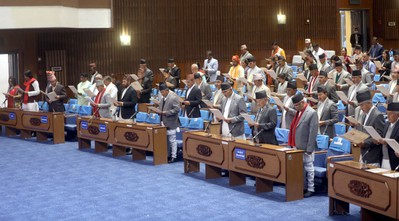
National Assembly Election 2026 | Upper House | Permanent Legislative Body | NC-UML alliance
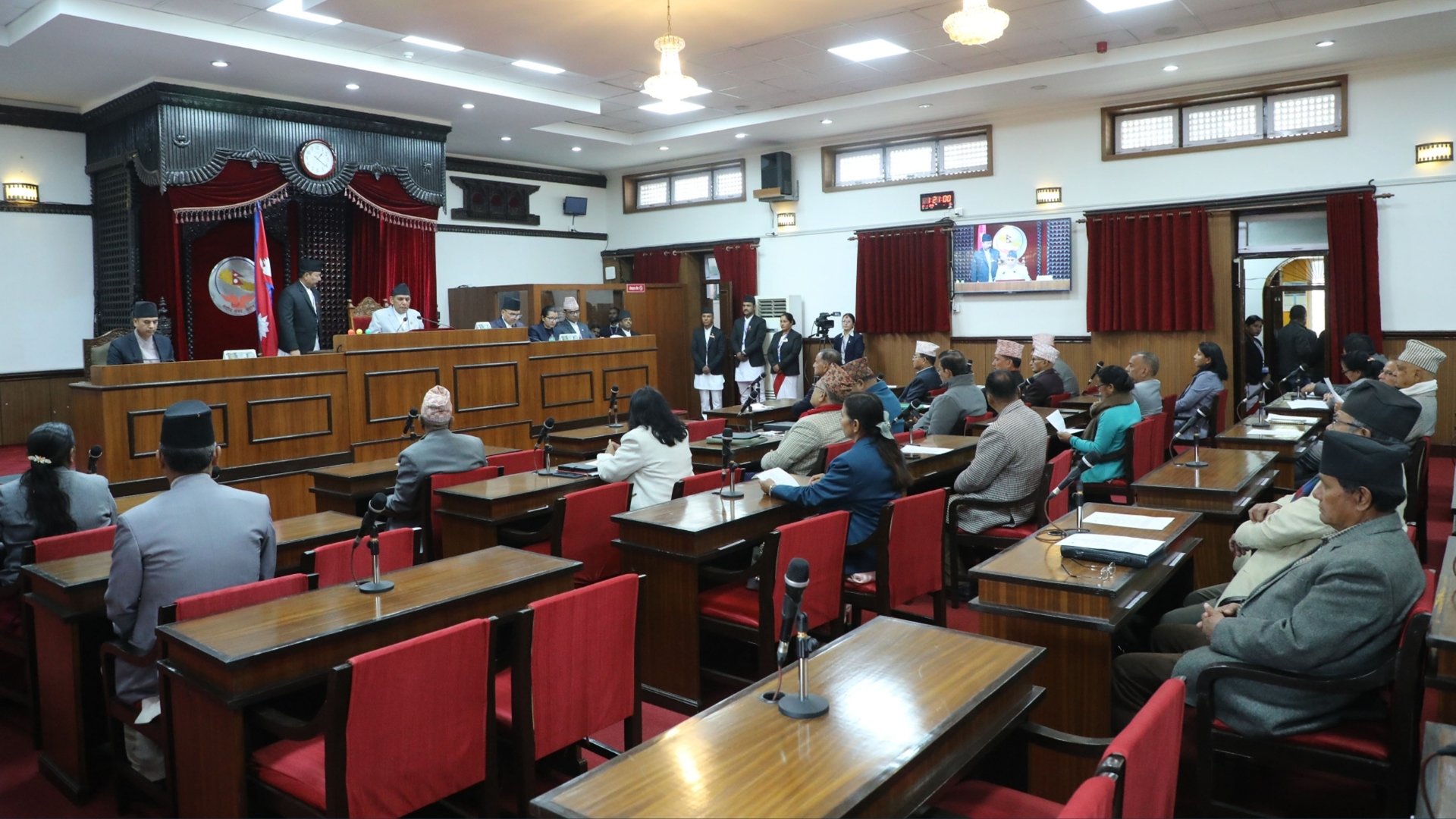
On Sunday, the government will hold the National Assembly (NA) election to fill 17 of the 19 seats whose tenure expires on March 4, 2026.
Of the remaining two seats, one is unopposed in the Open category seat in Koshi Province, already secured by Sunil Bahadur Thapa from Nepali Congress (NC), while the other will be nominated by President Ramchandra Paudel on the recommendation of the Council of Ministers.
NA members are chosen by an electoral college consisting of provincial assembly lawmakers and mayors, chairpersons, and their deputies from municipalities and rural municipalities.
What is the National Assembly?
Article 83 of the Constitution of Nepal states that Nepal shall have one bicameral federal parliament, meaning two houses: the 275-member House of Representatives, the lower house, and the 59-member National Assembly, the upper house.
Of 59 members, eight are elected from seven provinces each, totalling 56 members, and three are nominated by the President following the recommendation of the Council of Ministers. The upper house is the permanent chamber of the federal parliament, meaning it cannot be dissolved, with one-third of its members retiring every two years. It alone may exercise all the legislative functions of the federal parliament in the absence of the lower house.
According to Section 5 of the National Assembly Election Act, 2018, the government must hold elections for new members 35 days before the term of one-third members expires, to ensure continuity.
Votes within this college are weighted unequally: each provincial assembly member’s vote carries a weight of 53, while local-level representatives’ votes are weighted at 19, as determi\ned by the Election Commission (EC).
Who are the retiring NA members?
| Party | Lawmakers | Province | Cluster / Position |
| CPN-UML | Bimala Ghimire | Lumbini | Vice-chairperson of the House |
| Indira Devi Gautam | Koshi | Women | |
| Gopal Bhattarai | Lumbini | Open | |
| Tulsa Kumari Dahal | Madhesh | Women | |
| Debendra Dahal | Koshi | Open | |
| Bhagawati Neupane | Gandaki | Women | |
| Sharada Devi Bhatta | Sudurpaschim | Women | |
| Sumitra BC | Karnali | Open | |
| CPN (Maoist Centre) | Gopi Bahadur Sarki Achhami | Koshi | Dalit |
| Ganga Kumari Belbase | Bagmati | Women | |
| Jag Prasad Sharma | Lumbini | Disability and minority | |
| Taraman Swar | Sudurpaschim | Other | |
| Narayan Kaji Shrestha | Gandaki | Open | |
| Maya Prasad Sharma | Karnali | Open | |
| Radheshyam Paswan | Madhesh | Dalit | |
| Janata Samajbadi Party Nepal | Mrigendra Kumar Singh Yadav | Madhesh | Minority |
| Loktantrik Samajbadi Party Nepal | Shekhar Kumar Singh | Madhesh | Minority |
| CPN (Unified Socialist) | Beduram Bhushal | Lumbini | Open |
| Bamdev Gautam | Nominated | Nominated by the President on the government’s recommendation |
Even though the tenure of Bhagawati Neupane and Narayan Kaji Shrestha expires on March 4, they resigned early to contest the House of Representatives election scheduled for March 5. Bamdev Gautam initially resigned for the same reason, but later withdrew.
Who will be voting and who is contesting?
According to the voter’s list published by the EC, the electoral college includes 2,038 members: 545 provincial assembly members and 1,493 local-level representatives. Based on party strength, the weighted vote distribution is:
Provincial Assembly Members (weight 53 each)
| Party | Members | Weighted votes |
| Nepali Congress | 246 | 13,038 |
| CPN-UML | 198 | 10,494 |
| Nepali Communist Party (NCP) | 62 | 3,286 |
| Others/small parties | 39 | 2,067 |
| Total | 545 | 28,885 |
Local-level Representatives (weight 19 each)
| Party | Members (Mayors, Chairpersons, and their deputies) | Weighted votes |
| Nepali Congress | 708 | 13,452 |
| CPN-UML | 540 | 10,260 |
| NCP | 200 | 3,800 |
| Others/small parties | 45 | 855 |
| Total | 1,493 | 28,367 |
Combined weighted votes
| Party | Weighted votes |
| Nepali Congress | 26,490 |
| CPN-UML | 20,754 |
| NCP | 7,086 |
| Others/small parties | 2,922 |
| Total | 57,252 |
What’s the NC-UML strategy?
NC and UML have formed an alliance for the upcoming NA election, with them contesting for 10 and seven seats, respectively. With a combined weighted vote of 47,244 out of 57,252, the alliance is strongly positioned to win all 17 contested seats, while NC’s Sunil Bahadur Thapa has already secured the unopposed seat in Koshi.
Notably, no NC members are retiring in this cycle. With 11 new lawmakers set to enter, the party’s strength in the upper house will rise to 26 seats, making it the single largest party in the upper house.
The UML, meanwhile, is set to lose seven members due to retirement from its current tally of nine after Bhagawati Neupane has already resigned. With seven likely entrants, the party’s strength will stand at nine seats.
The current largest force in the National Assembly is the Nepali Communist Party, which holds 24 seats after the resignations of Narayan Kaji Shrestha and Bamdev Gautam. If the NC-UML alliance sweeps all the contested seats, the NCP’s strength will drop to 17.
A simple majority in the upper house requires 31 seats to pass ordinary legislation, while a special majority requires 40 seats.
Read More Stories

NEPSE falls nearly 75 points as market sentiment wavers
The stock market was unable to maintain the gains seen on Tuesday, slipping...

India has begun its long-delayed population census. Here's why it matters
India has begun the worlds largest national population count, which could reshape welfare...
The United Nations has called on Israel to repeal a law passed by...


Business + Finance + Economy + Tech + Environment + Nepal & South Asia + In-depth Analysis + News + Investigation + Research + Expert Opinion + Anatomy of Complex Issues.