Pakistan Flash Floods | Climate Vulnerability | Loss & Damage | Khyber Pakhtunkhwa
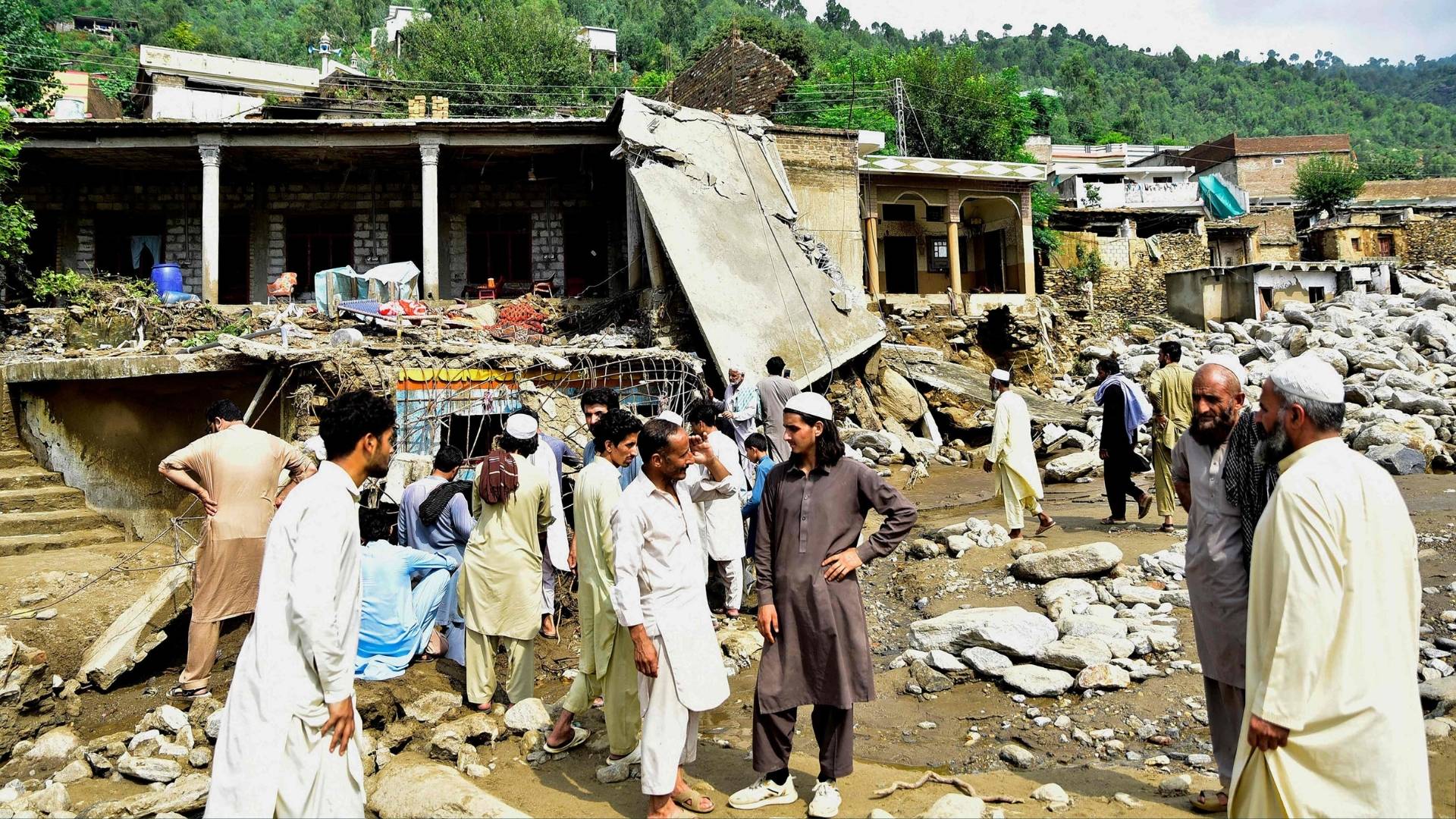
Pakistan is once again reeling from the fury of its monsoon with catastrophic flash floods and landslides across the northern provinces. Khyber Pakhtunkhwa (KP), one of the northern provinces, has borne the brunt where cloudbursts and torrential rains have washed away entire villages, leaving hundreds dead and thousands displaced.
Fresh rains on Monday alone claimed at least 20 lives in Swabi District, local officials told AFP, as villages were swept away and around 200 people remained missing. Across Khyber Pakhtunkhwa, the cumulative toll from the first heavy rains on Thursday to mid-August has surpassed 340 deaths, with 12 villages completely destroyed in Buner district, which received more than 150 millimetres of rain in just one hour between August 14 and 16.
Volunteer Nisar Ahmad described the scene: “Dozens of bodies are still buried under mud and rocks, which can only be recovered with heavy machinery. The makeshift tracks built to access the area have once again been destroyed by the new rains.”
Eyewitness accounts reveal the human cost in vivid detail.
Ghulam Hussain, 35, recounted fleeing with his family: “Even if it rains a little now, we feel scared because there was light rain that day. And then the unsuspecting people were swept away by the storm.” Eighteen-year-old Hazrat Ullah described children and women “running and screaming up the mountains to escape.” Volunteer Ahmad warned of worsening conditions due to a lack of food, clean water, and livestock losses.
According to Pakistan’s National Disaster Management Authority (NDMA), the floods have destroyed over 450 kilometres of roads, collapsed 124 bridges, and damaged 1,698 houses—780 fully and 918 partially. Roughly 30,000 people take shelter in 482 relief camps, while 17,900 rescues have been carried out nationwide—14,300 of them in KP alone.
Relief efforts have not been without tragedy: five crew members were killed in a helicopter crash during a supply mission. Hundreds of schools, government buildings, and private properties have also been damaged, with preliminary losses estimated at PKR 126 million (approximately NRs 62 million or $445,000).
The floods have killed at least 657 people nationwide since June 26, according to NDMA figures, including 171 children and 94 women. Khyber Pakhtunkhwa has suffered the heaviest losses: 392 deaths—288 men, 59 children, and 43 women—and 245 injured. Many survivors remain unaccounted for, with the official numbers reflecting only bodies brought to hospitals.
Pakistan’s Prime Minister’s Coordinator for Khyber Pakhtunkhwa Affairs, Ikhtiar Wali Khan, expressed grave concern: “Entire villages have been wiped out. Some rocks carried by floodwaters were bigger than trucks. Houses along the riverbanks have vanished without a trace, and whole families have been swept away.” Describing the situation as a human tragedy, he warned that in the Dir district alone, deaths could exceed 1,000, while over a thousand people are still missing.
The floods, while catastrophic, are not simply natural misfortunes. They are symptoms of a deeper climate vulnerability.
The Global Climate Risk Index 2025 ranks Pakistan as the most affected country globally from climate-related extreme weather events in 2022, largely due to monsoon floods that submerged one-third of the country and claimed approximately 1,700 lives that year.
While the long-term index (1993–2022) placed Pakistan 56th globally, the overall trend highlights its acute exposure to climate shocks. UNDP reports consistently rank the country among the top 10 most climate-vulnerable nations. Melting glaciers in Gilgit-Baltistan, deforestation, and unplanned settlements exacerbate the risks.
Monsoon rains, which account for roughly three-quarters of South Asia’s annual rainfall, are vital for agriculture but also bring recurrent destruction. On August 16, the Pakistan Meteorological Department issued warnings that heavy rains would likely intensify from August 17 and continue into late August, increasing the risk of urban flooding in Lahore, Islamabad, Peshawar, and Karachi; flash floods in hilly regions of Punjab and Kashmir; and landslides in Gilgit-Baltistan. With roads, bridges, and homes already in tatters, every new storm threatens to plunge more communities into crisis.
Residents, volunteers, and officials describe a humanitarian disaster in real time. Sharif Khan, a flour dealer from Buner, lost his house of six years: “Nothing compares to one’s own home… Now it lies in ruins. Since most houses in my area have been destroyed, it seems likely I will have to move outside the area.”
As monsoon rains continue and rescue operations face delays due to new downpours, Pakistan faces both an immediate human tragedy and a long-term battle with climate vulnerability.
(With inputs from RSS)
Read More Stories

NEPSE falls nearly 75 points as market sentiment wavers
The stock market was unable to maintain the gains seen on Tuesday, slipping...

India has begun its long-delayed population census. Here's why it matters
India has begun the worlds largest national population count, which could reshape welfare...

The United Nations has called on Israel to repeal a law passed by...


Business + Finance + Economy + Tech + Environment + Nepal & South Asia + In-depth Analysis + News + Investigation + Research + Expert Opinion + Anatomy of Complex Issues.