CPN-UML | 11th General Convention | Leadership Election | Intra-Party Democracy
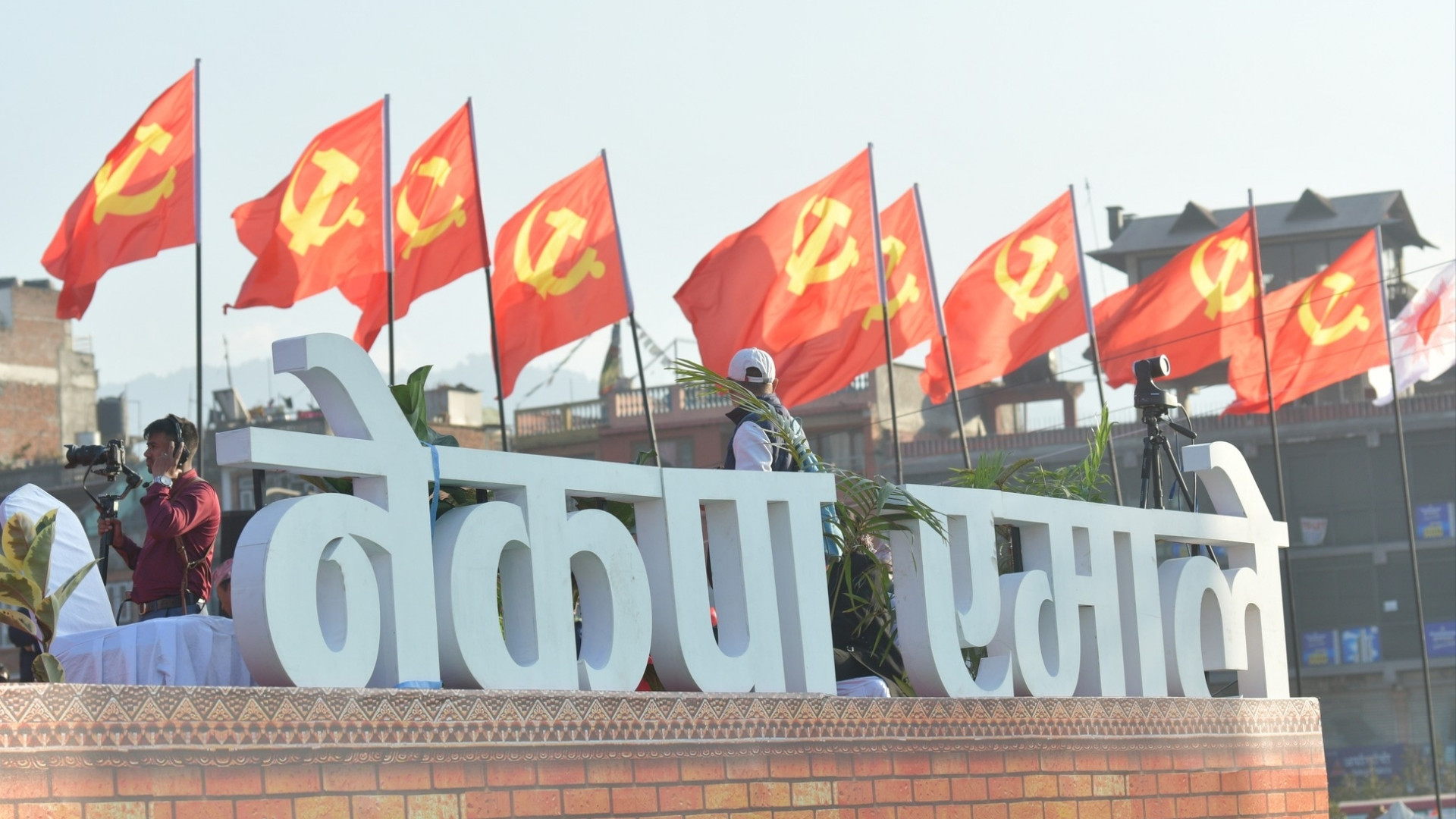
The 11th General Convention of the CPN-UML, unfolding in the federal capital valley, was called a year ahead of schedule, breaking from the party’s usual five-year convention cycle.
The decision followed September protests, which ousted party chair KP Sharma Oli from the prime ministership. Faced with mounting pressure and political uncertainty, the party leadership chose to seek renewed legitimacy through an early convention.
The convention opened on December 13 at Sallaghari, Bhaktapur and has moved into closed-door deliberations at Bhrikutimandap, Pradarshani Marga, where over 2,200 will elect party leadership, likely by December 17.
Ishwar Pokhrel, 71, has challenged KP Sharma Oli, 73, over rules, authority, and the future character of the party. Meanwhile, vice chairs Ashta Laxmi Shakya and Yubaraj Gyawali, both in their early 70s, have decided not to contest for party office but remain as members, citing the need for generational transfer.
In his opening address, Oli framed his leadership as necessary for stability and sovereignty, painting the widespread mistrust against the party as external and internal misunderstandings that require firm leadership. The establishment panel counts on organisational control and institutional networks to drive votes.
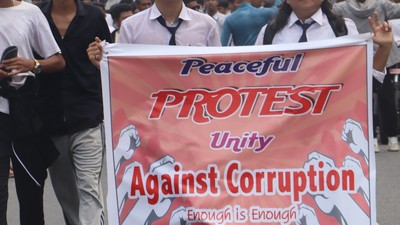
Ishwar Pokhrel’s camp, on the other hand, stresses internal democracy and generational change, articulating a political critique based on youth-led anti-corruption protests and calls for reform. Notably, his challenge carries symbolic weight but contradictions too.
Statute changes: Accommodation, authority, and factional faultlines
Several statute changes made over the past decade have shaped the fundamentals of party leadership. UML introduced a two-term limit for top leaders in 2009 and added a 70-year age cap in 2014.
However, at the party’s first statute convention in 2021, the two-term limit was removed, while the age bar remained. That age limit was temporarily suspended in 2023 and formally abolished at the September 2025 statute convention, clearing the way for leaders above 70, including Oli and Pokhrel, to contest top posts.
The September statute also reduced the party’s leadership size, fixing a 251-member Central Committee and 15 office bearers. But midway through the current convention, the Central Committee on December 14 moved to restore a 301-member Central Committee and expand office bearers to 19, reversing the earlier decision.
That manoeuvre has become the convention’s one of the most contentious issues.
Delegates, including youths, aligned with the reformist camp frame their vote as a defence of statutory authority. Those closer to the establishment see the expansion as a pragmatic compromise that keeps the party intact.
Supporters of the late amendment argue that UML’s size and internal diversity require political accommodation over procedural streamlining. Party chair Oli has defended the expansion as a matter of organisational necessity, not ideology.
Senior leaders close to him, including Bishnu Paudel, said that a broader leadership structure is essential to balance provincial power centres and prevent internal discontent ahead of national elections. Party spokesperson Rajendra Gautam framed the move as a stabilising step to ensure unity and a smooth transition to leadership selection.
On the other hand is the reformist panel led by Pokhrel. The panel has objected to revisiting statute decisions settled just months earlier. Pokhrel and leaders aligned with him argue that altering the rules mid-convention weakens the authority of the statute itself and undermines internal democracy.
Gokarna Bista has been among the senior figures critical of reversing the earlier decision, warning that the expansion risks centralising power rather than dispersing it. Leaders close to former president Bidhya Devi Bhandari have echoed concerns that the move represents a retreat from reform and accountability.
But here’s the threefold irony.
Oli projects a singular focus on personal authority, often signalling that he stands alone in defending the party’s course as well as national interests. His leadership style was built on centralised control and a concentration of decision-making power.
Controversies surrounded his tenures as prime minister, such as the house dissolution in 2020 and 2021, the land swap deal involving Giribandhu Tea Estate, shielding the accused of the Lalita Niwas landgrab scandal, and the recent social media ban, among others.
Moreover, many see his rise to party and national leadership emerging from the rhetoric of nationalism, while critics also question his belief in federalism.
Oli’s opponent Pokhrel’s camp has drawn support from figures close to former president Bhandari, signalling an alignment that goes beyond simple factional politics. This link gives Pokhrel some institutional support, even though he presents himself as a reform-minded leader within UML.
His reform credentials are questionable, too. On prima facie, Pokhrel himself, in his early 70s leading an agenda for generational transfer of leadership, while two of his party comrades, Ashta Laxmi Shakya and Yubaraj Gyawali, retired citing the same agenda he carries.
Notably, he has been named in past allegations related to irregularities in covid‑19 procurement, infamously known as Omni scandal, and other administrative controversies. Observers argue that his current challenge seems selective, aimed primarily at removing Oli rather than pursuing a broader reform agenda.
Similarly, his close aide Bhandari’s stance also appears contradictory.
Her attempt to re-enter mainstream politics after serving as president for two terms undermines the prominence and legacy of the President as the apex institution of the republic. During her tenure, she colluded with Oli despite sitting in the top-most constitutional position, where her decisions should have been neutral.
Yet, her current alignment with Pokhrel shows the complex interplay of experience, influence, and personal networks that shape factional politics within UML.
Beyond factional rivalries, a glaring issue is limited women representation in the party's internal leadership race. Among the 36 officials who have been announced or are considered contenders for party leadership posts, only three are women. This indicates that questions of leadership, reform, and continuity are being debated largely within a narrow circle, with gender representation receiving relatively little attention in either camp’s priorities.
Who votes in the convention and why it matters
The leadership and procedural battles are being decided by a large and diverse electorate. A total of 2,265 eligible voters are participating in the convention’s closed sessions. They are drawn from parliamentary constituencies, provincial committees, central party bodies, commissions, mass organisations, and diaspora chapters.
Automatic delegates include members of the Central Committee and statutory commissions, while constituency delegates are selected through quotas for women, Dalits, youth, and other groups.
This composition has heightened the role of swing delegates, many of whom are not firmly aligned with either camp. For them, the statute dispute is not abstract. The number of office bearers and committee seats directly affects their prospects for representation. As a result, procedural integrity, leadership preference, and personal political calculus are tightly intertwined.
Youth representation: Presence and limitations
UML statutes guarantee youth representation through age-based quotas and nominations. Members aged 40 or below qualify as youth, and each parliamentary constituency is required to elect at least one youth delegate.
Additional youth delegates come from provincial committees, mass organisations, and party-affiliated wings, ensuring that younger cadres make up a significant portion of the convention floor. In the ongoing 11th General Convention, while no official figure is made public, youth are estimated to account for roughly 20–25% of delegates among the 2,265 eligible voters.
Despite these provisions, youth influence is limited. Statutes do not guarantee top office-bearer positions, and most youth delegates are aligned with senior leaders’ factions, meaning their votes and participation are often guided by patronage networks.
While they can shape discussion and symbolically signal generational inclusion, their ability to determine leadership outcomes or control committee appointments remains constrained by pre-negotiated panels, factional negotiations, and seniority rules. Youth presence provides visibility and legitimacy but rarely translates into decision-making power.
Will Oli rise to the party leadership, again?
All signs point to KP Sharma Oli retaining control of the party. Not because dissent is absent, but because UML’s organisational structure continues to reward command over consensus. The reformist challenge has forced debate and exposed unease within the ranks, but it has yet to overcome the establishment’s grip on institutions.
If Oli rises again, it will be the most dominant figure in UML’s history. The more enduring question lies beyond the convention hall: whether a party that repeatedly returns to the same leadership can persuade a restless electorate that continuity does not mean stagnation. The answer to that will be tested not in Bhrikutimandap, but at the national ballot box.
As of December 15 evening, the elections are scheduled for December 16 from 12 PM to 6 PM.
Read More Stories

NEPSE falls nearly 75 points as market sentiment wavers
The stock market was unable to maintain the gains seen on Tuesday, slipping...
India has begun its long-delayed population census. Here's why it matters
India has begun the worlds largest national population count, which could reshape welfare...
The United Nations has called on Israel to repeal a law passed by...


Business + Finance + Economy + Tech + Environment + Nepal & South Asia + In-depth Analysis + News + Investigation + Research + Expert Opinion + Anatomy of Complex Issues.