Nepal Political Crisis | Political Vacuum | Mob Violence | Institutional Collapse | Economic Crash
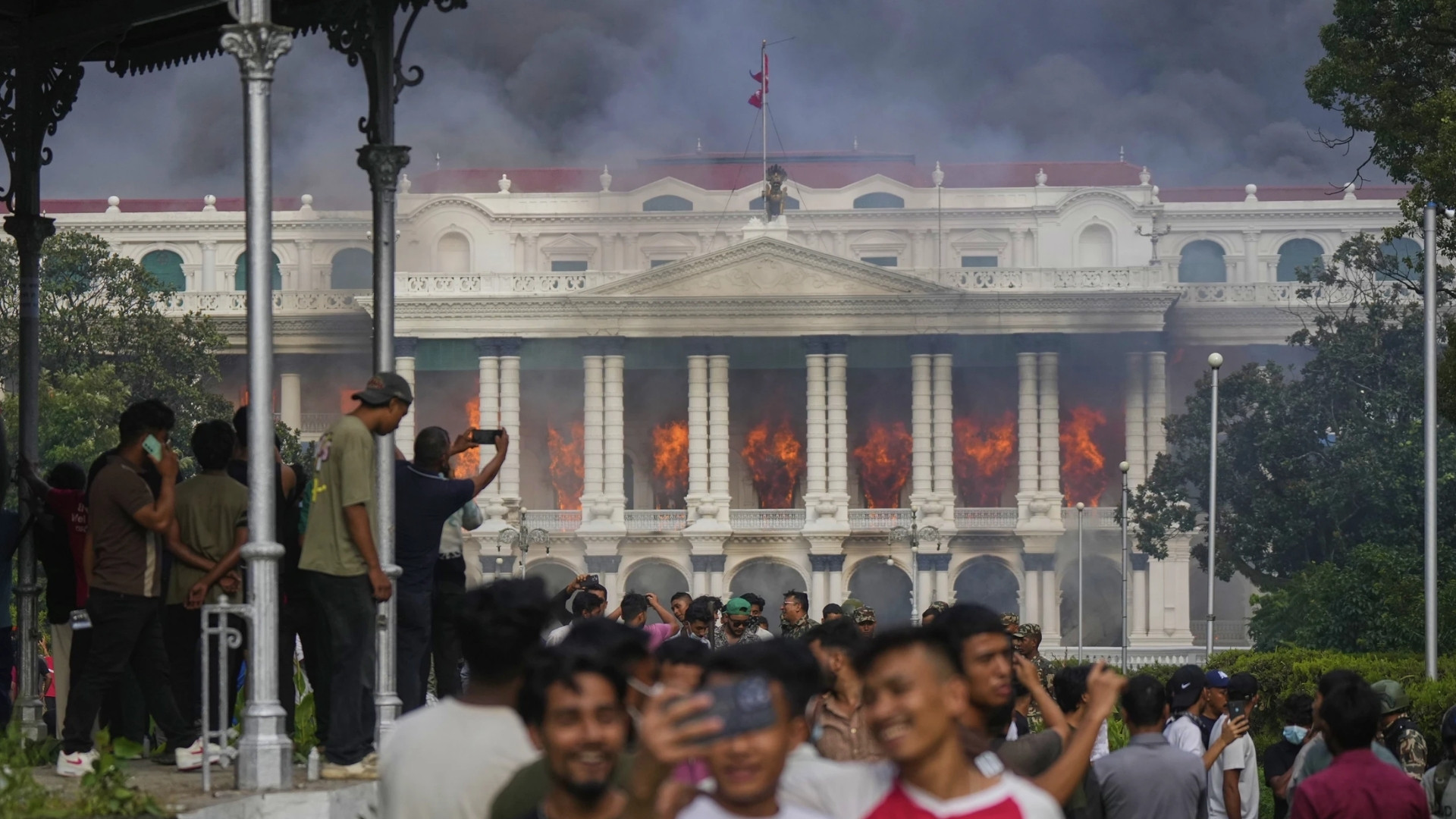
A wave of unprecedented violence has engulfed the nation during the second day of protests—arson on bureaucratic and constitutional buildings of the country, vandalising of public and private properties and indiscriminate mob attacks on political leaders.
So far, the country has witnessed the torching of Singha Durbar and the ministries inside the premises—including Home, Energy, and Education; the Parliament, the Supreme Court and other courts, and the offices of the Attorney General and Kathmandu district attorney, the Office of the President, CIAA Headquarters, and road and drug administration departments, etc.
Mobs also torched the offices of Kantipur Television and Radio Kantipur.
Besides, public offices across the country, including local governments—almost all of Chitwan and Pokhara, Birgunj’s inland revenue office and metropolis; and police offices, stations and posts, among others, were put to the fire.
Visuals posted on the internet suggest crucial documents and records were burned down to ashes, while office equipment and furniture were stolen.
As mob violence and control of the streets escalated throughout the day, the country’s only international airport, Tribhuvan International Airport, was shut down around 12:45 PM with the army deployed for its security.
Residences of almost all key politicians in and outside Kathmandu were set to blaze throughout the day, with mobs attacking former PM and NC President Sher Bahadur and his wife, former Foreign Affairs Minister Arzu Rana Deuba, at their residence. The duo were dragged and beaten, almost to death, while former PM Jhalanath Khanal’s wife was set on fire inside her house. A mob in Rupandehi set fire in the parking of the Gautam Buddha International Airport in Bhairahawa.
Reportedly, three individuals from Monday’s protest succumbed to their injuries on Tuesday, while three police personnel were also killed by the mobs, and reports suggest the casualty toll will rise.
The two-day nationwide shutdown has forced schools to close, while properties worth billions have been set ablaze. Ullens school buses in Khumaltar, Hotel Hilton Kathmandu; Bhatbhateni stores in Naxal, Maharajgunj, Hetauda, and Chitwan; and CG Factory in Satungal and CG Landmark in Chitwan were also targeted with arson attacks. For a country already struggling with an economic crisis, the deadly violence signals a deepening economic and financial catastrophe on the horizon.
The streets of the capital are engulfed in chaos, with entire blocks ablaze from burning tires and wood, completely overrun and controlled by mobs.
Throughout the day, the violent protest marked the collapse of institutions which were built to uphold the rule of law.
As the chaos subsides in the coming days and senses come to prevail, and hopefully so, there are a few significant questions for the entire nation to self-reflect:
And finally, with an abrupt transfer of power on the immediate horizon, what lies ahead for the nation?
Read More Stories

NEPSE falls nearly 75 points as market sentiment wavers
The stock market was unable to maintain the gains seen on Tuesday, slipping...
India has begun its long-delayed population census. Here's why it matters
India has begun the worlds largest national population count, which could reshape welfare...
The United Nations has called on Israel to repeal a law passed by...


Business + Finance + Economy + Tech + Environment + Nepal & South Asia + In-depth Analysis + News + Investigation + Research + Expert Opinion + Anatomy of Complex Issues.