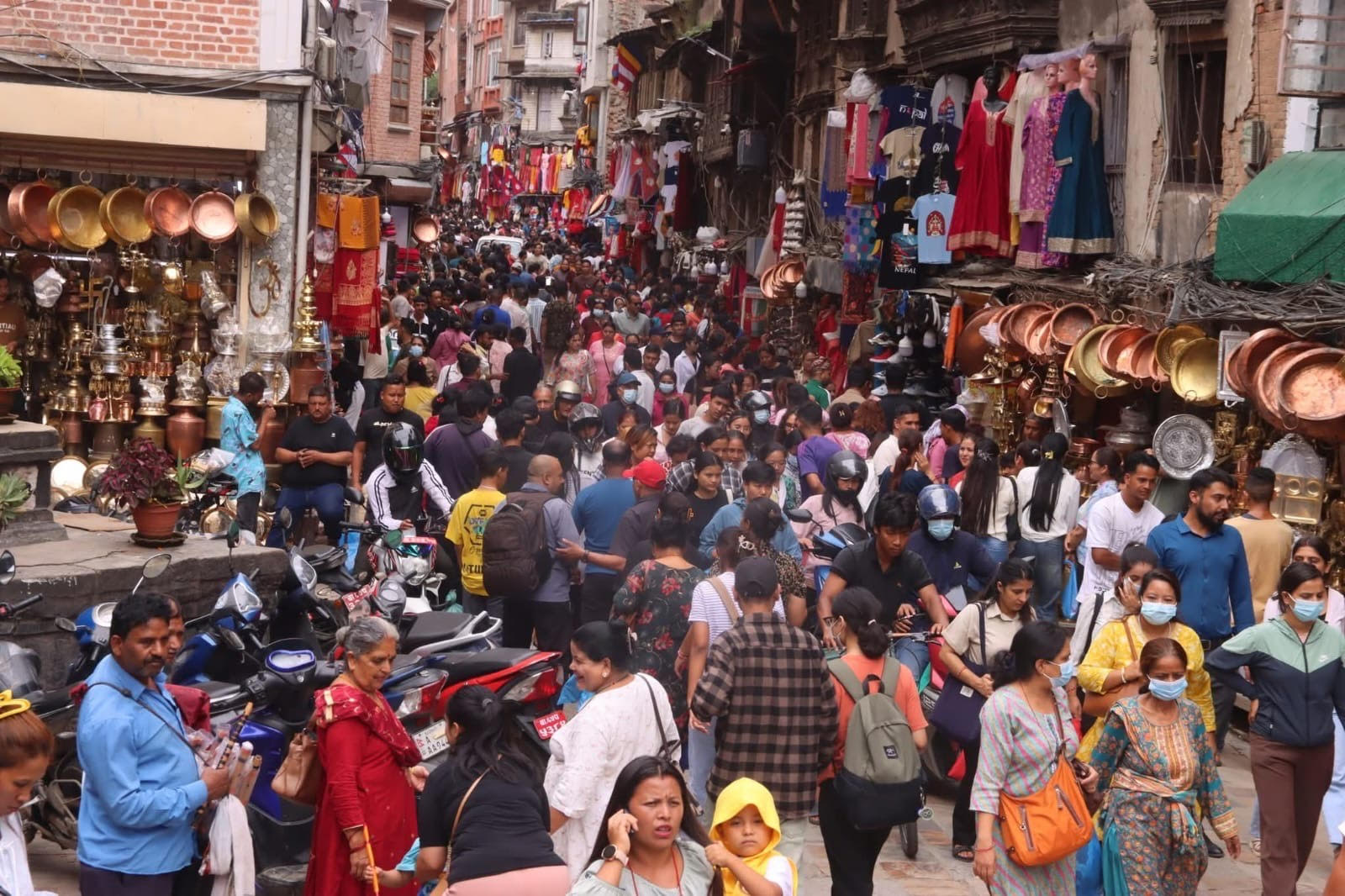
A staggering number of Nepalis are systematically excluded from voting—not by law, but by design. Rigid constituency-based voting laws mean there are no ballot boxes available for them to vote while away from home. The issue is exacerbated by expensive and time-intensive travel and poorly timed elections.
The numbers: Millions denied democratic say
By a conservative estimate, around seven million Nepalis, almost one-fourth of the country’s population, are presently living and working abroad, most of them as migrant workers.
Nepal is also deeply shaped by internal migration. 29.2% of the total population (approximately 8.2 million out of 29,164,578) have migrated at least once in their lifetime, shows the 2021 census internal migration report. Additionally, 1.9 million people, or 7.1% of the native-born population, were recorded as recent migrants, reflecting migration within the last five years of the census. These figures together demonstrate both the long-term cumulative volumes of migration as well as its ongoing, dynamic character.
The report highlights lack of mechanisms for continuous tracking of internal migrants while the decennial census remains the primary source for data for a phenomenon ever present across all parts of the country.
The report further shows that 18 districts have lost more than half of the total native population as a result of out-migration with no districts having experienced zero out-migration. With more than four years since the last census, these numbers have likely grown significantly.
While Nepal's Constitution guarantees that every Nepali citizen aged over 18 years has the right to vote in one electoral constituency in accordance with federal law, the country’s law only allows voting from a registered place of residence and lacks comprehensive provisions for absentee voting.
Meanwhile, there is no accurate disaggregated data on how many potential Nepali voters live in a different area than their registered place of voting. As a result, both internal and outbound migrants are deprived of voting, resulting in widespread political disenfranchisement. The only exceptions are a small group of provisional voters who are election staff, security forces, prisoners, and residents of government-run senior homes.
This was evident in the 2022 House of Representative elections with only 11 million casting votes—a mere 57% of the 19.3 million eligible voters of the total population. This low turnout raises fundamental questions about the country’s democratic process and whether the “people’s mandate” truly represents the will of the population.
High cost of voting: Further marginalising the most vulnerable
For many Nepalis, especially for the most vulnerable, the opportunity cost for voting is simply too high. Additionally, elections are organised in a way (at different phases) that actively disincentivise potential voters.
This is because many Nepalis who live outside their registered place of residence, both at home and abroad, are unable to return to vote, even once. Consider out-of-pocket money (like airfares) or the time to travel back to Nepal to cast their votes in their respective local levels. It doesn’t get easier or cheaper for domestic migrants either as domestic travel costs are both sky high and time intensive.
Much of the migrants within the country are concentrated in the capital Kathmandu Valley, which is the single largest magnet for internal migration. Districts in the valley have the highest number of internal migrants: Kathmandu (57.2%), Bhaktapur (50.2%) and Lalitpur (46.2%), shows the 2021 census report. Overall, 60.3% of native born population are migrants—meaning that 6 out of every 10 residents have moved there from elsewhere at some point. This trend is reflected across all categories of internal mobility: the valley alone accounts for 20% of all rural-to-urban migrants, 40% of ecological zone migrants, and 52% of inter-provincial migrants. These figures make Kathmandu valley the demographic hub of internal mobility, a status that carries not only economic and social implications but also direct consequences for voter registration and electoral participation.
The table below shows the cost and time for a roundtrip for individuals based in Kathmandu to the headquarters of randomly selected districts across all provinces. The costs are weighted as a percentage of the latest national minimum wage.
| Districts | Estimated travel time for round trip (In hrs or days) | Estimated costs (round trip) | Cost (In % of minimum wage) |
| Jhapa | 20-24 | 3,000 | 15.3 |
| Dhanusha | 12-14 | 2,200 | 11.3 |
| Rasuwa | 12-16 | 2,400 | 12.3 |
| Mustang | 28-32 | 5,000 (By air: 18,000) | 25.5 (By air: 92%) |
| Banke | 28-32 | 3,600 | 18.4 |
| Humla | 4 days | 13,000 (By air: 30,000) | 66.4 (By air: 153%) |
| Darchula | 3 days | 9,000 | 46 |
| Taplejung | 40 | 6,000 | 30.6 |
| Okhaldhunga | 16 | 3,000 | 15.3 |
Notes: Ticket prices are extracted from Esewa and news outlets. The prices tabulated are only up to district headquarters. There are additional costs for people whose places of residence are in areas away from district headquarters.
It’s hard to imagine someone from Mustang or Humla, working a low-wage job in Kathmandu, travelling back home just to vote—it simply does not make financial sense. The cost of that trip amounts to a staggering 25.5% and 66.4% of the national minimum wage, respectively. Add poor road conditions, long travel times to go back and forth and difficulty taking time off to vote—it’s no surprise many would opt out entirely. These barriers don’t just suppress voter turnout—they leave migrant populations vulnerable to potential exploitation, reducing their political participation to transactional politics instead of meaningful representation.
This isn’t just a logistical issue, but a structural one. In the current federated system, elections take place in two phases, one for federal and provincial elections, the other for local elections.
In 2022, local elections took place in mid-May while the federal and provincial ones took place in mid-November. The latter two elections were squeezed around three weeks after the country’s biggest holidays, Dashain and Tihar—a time when most working class Nepalis already stretch their budget to visit home. This overlap of timing and cost places a disproportionate burden on low-income migrants. For many, the financial and logistical strain of traveling thrice within a single year to exercise their voting rights is simply unsustainable.
As a result, even by conservative estimates, 1 to 1.5 million migrants were unable to vote in the previous elections—despite being within the country. This figure doesn’t even include millions more Nepalis living and working abroad. When the cost of travel and elections timing and design make voting practically impossible, it entirely leaves out the most vulnerable from the democratic process. The question now is not whether to maintain the status quo, but whether Nepal is willing to move the needle in the upcoming elections by finally allowing absentee voting.
In the next part of this election series, the author will explore existing legal bases on which the interim government can progressively operationalise absentee voting while recommending low-hanging pragmatic steps.
*This work was updated on 14 October, 2025*
Read More Stories

NEPSE falls nearly 75 points as market sentiment wavers
The stock market was unable to maintain the gains seen on Tuesday, slipping...
India has begun its long-delayed population census. Here's why it matters
India has begun the worlds largest national population count, which could reshape welfare...
The United Nations has called on Israel to repeal a law passed by...


Business + Finance + Economy + Tech + Environment + Nepal & South Asia + In-depth Analysis + News + Investigation + Research + Expert Opinion + Anatomy of Complex Issues.