The Ministry of Finance (MoF) has slashed its budget mid-year after falling far short on both revenue collection and spending.
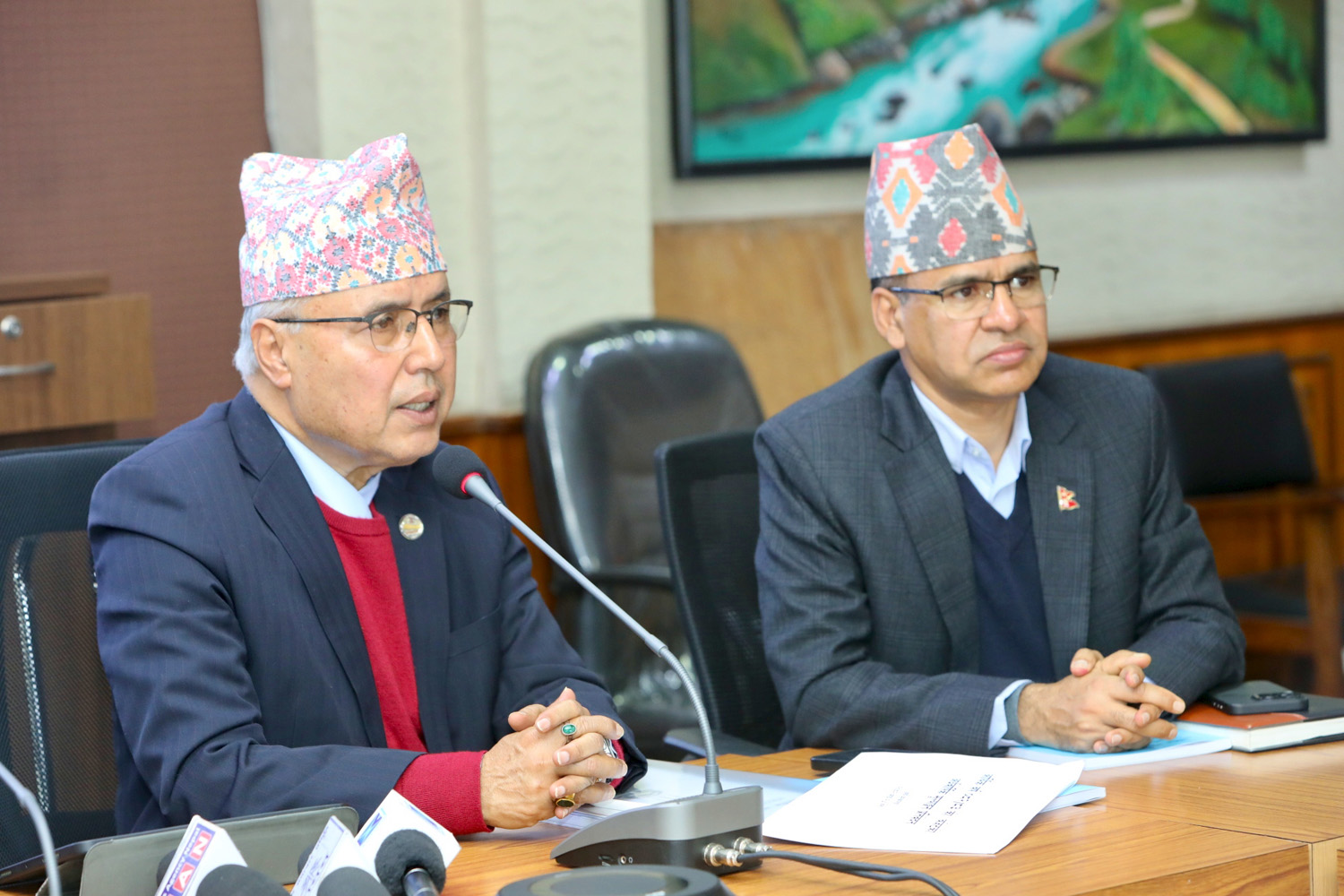
On Tuesday, Finance Minister Rameshwar Khanal announced that the government was cutting NRs 275.78 billion (about $2 billion and 14% of the previous budget) from the current fiscal year’s budget, based on mid-year review released by the Finance Ministry.
The budget, originally unveiled at NRs 1.964 trillion by then–Finance Minister Bishnu Prasad Paudel, will now effectively stand at NRs 1.688 trillion after revisions. The move, which is not new in the country’s fiscal spending pattern, comes after officials concluded that the government simply could not achieve its budget plans. Khanal insisted the budget has not technically shrunk. “The budget is still NRs 1.964 trillion. If any government body can spend that amount, it will be made available,” he said.
The sharpest problem lies in capital spending, the money set aside for infrastructure and development projects. As of mid-January, just 12.12% of the capital budget had been spent, an extremely dismal situation. Originally, NRs 407.88 billion had been earmarked for capital expenditure. That figure has now been estimated to be nearly 60% (NRs 243.8 billion) of the initial allocation.
According to the mid-term review report, weak upfront project preparation, complications in land and forest-use, and infrastructure damage during the September protests caused the setback in capital spending.
The revised plan concentrates money on “national pride” and strategically important projects, while shelving poorly prepared ones. Projects worth NRs 119.53 billion have been suspended for lacking readiness, while NRs 42 billion has been reauthorised for projects that ministries justified as viable.
Recurrent spending, the government’s day-to-day operating costs, was also trimmed, from NRs 1.18 trillion to NRs 1.13 trillion. Allocations for financial management were reduced as well.
Part of the slowdown is political. The initial months of the fiscal year were consumed by managing a transitional period and preparing for national elections.The government has diverted significant resources toward election management. Around NRs 20 billion has been arranged in cash for the polls, with additional logistical support, including 650 vehicles pledged by India. Nepal has also secured permission to use NRs 392.5 million from a Japanese grant for election-related costs.
Out of the NRs 67.08 billion allocated to so-called national pride projects, major infrastructure initiatives meant to signal development progress, only 15.49% has been spent so far.
Meanwhile, unresolved liabilities continue to surface. Under Nepal’s national health insurance program, hospitals are awaiting payments. The MoF has released NRs one billion to prevent immediate shortfalls, but disputes remain over the total amount owed, with reports stating the liability to exceed NRs 10 billion.
Despite the budget cuts, there are signs of recovery. Revenue collection reached NRs 581.4 billion by mid-year. Domestic borrowing has reached nearly half its annual target, and foreign aid commitments during the review period totaled NRs 65.39 billion, about 29% of which came as grants.
Half-year progress
The government has spent just over a third of its total budget of NRs 19.64 trillion, spending NRs 6.9 trillion (35.14%).
While capital spending remains low at 12.12% of allocations, current expenditure, including fiscal transfers, accounts for 41.25% of total allocations, while nearly 41% of the budget for financial management has been spent. The overall spending has increased by 3.4% compared to half-year of the last fiscal year, says the report.
Revenue collection reached NRs 5.81 trillion, achieving 81.75% of the NRs 7.11 trillion target, with year-on-year growth of 2.5%.
Internal loan mobilisation stood at 49.1% of the annual target, and domestic debt repayment reached 45.53% of the planned amount.
Foreign aid totaling NRs 65.39 billion was received, mostly in loans (70.56%), but only 21.27% of the planned aid had been utilised by mid-year.
Growth projection revised to 3.5%
The economy was initially projected to grow 6% this year, but slower paddy production, falling crop yields, a sluggish construction sector, and a cooling real estate market have pushed growth projection down to 3.5%, says the review. By comparison, last year’s GDP growth was around 4.6%.
Preliminary estimates show GDP at basic prices grew 3% in the first quarter, slightly up from 2.9% in the same period last year.
The agriculture sector grew 1.36% in Q1, held back by lower paddy output, despite gains in livestock, vegetables, and fruit. Maize, millet, and buckwheat production is expected to rise this year.
Industry expanded 5.44%, driven by construction and energy, while manufacturing alone rose 1.52%. The service sector grew 3.03%, supported by wholesale and retail trade, finance, public administration, tourism, and personal services.
Inflation eased sharply, averaging 1.7% in the first six months of the fiscal year, down from 4.97% during the same period last year.
Read More Stories

NEPSE falls nearly 75 points as market sentiment wavers
The stock market was unable to maintain the gains seen on Tuesday, slipping...
India has begun its long-delayed population census. Here's why it matters
India has begun the worlds largest national population count, which could reshape welfare...
The United Nations has called on Israel to repeal a law passed by...


Business + Finance + Economy + Tech + Environment + Nepal & South Asia + In-depth Analysis + News + Investigation + Research + Expert Opinion + Anatomy of Complex Issues.