Nepal Stock Market | Securities Board of Nepal | Online Trading System | Market Capitalization
In 2021, inaugurating the provincial convention of the party, CPN (Maoist Center) Chairman Pushpa Kamal Dahal ‘Prachanda’ remarked that growing investment in the stock market is a form of developed imperialism. A partly true observation as capital is often more productive when invested in the real economy, which was also the context when Prachanda remarked.
Just before Prachanda’s remarks, the country’s banking system was flush with liquidity but facing low credit demand, much like today. A significant amount of credit at that point in time flowed into the stock market, driving up the index.
Ever since the country’s capital market came into its modern form, such observations have often made headlines. Investors get nervous when they see such crude remarks about the stock market, which remains mired in controversy. However, it has also grown to an extent, any insensitive comments about the market can make politicians unpopular, even when the market is fraught with ills.
That same year, the Securities Board of Nepal (SEBON), the regulatory board for the country’s stock market, found irregular trading practices in the transactions of 51 companies, highlighting significant risks for investors.
Greetings and welcome to this weekly series from the_farsight, where we cover events that could have or would spark movements, trends, and subtle shifts in Nepal’s stock market. We will provide you with a weekly overview of market response, company-specific analysis, and insight into investors’ sentiment, policy signals, and structural dynamics shaping NEPSE. That’s what this section will focus on in the weeks to come.
But that’s not what this piece is about, the nuances. Still, it is true that over time, Nepal’s stock market has grown enormously along with stakeholders, capital, and overall interest. That brings opportunities along with challenges. For now, let's just briefly understand how Nepal’s stock market came to be.
Nepal’s stock market can be traced back to the early 20th century, with 1936 marking the first public issuance by Biratnagar Jute Mills, followed a year later by Nepal Bank. These early issuances were informal; there was no central trading platform, no regulatory oversight, and little understanding of risk among investors.
A more formal financial system only emerged after the establishment of the Nepal Rastra Bank (NRB) in 1956, bringing banks under centralised authority. For a decade, the government remained the primary issuer of treasury bills, development bonds, and securities to finance public projects.
The introduction of the Company Act in 1964, coupled with the issuance of government bonds the same year, gradually laid the groundwork for formal security activity.
Formal inauguration of its capital market happened after the formation of the Securities Exchange Center (SEC) in 1976, under joint contributions from NRB and Nepal Industrial Development Corporation (NIDC). The mission was clear: channel public funds into enterprises and give ordinary citizens a stake in the country's growth. But without a legal framework, the market could only operate in a vacuum. That ended in 1983 when the legal framework was enacted.
Around the same time, Nepal began opening its doors to the global economy. The 1980s brought liberalisation, with the Industrial Enterprise Act (1982), the Foreign Investment and Technology Transfer Act (1983), and the Finance Companies Act (1986) inviting private and foreign investment into the finance sector.
The political transformation of 1990, which restored democracy, also marked a decisive turn towards privatisation. The state began divesting from public enterprises, while transferring ownership and management to private hands.
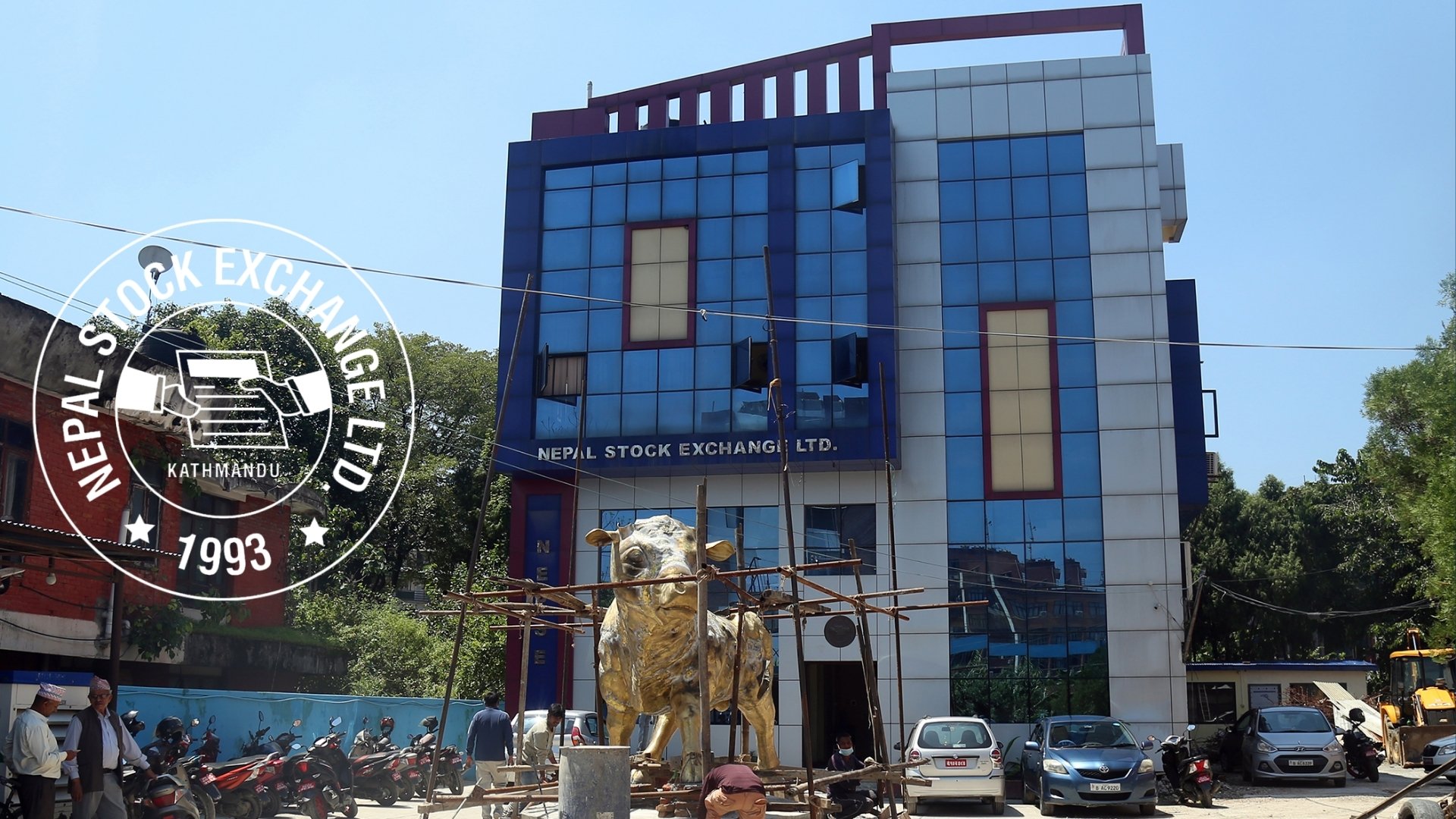
In 1993, Nepal’s capital market reached a decisive turning point. The government moved to institutionalise the capital market, transforming the longstanding SEC into what we today know as Nepal Stock Exchange (NEPSE), a structured and formalised trading platform where shares could be issued and exchanged. Alongside, the Securities Board of Nepal (SEBON) was established as the market regulator, responsible for overseeing market participants, licensing intermediaries, and promoting market development.
By 1994, Nepal began its trading session from its office at Singha Durbar. At the time, only 79 companies were listed with a market capitalisation amounting to NRs 12.96 billion.
However, trading was still manual. Brokers shouted bids and offers across the floor. Papers exchanged in a rhythm dictated much by people as by the market. Over the next decade, NEPSE expanded steadily — more companies were listed, and capitalisation also rose. Yet the exchange itself lagged, as the trading system continued to operate in archaic ways.
In 2007, NEPSE adopted a semi-automated, screen-based trading system, transforming the way the market is operated. Brokers no longer needed to be physically present; orders could be placed electronically, and settlements were improved. At that time, market capitalisation rose by around 60% within a year, reaching NRs 509.8 million.
Another watershed moment is the establishment of the Central Depository Service (CDS) and Clearing Limited in 2011, which introduced centralized depository, clearing, and settlement services, while also beginning DEMAT services (dematerialization of shares). Before this, share ownership and transfers were paper-based with manual exchange of physical certificates.
In 2021, the NEPSE Online Trading System (NOTS) was established, which dramatically shortened the trading cycles and reduced reliance on intermediaries. This digital expansion has democratised access, allowing retail investors from remote areas to participate. Moreover, the C-ASBA system for IPO applications further reduced barriers to entry.
Expansion of Demat accounts and active investors
| Description | Fiscal Year | % change | |||
| 2018/19 | 2019/20 | 2020/21 | 2019/20 | 2020/21 | |
| Number of Demat Accounts | 1,852,000 | 3,892,000 | 5,354,00 | 110.15 | 37.56 |
| Number of My Share Users | 742,000 | 2,950,000 | 4,735,000 | 297.57 | 60.51 |
| Total Secondary Market Investors | 1,356,589 | 1,474,775 | 1,999,654 | 8.71 | 35.59 |
| Online Investors | 35,991 | 74,374 | 126,454 | 106.65 | 70.02 |
| Active Investors | 172,648 | 896,893 | 1,037,359 | 419.49 | 15.66 |
| Active Online Investors | 95,954 | 456,968 | 625,339 | 376.24 | 36.85 |
In the present time (last fiscal year), market capitalisation surpassed NRs 45 trillion—a figure notably high relative to the economy. A total of 268 companies were listed and 92 licensed brokers facilitated trade and market accessibility.
Sector-wise distribution of listed companies
| Description | No. of listed shares (2080/81) |
| Financial [BFIs + MFIs] | 108 |
| Insurance | 24 |
| Manufacturing | 22 |
| Hotel & Tourism | 7 |
| Hydropower | 91 |
| Trading Company | 4 |
| Investment Group | 7 |
| Other Group | 7 |
| Total | 270 |
While the capital market has grown in scale, but not yet in diversity. The financial sector and energy sector (read: hydropower firms), which are mandatorily required to become public, continue to carry the market weight. Meanwhile industries tied to production, trade, and tourism are few. Voluntary listing remains limited. For the market to truly deepen, it must represent more than just finance to truly reflect the full economic picture.
What is promising is the steady rise of digital trading and an expanding demat base. As of mid-March 2025, the market continues to witness a growing investor participation, with 6.55 million DEMAT accounts representing almost 23% of the total population, 5.59 million MeroShare accounts, and 2.5 million investors trading online in the secondary market.
Adding to this momentum is the prospect of a separate SME platform, which can add capital formation for SMEs looking to expand to grow in the face of limited access to finance. To realise this potential and encourage broader participation and transparency from firms, regulators must entice firms with stronger incentives.
On the other hand, SEBON continues to grapple with institutional weaknesses that limit its ability to function as an assertive and independent regulator. Issues such as insider trading, market manipulation, and poor corporate disclosure persist.
Addressing these remains critical if Nepal’s stock market is to mature into a fair, efficient, and trustworthy platform for capital formation.
Read More Stories

NEPSE falls nearly 75 points as market sentiment wavers
The stock market was unable to maintain the gains seen on Tuesday, slipping...

India has begun its long-delayed population census. Here's why it matters
India has begun the worlds largest national population count, which could reshape welfare...

The United Nations has called on Israel to repeal a law passed by...


Business + Finance + Economy + Tech + Environment + Nepal & South Asia + In-depth Analysis + News + Investigation + Research + Expert Opinion + Anatomy of Complex Issues.