Political Crisis | Gen-Z Negotiation | President | Nepal Army | Leadership Vacuum
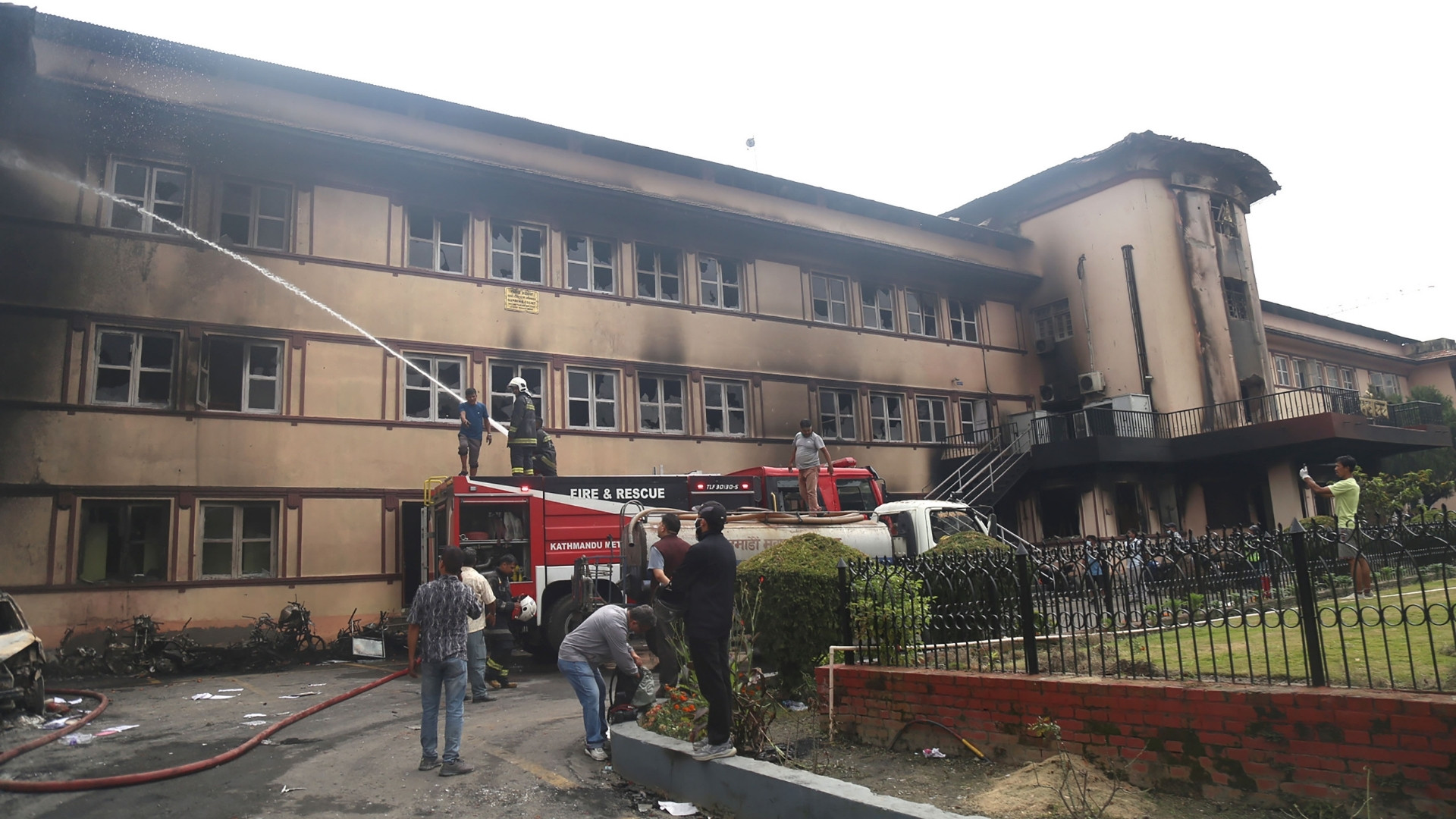
A leadership vacuum looms at the highest level of the government amid the deadly devastation across the country that swept the state institutions.
Amid devastation and a brief episode of anarchism across the country, including the arson attack carried out on the Office of the President, the Supreme Commander-in-Chief of the Nepal Army, the military, on September 9, secured President Ram Chandra Paudel and the cabinet ministers.
Thereafter, President Paudel called on the protesting groups and stakeholders for negotiation talks, while the military took control of the situation and law and order, coordinating with Nepal Police and the Armed Police Force.
The army is playing the role of mediator between the protesting groups and the President, who is currently the only elected institution functioning. The mediation seeks to break through to a peaceful resolution through political dialogue.
Protesting groups and factions of young people are demanding a new face, including the appointment of a caretaker government, only after the dissolution of the House of Representatives (HoR).
As of now, Sudan Gurung, founding president of Hami Nepal—a volunteer group organisation, has reportedly emerged as the common leader of 12 protesting groups and representative at the negotiation table. In a live broadcast on the internet, he confirmed the interim government would be led by former Chief Justice Sushila Karki, demanding the House of Representatives (HoR) be dissolved and emphasising that the Constitution must be upheld. However, the representatives currently engaged in the dialogue, including Gurung, appear to have little understanding of the constitutional process.
KMC Mayor Balendra Shah, who holds significant support among the protesters, has also twice demanded the dissolution of the lower house as a precondition, but offered no constitutional justification. In a recent Facebook post, he asserted that “an interim government should be formed and [lower house] dissolved without delay”, expressing his confidence in former Chief Justice Sushila Karki, as proposed by a faction of protestors, to lead the interim administration.
However, the Constitution does not allow the President to dissolve the House unilaterally.
Earlier, a lack of central leadership and confusion over choosing the “right person” to form the interim government appeared to delay the resolution process further, exacerbating the vulnerability amid executive vacuum—enabling various groups with diverging agendas as far as scrapping the constitution and changing the political system at play.
On Thursday noon, President Paudel stated that, given the country’s current crisis, he is engaged in efforts for a constitutional course that would safeguard democratic principles while preserving peace and order.
Meanwhile, key leaders across party lines are now coming to the front, urging protesting groups to seek a resolution within the constitutional framework. These include Gagan Thapa, Bishwa Prakash Sharma, KP Sharma Oli, Shankar Pokharel, Pradeep Gyawali, Pushpa Kamal Dahal, Sobita Gautam, Shishir Khanal, and CK Raut.
How can an interim government be formed constitutionally?
In plain terms, the President cannot dissolve the lower house himself under the current provisions, without the Prime Minister’s written advice. Nor can the President establish a new civilian government unilaterally. The Constitution neither permits the president to unilaterally declare a state of emergency nor suspend constitutional provisions.
Under normal circumstances, per Article 76 of the Constitution, the outgoing prime minister would serve in a caretaker capacity, overseeing the process of electing a new leader from the HoR. The government also becomes caretaker in case the term of the House expires or is dissolved before the term.
Following the resignation, KP Sharma Oli is under the protection of the Nepal Army. At first glance, he is not in his office—PMO or the official residence in Baluwatar—deeming him unable to perform his caretaker duties.
Article 77 (3) provides that if the office of the prime minister falls vacant as per Article 77 (1), including if he or she tenders resignation in writing to the President, the Council of Ministers still functions until a new one is formed.
Similarly, the Constitution under Article 66 (2) requires the President to seek recommendations and consent from the Council of Ministers to exercise his powers or duties, including the emergency powers.
Under emergency powers, the President can declare a state of emergency on the recommendation of the Council of Ministers, opening doors for him to “issue such orders as are necessary to meet the exigencies,” including calling for the formation of a caretaker government from outside the Parliament and as negotiated at the table.
However, such orders of exigencies need to be tested in both houses of the Parliament. In case the lower house is dissolved or yet to be elected, the upper house—National Assembly—can perform the said duties.
Moreover, even if the House is dissolved or the term expires, the position of Speaker and the occupant remain intact until a new House is elected. This provides a way for the President to reinstate or extend the term of the House using emergency powers.
In Bangladesh, President Mohammed Shahabuddin dissolved parliament after Prime Minister Sheikh Hasina resigned and fled the country in August 2024. An interim government was then appointed, and its legitimacy was later upheld by the Appellate Division of the Supreme Court of Bangladesh.
The Appellate Division of the Supreme Court reasoned with the doctrine of necessity, arguing that the move was essential to address the constitutional vacuum and ensure continuity of governance, drawing on historical precedents—which legal scholars still debate.
However, for Nepal, such a test of validity may not be required. Despite the resignation en masse by 20 RSP lawmakers and several lawmakers from other parties remaining in hiding, the legislature remains technically intact.
Considering the present circumstances of trust deficit, the President can convene a meeting of the House, where lawmakers declare a proclamation that a new interim government would be formed outside the Parliament, with a mandate to conduct fresh elections and others as negotiated with the protesting groups at the table.
The original headline for this piece was "Executive crisis creates confusion about next leadership."
Read More Stories

NEPSE falls nearly 75 points as market sentiment wavers
The stock market was unable to maintain the gains seen on Tuesday, slipping...
India has begun its long-delayed population census. Here's why it matters
India has begun the worlds largest national population count, which could reshape welfare...
The United Nations has called on Israel to repeal a law passed by...


Business + Finance + Economy + Tech + Environment + Nepal & South Asia + In-depth Analysis + News + Investigation + Research + Expert Opinion + Anatomy of Complex Issues.