Candidacy Filing | Political Confrontation | CPN-UML | RSP | Security Concern
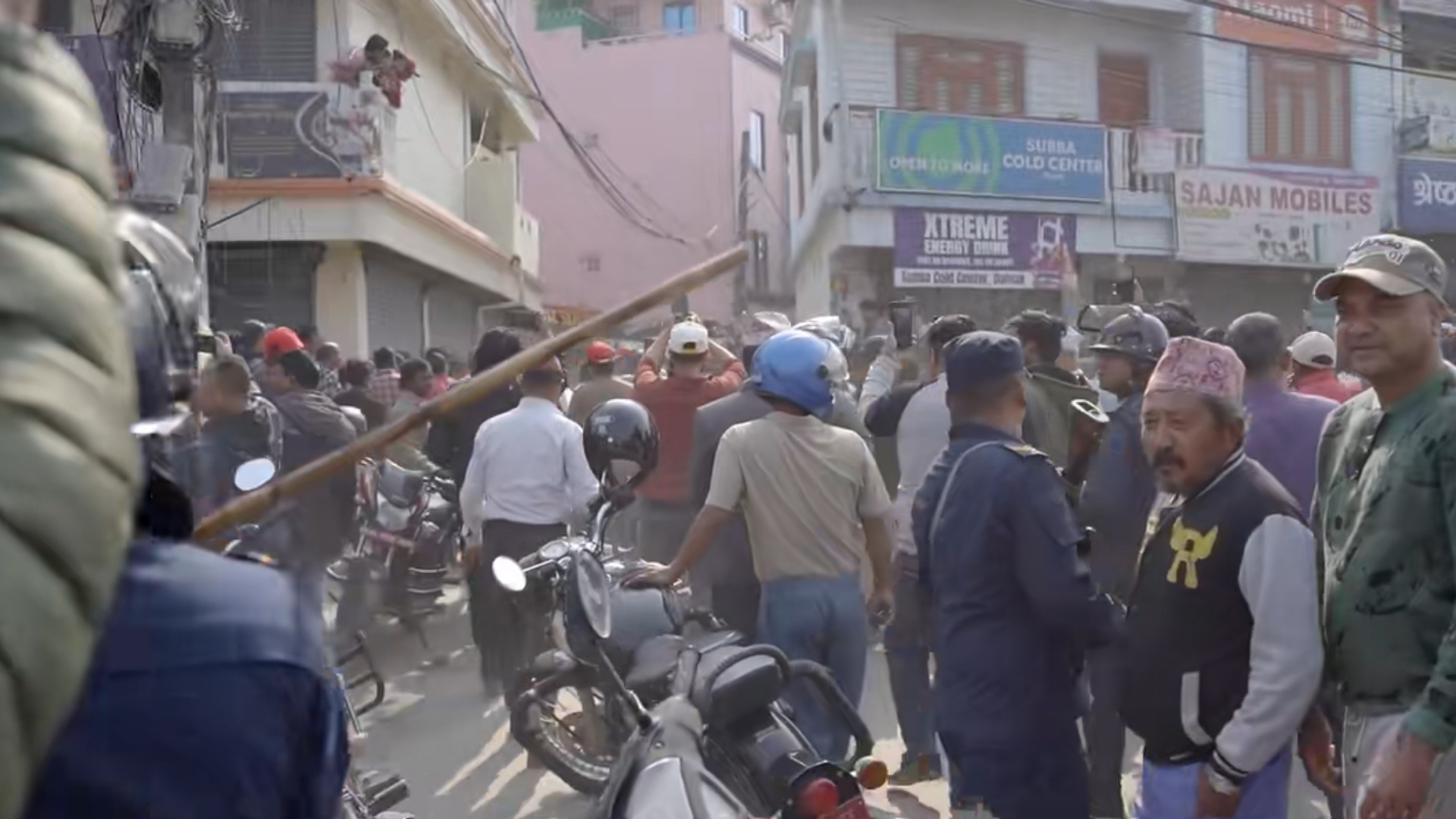
On January 20, a clash between supporters of the CPN-UML and the Rastriya Swatantra Party (RSP) in Damak, Jhapa, has once again raised concerns about political confrontation during Nepal’s election period.
The incident occurred between 1:30 PM and 2 PM at a major intersection in Damak, which falls under the Jhapa-5 constituency, as top leaders from rival parties arrived to file their candidacies for the March 5 election.
RSP senior leader Balendra Shah had already left the election office after filing his nomination around noon. At the same time, CPN-UML President and former Prime Minister KP Sharma Oli arrived around 2 PM.
Supporters accompanying the candidates crowded the Damak Chowk area, and tensions escalated into physical clashes. Local media reported that the situation was later brought under control, with a few supporters from both sides sustaining minor injuries.
Jhapa-5, long considered a stronghold of UML President Oli, has emerged as one of the most closely watched constituencies this election cycle, as Shah, a high-profile figure with strong youth support, is contesting from the same seat.
While the Damak clash did not result in serious injuries, it reflects a recurring pattern in the country’s elections, where intense political competition frequently spills into confrontation.
This election period has also seen the circulation of alarming claims on social media. Videos shared on platforms such as TikTok suggest individuals discussing extreme measures to influence the outcome of the Jhapa-5 race.
In another instance, a video circulating online shows CPN (UML) Secretary Mahesh Basnet making derisive comments about Rastriya Swatantra Party leader Balen Shah’s recent statement in Janakpur, where Shah described himself as a “son of Madhesh.” Such remarks could further inflame tensions between the supporters of the two parties, adding to an already charged political atmosphere.
Although elections in the country are often described as largely peaceful, the past decade shows that they have not been entirely free of fatal violence, including clashes during campaigns, voting, and vote counting.
Clashes during the election campaign are also often the result of candidates disregarding the election code of conduct, coupled with Election Commission’s failure to act decisively against such flashy campaigns. The two candidates, for instance, attended the registration venue in Jhapa backed by hundreds of supporters, in violation of EC’s code of conduct.
In recent analyses, it noted rising hostility against political actors, particularly against the UML leadership, now seen against Shah, and aggressive competitive mobilisation amid unresolved tensions. Such trends, the_farsight warns, could pose security risks throughout the election period, including on polling day.
Recent electoral history is replete with such flashpoints. In the 2022 election cycle, UML candidate Hari Kafle and his supporters were attacked in Gorkha-2 during campaigning.
Clashes were reported between RSP supporters and the then ruling coalition (Nepali Congress, Maoist Centre and Unified Socialist) cadres in Chitwan and between UML supporters and ruling coalition cadres in Darchula.
Additionally, during the 2017 local elections, one person was killed in Dolakha after police opened fire to control a crowd attempting to disrupt voting.
The 2022 local elections saw at least three deaths in Udayapur, Solukhumbu and Dolakha during clashes linked to voting disputes and ballot-box seizure attempts. Later that year, during the federal and provincial elections, a 25-year-old man was killed in Bajura after security forces fired during unrest at a polling centre, forcing the suspension of voting in the area.
These deaths were not the result of organised armed conflict between political parties but occurred during election-day clashes and security crackdowns, underscoring how quickly confrontations can turn deadly when tensions escalate.
The clash in Damak, though limited in scale, serves as a reminder that Nepal’s elections continue to test the country’s ability to conduct peaceful, free and fair democratic exercises amid deepening political polarisation.
Read More Stories

NEPSE falls nearly 75 points as market sentiment wavers
The stock market was unable to maintain the gains seen on Tuesday, slipping...
India has begun its long-delayed population census. Here's why it matters
India has begun the worlds largest national population count, which could reshape welfare...
The United Nations has called on Israel to repeal a law passed by...


Business + Finance + Economy + Tech + Environment + Nepal & South Asia + In-depth Analysis + News + Investigation + Research + Expert Opinion + Anatomy of Complex Issues.