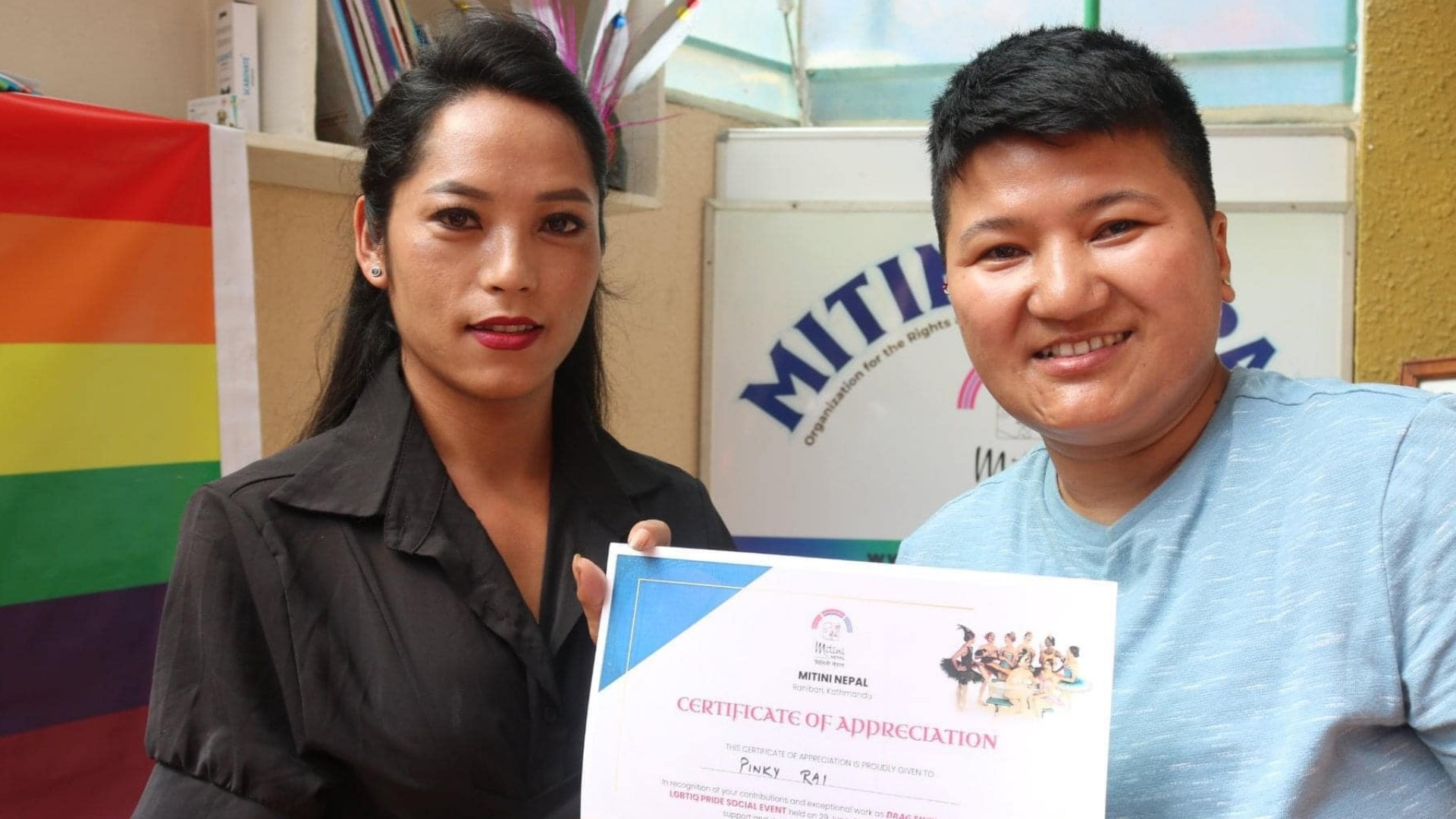
Pinky Rai is a 32-year-old candidate representing the Samaveshi Samajwadi Party (SSP) in Okhaldhunga–1. An LGBTQ+ activist, she is recognised as one of the few openly sexual and gender minority candidate to contest a direct parliamentary election in Nepal. Originally from eastern Nepal, Rai completed her School Leaving Certificate (SLC) in Khotang and later became involved in advocacy focused on citizenship rights and legal recognition for sexual and gender minorities.
Her entry into politics follows years of engagement with issues affecting gender-diverse communities. After a prolonged legal process, she successfully amended her citizenship documents to reflect her gender identity, an experience that exposed structural barriers within state institutions. During her candidacy process, she navigated documentation hurdles and secured a nomination fee reduction under Election Commission provisions for minority candidates. These experiences shaped her understanding of institutional reform and political participation.
While Rai’s public identity is closely tied to LGBTQ+ rights advocacy, her campaign extends beyond identity-based politics. She links recognition and dignity with broader socioeconomic challenges facing rural constituencies. In Okhaldhunga, she highlights limited employment opportunities, infrastructure gaps, and constrained market access for farmers as persistent barriers to development. Her platform combines inclusion with local economic strengthening.
Q&A Sidebar
Q: What is your top priority if elected?
To expand equitable access to healthcare, education, and employment while strengthening inclusion for women, children, marginalised castes, and LGBTQ+ communities.
Q: What problem concerns you most right now?
Social exclusion and limited economic opportunities, particularly for gender-diverse individuals, which contribute to early school dropout and long-term vulnerability.
Q: What experience best prepares you for this role?
My advocacy for legal gender recognition and citizenship rights, and witnessing the absence of government initiatives for intersex and gender-diverse individuals, has strengthened my commitment to policy reform and equal opportunity.
Q: What change would you like to deliver in one term?
Stronger inclusive representation, improved rural healthcare and education systems, and expanded local employment opportunities in Okhaldhunga.
Q: How do you define good leadership?
Leadership that ensures development is inclusive, equitable, and benefits all members of society.
Read More Stories

NEPSE falls nearly 75 points as market sentiment wavers
The stock market was unable to maintain the gains seen on Tuesday, slipping...
India has begun its long-delayed population census. Here's why it matters
India has begun the worlds largest national population count, which could reshape welfare...
The United Nations has called on Israel to repeal a law passed by...


Business + Finance + Economy + Tech + Environment + Nepal & South Asia + In-depth Analysis + News + Investigation + Research + Expert Opinion + Anatomy of Complex Issues.