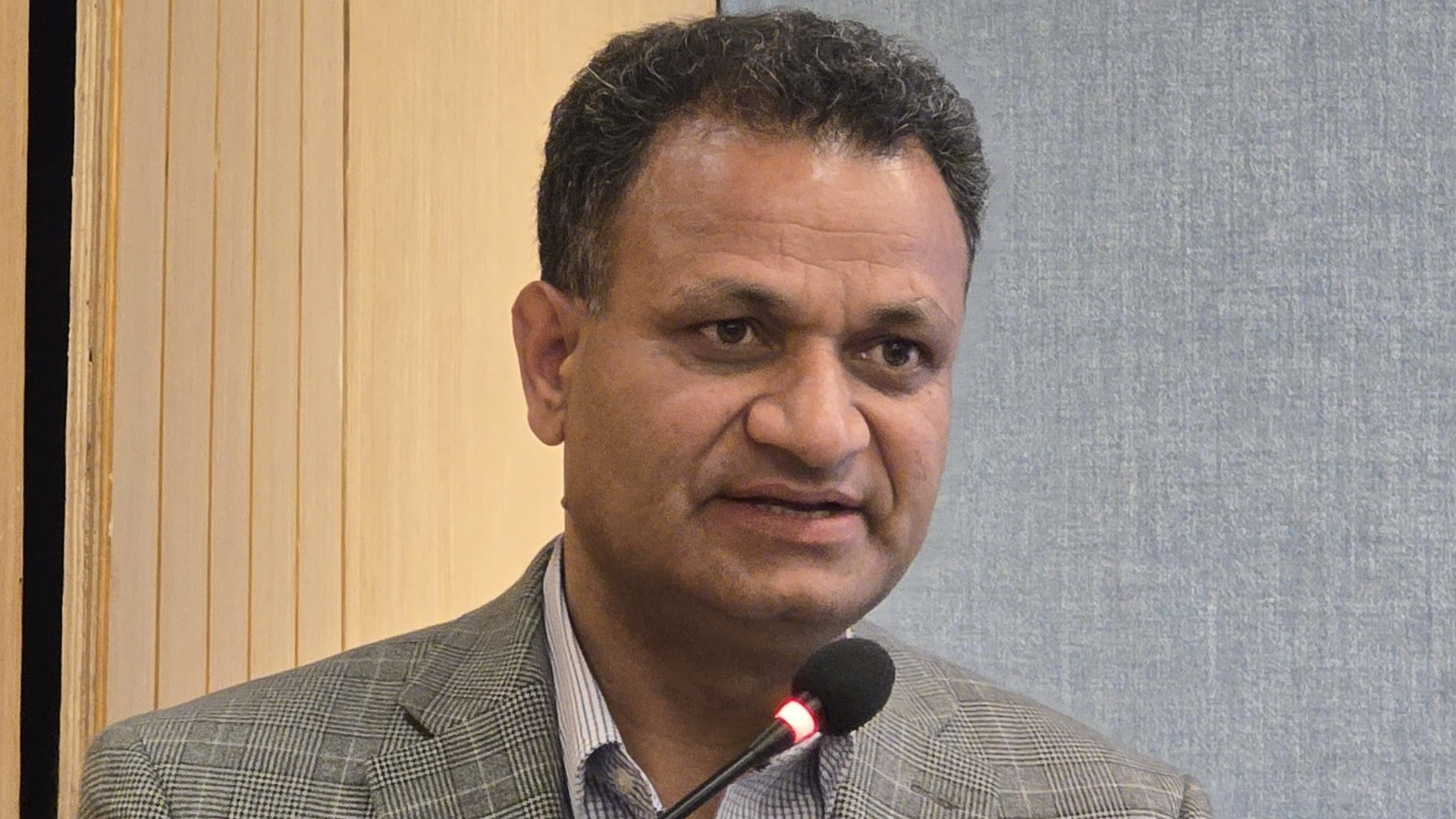
Deepak Prakash Bhatt, 53, is a senior leader of the Communist Party of Nepal (Unified Marxist–Leninist) and a nationally recognised voice on security, foreign policy, and international relations. He completed his Master’s degree in Political Science from Dehradun, India, and went on to earn a PhD in International Relations from Jawaharlal Nehru University (JNU), New Delhi.
Bhatta began his political journey during his time in India, influenced by the movement against the Panchayat system and the broader struggle for democracy in Nepal. In 1988 he became affiliated with the All India Nepalese Free Students’ Union (ANNFSU) and subsequently advanced through the organisation’s regional committee (1991) and central committee (1994), to be elected as Central President in 2000. He later held key organisational roles within the UML, including positions in the Central Coordination Committee and the party’s Central Department of Finance and Planning.
Bhatt served as a Member of the House of Representatives from Kanchanpur-3 between 2018 and 2022. In the 2017 general elections, he won a closely contested race in Kanchanpur-3, defeating Nepali Congress’ Ramesh Lekhak by a narrow margin of 258 votes.
During his parliamentary tenure, he was a member of the International Relations and Human Rights Committee, where he actively contributed to debates on national security challenges, regional geopolitics, and Nepal’s foreign policy positioning. Additionally, he played a vital role in pushing for the establishment of Martyr Dasharath Chand University of Health Science (MDCUHS), Kailali - the first health science University of Nepal.
Beyond elected office, Bhatta has held advisory and academic roles that align closely with his policy interests. He has served as an Advisor to the Nepal Center for Security Governance (NCSG) and as a Visiting Professor at the APF Command and Staff College. He has also authored and contributed to several works on Nepal’s geopolitics and conflict transformation. Within his party, he has been involved in policy formulation related to security and international relations.
Policy identity and priorities
Bhatta’s policy orientation centers around national security, international relations, foreign policy reform, education policy, and digitalisation. One of the pillars of his agenda is strengthening democratic control and oversight of security forces. He further advocates for streamlining the implementation of official foreign policy reports while advancing anti-corruption and ethical integrity initiatives in governance.
In education, Bhatt pledges to reform Technical and Vocational Education and Training (TVET) to better align with labor market trends and evolving digital transformation needs. He has also pledged to modernise Sudurpashchim University through employment-oriented programs in Herbal Science, Sports Science and Management, Artificial Intelligence, Climate Change, and Disaster Risk Management.
His health sector agenda includes developing Shahid Dasharath Chand Health Sciences University into a modern research center, upgrading Mahakali Provincial Hospital and expanding Dodhara Chandani Hospital to 25 beds with the establishment of a dedicated snakebite treatment center.
He has also committed to provide land ownership certificates to landless and informal settlers and to implement secure housing programs for homeless and marginalised communities.
For Kanchanpur-3 specifically, his priorities include upgrading Majhgau Airport, advancing the Mahakali Corridor and Dry Port projects, implementing Phase III of the Mahakali Irrigation Project, and constructing four-lane highways, including the Gaddachauki–Daiji road section and ring roads in Dodhara Chandani and Bhimdatta.
Sidebar
Top Priority if Elected
Major concerns
Previous experiences that best prepare him for the role
Read More Stories

NEPSE falls nearly 75 points as market sentiment wavers
The stock market was unable to maintain the gains seen on Tuesday, slipping...

India has begun its long-delayed population census. Here's why it matters
India has begun the worlds largest national population count, which could reshape welfare...
The United Nations has called on Israel to repeal a law passed by...


Business + Finance + Economy + Tech + Environment + Nepal & South Asia + In-depth Analysis + News + Investigation + Research + Expert Opinion + Anatomy of Complex Issues.