Women & Marginalised Groups Representation | Inclusive Political Process | Election Reform
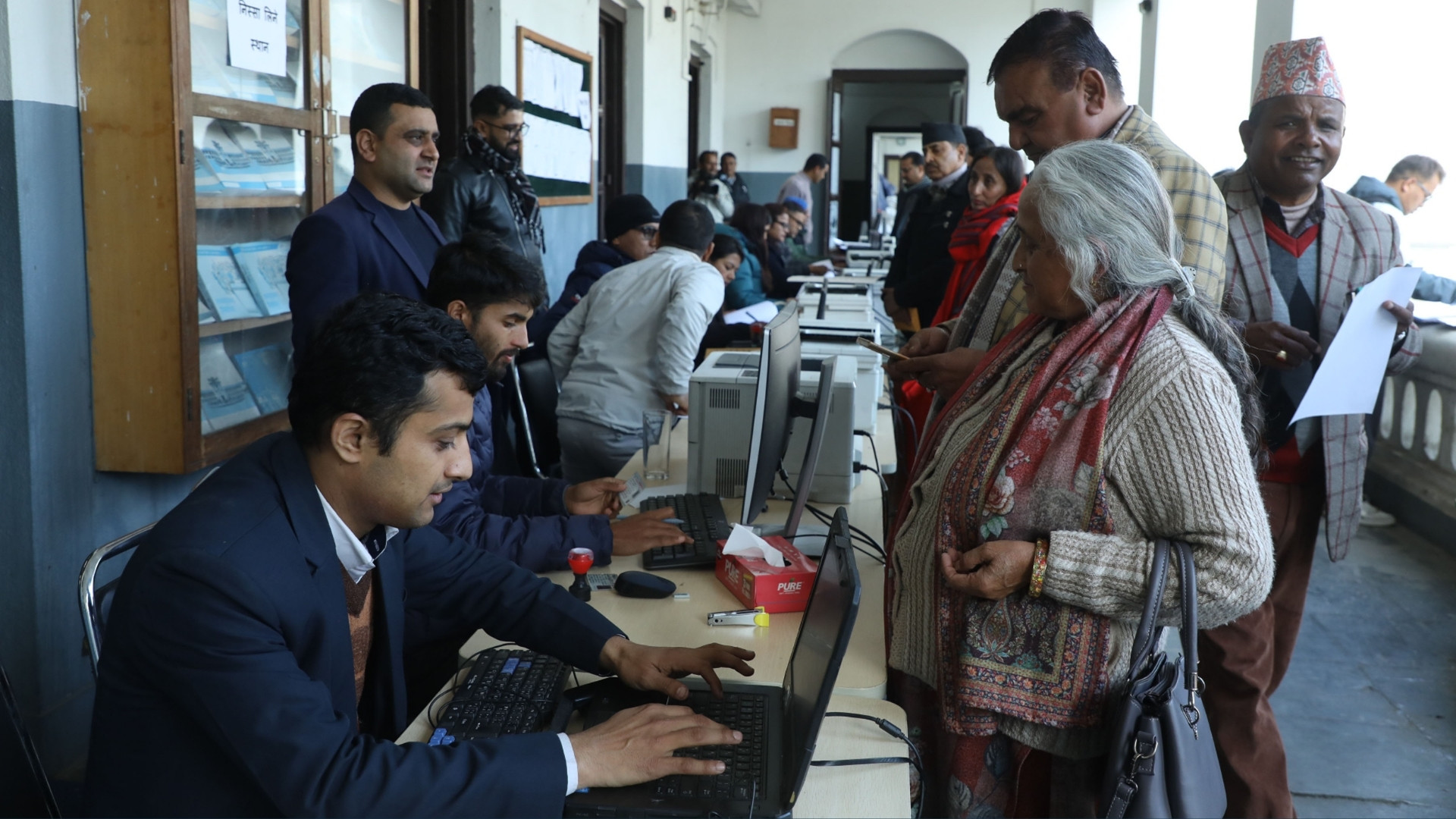
It’s been nearly three-quarters of a century since women attained political enfranchisement in Nepal. However, together with marginalised social groups, who often form the centre of political discourses for inclusion in the country, genuine and meaningful political representation is limited.
Inclusive in papers
In 2007, Nepal adopted a mixed electoral system, consisting of First-Past-The-Post (FPTP) and Proportional Representation (PR), intended to reflect the country’s diversity and amplify the voices of marginalised groups, including women. The Interim Constitution, 2007, enshrined 40% FPTP and 60% PR of 601 seats in the Constituent Assembly-cum-legislature parliament.
However, with the adoption of the Constitution in 2015, the proportions interchanged to 60% FPTP and 40% PR, alongside a bicameral legislature at the federal level.
Article 84 (8) of the Constitution mandates that each political party in the Federal Parliament, both the House of Representatives (HoR) and the National Assembly (NA), has 33% of their total members women.
The article also allows political parties to meet the stated reservation by filing women candidates from the closed list for PR in the HoR, given that the number of women elected from the FPTP system falls short. Similar requirements exist for provincial assemblies.
Additionally, the Local Level Election Act, 2017 requires two out of four members (other than the president) of ward committees to be women, including one Dalit woman, guaranteeing 40% women’s representation at the local level. Articles 222 and 223 of the Constitution mandate representation of at least two women from each ward in the local-level assembly.
These arrangements have led to an increased women’s participation across all levels of government.
Establishing quotas as a ceiling, not a floor
It was in 1947 that Nepalis first exercised electoral rights to choose their representatives during municipal elections across the then 21 wards in Kathmandu City. But women were excluded from voting, let alone contesting. Despite their engagement in prior political movements, formal democratic space opened to them only after 1951.
As a result, in 1954, Nepali women were able to run for office and vote in Kathmandu city elections. In the 1959 general elections, Dwarikadevi Thakurani from Nepali Congress became the first woman elected to Parliament and minister, while Kamal Rana became Deputy Speaker with King Mahendra’s nomination.
Women’s participation remained symbolic during the Panchayat era. Despite constitutional guarantees, women’s participation in the National Panchayat, both elected and nominated, was limited to 4% and 5% during its two terms. Additionally, during the 30-year history of the Panchayat rule, only seven of the 24 governments had a single woman serving as a minister.
It is against this backdrop that the current proportional representation system and mandatory inclusion provisions were introduced.
In practice, quotas have functioned as ceilings rather than empowerment. In the 2022 parliamentary elections, women held 33.1% of the total HoR seats, just above the required mandate. In the National Assembly, the current proportion is at 37.3%. Most of the HoR seats were filled via the PR system, while only nine women, 5.4% of the 165 constituencies, came via FPTP.
Across provincial assemblies, women occupied 36.36% of seats through the PR, while only 4.24% through direct elections.
This distinction is underpinned by a deeply patriarchal political culture which largely sees women as gap fillers to fulfil constitutional requirements rather than active political actors, evident in the persistently low number of women contesting FPTP races, as the table below shows.
Gender breakdown of candidates in the 2022 elections
| House of Representatives | |||||
| Electoral System | Total Candidates | Men | Total ( %) | Women | Total (%) |
| FPTP | 2,412 | 2,187 | 90.67% | 225 | 9.33% |
| PR | 2,199 | 1,013 | 46.06% | 1,186 | 53.94% |
| Provincial Assemblies | ||||||
| Electoral System | Total Candidates | Men | Total ( %) | Women | Total (%) | Other |
| FPTP | 3,224 | 2,943 | 91.28% | 280 | 8.72% | 1 |
| PR | 3,708 | 1,512 | 40.78% | 2,196 | 59.22% | - |
A similar pattern persists across several marginalised groups, many of whom have only limited representation compared to their share of the population.
In the 2022 HoR, Khas Arya, who constituted 31.25% of Nepal’s population, secured 47.27% of seats, with 57.58% elected through FPTP and 31.8% through PR.
In contrast, Dalits, comprising around 14% of the population, held just 5.82% of seats, with one via FPTP and 15 through PR. The Tharu community, which represented 6.56% of the population, occupied 4.73% of seats, seven from FPTP and six from PR. Meanwhile, Muslims, who made up 4.4% of the population, had no representatives elected through FPTP, with six members entering the parliament via PR.
A similar pattern persists across several marginalised groups with only limited representation, and even declining, compared to their share of the population, as seen in the comparative chart below.
Election results of past four elections and representation of different caste/ethnicity
As PR lists in Nepal are driven by fixed quotas based on demography, the system built to advance gender and social inclusion also benefits groups that are already well represented.
This raises concerns about alignment with international equality standards, which view affirmative action as a corrective measure solely for the disadvantaged. A review is needed to assess PR’s impact on the ethnic composition of the HoR and provincial assemblies to ensure affirmative measures target only structurally disadvantaged groups.
Pathways for Reform
Fix elite capture
One of the most pressing issues with the PR system is its indiscriminate, unaccountable use in recycling political elites. Many nominees are long-time insiders who have repeatedly held political positions or ones with financial muscle.
In the 2022 HoR elections, major parties used their closed PR lists to accommodate senior leaders despite their long tenures in elected office. Nepali Congress placed Arzu Rana Deuba, Bimalendra Nidhi, and Gopal Man Shrestha under the Khas Arya, Madhesi, and Indigenous clusters, respectively.
CPN-UML included former minister Nain Kala Thapa under Khas Arya, while the then CPN (Maoist Centre) nominated former Speaker and minister Krishna Bahadur Mahara in the same cluster. Similarly, CPN (Unified Socialist) listed former lawmaker and minister Ganga Lal Tuladhar under the Indigenous cluster.
A similar pattern exists in the provincial PR seats, where leaders of major parties allocate PR seats along factional lines.
These choices reinforce concerns that the PR system is being leveraged to favour those already close to power rather than expand meaningful political access. Moreover, even when PR lists feature genuinely marginalised candidates, the system is frequently misused by repeatedly nominating the same individuals.
As parties submitted closed PR lists for the March 2026 elections, the names in the list reveal that almost all parties have resorted to the same practice to consolidate power and limit representation to tokenism.
Section 28 of the House of Representatives Election Act, 2017 and Section 28 of the Provincial Assembly Election Act, 2017, respectively, govern the preparation of closed PR lists, mandating 50% women and proportional inclusion of various social groups.
However, the acts do not restrict the nomination of politically privileged individuals who have already held power, such as previous ministers or lawmakers.
This undermines the core intent of PR, fueling public resentment against the system, as voters see it as a backdoor for parties to ‘sell’ parliamentary positions to political/societal elites. To ensure the system genuinely advances inclusive representation, necessary amendments to the articles with barring clauses have become imperative.
Invest, educate, empower
To strengthen political participation of women and marginalised groups, especially under the FPTP system, the state should support capacity-building programmes, including leadership training, campaign financing support, media exposure and mentorship for first-time candidates.
Additionally, women's caucuses, which were discontinued after the 2008 Constituent Assembly, should be fostered and formalised within legislative bodies.
Mandate women’s candidacy for direct elections
Women leaders across the political spectrum at all levels have been consistently pushing for 50% candidacy under FPTP, in line with other constitutional provisions for women’s representation.
The political class has turned a blind eye to the issue while continuing to use the PR system to fulfil their constitutional obligations, which has limited women’s participation to tokenism while undermining their leadership development, as political parties refrain from investing in them.
Necessary amendments to Chapter 2 of the House of Representatives Election Act 2017, which lays out the legal framework for Candidates and Nominations, should be made to include a mandatory clause requiring parties to field at least 50%, or a different proportion reached by consensus, for direct election candidacy.
Legal provisions can be set in place for periodic review of this mandatory clause, with the ultimate aim of progressively phasing them out once structural obstacles are demolished.
An alternative used to expand women’s participation under FPTP while building their leadership is the best-loser system. In Nepal’s context, under this model, women candidates who secure the highest proportion of votes within across constituencies but fail to win could be elected until quotas are met, taking priority over PR closed-list nominees.
Once the preset number is fulfilled via this system, the seats will be allocated as per the PR list until thresholds are met. This system increases women’s agency in direct elections while creating incentives for political parties to invest in their leadership growth. Because this directly affects PR allocations, it must be clearly entrenched in law and uniformly enforced.
Strengthen enforcement powers
The Election Commission should be empowered to monitor political parties’ progress toward diversity and equality within their structures and to reprimand them if standards are not met. To this end, a specific clause can be added under Chapter 2, Functions, Duties and Powers of Commission in the Election Commission Act 2017.
Read More Stories

NEPSE falls nearly 75 points as market sentiment wavers
The stock market was unable to maintain the gains seen on Tuesday, slipping...
India has begun its long-delayed population census. Here's why it matters
India has begun the worlds largest national population count, which could reshape welfare...
The United Nations has called on Israel to repeal a law passed by...


Business + Finance + Economy + Tech + Environment + Nepal & South Asia + In-depth Analysis + News + Investigation + Research + Expert Opinion + Anatomy of Complex Issues.