Interim Council of Ministers | Karki Cabinet Fifth Expansion | Minister for Foreign Affairs
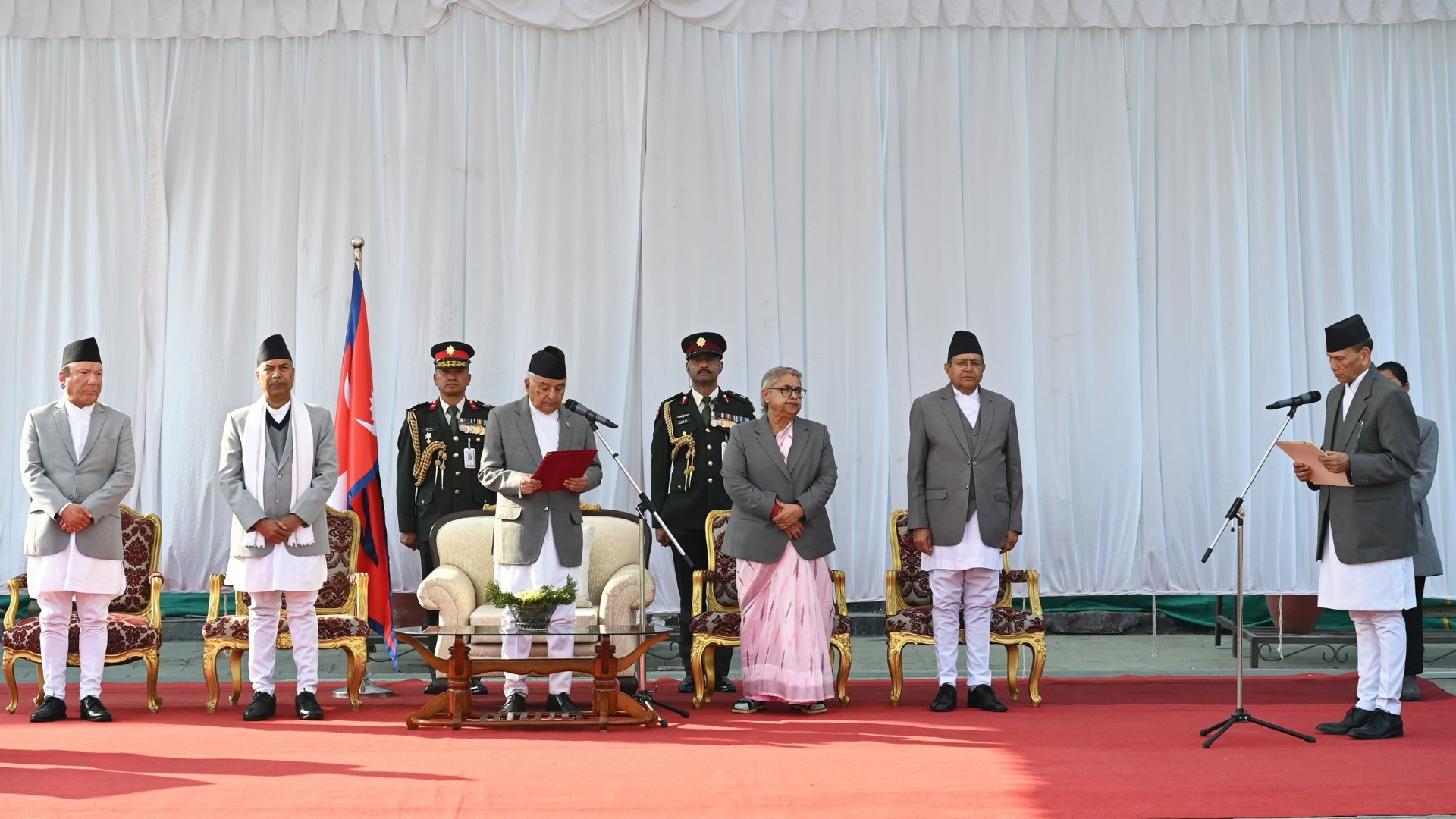
President Ramchandra Paudel has appointed retired Nepal Army Lieutenant General Balananda Sharma as Minister for Foreign Affairs following a recommendation by Prime Minister Sushila Karki.
President Paudel administered the oath of office and secrecy to the newly appointed minister Sharma at a ceremony held at Sheetal Niwas on December 26.
During his service in the army, Sharma served as the coordinator of the Army Integration Technical Committee, which oversaw the integration and rehabilitation of Maoist combatants into the Nepal Army and civilian life following the 2006 Comprehensive Peace Accord between the state and the Maoists.
He also served as the chief executive officer (CEO) of the COVID-19 Crisis Management Centre (CCMC).
Besides, he worked as Force Commander of the UN Disengagement Observer Force (UNDOF) in the Golan Heights, Assistant Senior Military Officer in the UN Interim Force in Lebanon (UNIFIL), Brigade Major in an infantry brigade, and Chief Instructor at the Army Training School and Staff College.
Foreign affairs minister’s appointment came too late
This marks the fifth expansion of Prime Minister Karki’s cabinet, which now totals 15 members. However, observers have raised concerns over the delay in appointment to one of the crucial ministries, given that not even two and a half months remain for the elections scheduled for March 5, 2026.
“With barely two months left before the election date, appointing ministers was unnecessary and only invited public ridicule,” wrote analyst Lekhanath Pandey, an assistant professor of Journalism at Tribhuvan University. “In fact, this government could have functioned with just five ministers besides the prime minister: finance, home, communications, foreign affairs, and physical infrastructure.”
With Karki’s plate already full of managing various actors, including the factions of ‘Gen Z’ activists, among other pressing responsibilities, assigning the task of diplomatic engagements should have been a priority since she took office on September 12, considering the government is also looking into implementing diaspora voting this election. Other than the required laws and preparations at home, conducting voting abroad needs international cooperation.
“What can a minister realistically accomplish in the next two to two-and-a-half months? Unless, of course, there is a political objective or plan that goes beyond the election,” added Pandey.
Questions of transparency
Currently, only 10 members of the cabinet, including the prime minister, have submitted their property details to the Office of the Prime Minister and Council of Ministers.
The status of submissions from the four ministers inducted in the fourth expansion on December 12 remains unclear. With the deadline on February 10, 2026, ministers Prof Dr Kumar Ingnam, Rajendra Singh Bhandari, Madhav Chaulagain, and Shradha Shrestha have 46 days remaining to submit their property details.
Meanwhile, the submitted details of the 10 members of the cabinet, including PM Karki, have not been made public yet. While submission is mandatory, existing law does not mandate disclosure of property details to the public, limiting external scrutiny and accountability.
Minister for Communications Jagdish Kharel has defended the non-disclosure of the submitted details, citing a bylaw which, he said, assigns the responsibility for making the details public to the Office of the Prime Minister and Council of Ministers.
In a subsequent response, Kharel referred to his long career in the media sector, describing the sector, those associated with it, and the general public as his “inherited property.”
Many highlight that the Karki government, apart from focusing on its main task of conducting elections, should have taken this opportunity to send a strong message of transparency and differentiate itself from previous administrations, especially amid widespread concerns over corruption in the country.
By publicly sharing these declarations, the government could have reinforced its commitment to integrity and addressed public expectations of transparency and accountability.
Read More Stories

NEPSE falls nearly 75 points as market sentiment wavers
The stock market was unable to maintain the gains seen on Tuesday, slipping...

India has begun its long-delayed population census. Here's why it matters
India has begun the worlds largest national population count, which could reshape welfare...

The United Nations has called on Israel to repeal a law passed by...


Business + Finance + Economy + Tech + Environment + Nepal & South Asia + In-depth Analysis + News + Investigation + Research + Expert Opinion + Anatomy of Complex Issues.